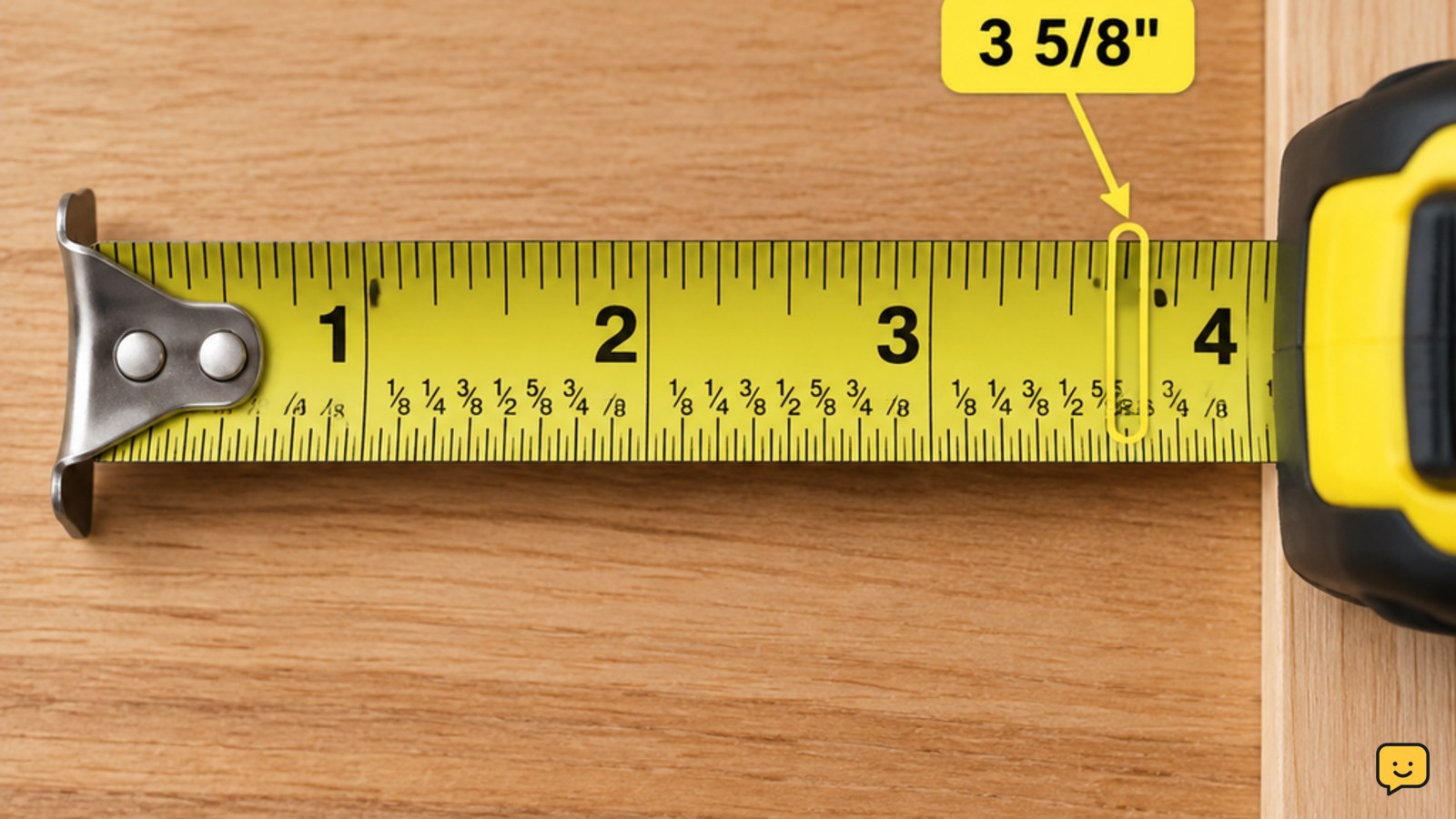
To read a tape measure, find the last whole-inch number before the edge, then count the fractional marks beyond it. On a standard imperial tape, the longest mark is 1 inch, followed by 1/2, 1/4, 1/8, and often 1/16-inch marks. Combine the values—for example, 3 inches plus 5/8 inch equals 3 5/8 inches.
For more help with this topic, use the Home Maintenance guides.
Identify the inch and fractional marks
A standard imperial tape measure divides each inch into smaller fractions, so the number and position of marks determine the reading. The numbered lines mark whole inches. The longest unnumbered line halfway between two numbers is 1/2 inch. Shorter lines commonly represent 1/4, 1/8, and 1/16 inch.
Mark lengths can vary by tape design, so do not identify a fraction by line length alone. Count the equal spaces between two whole-inch numbers. If there are 16 spaces, each smallest division is 1/16 inch. Johnson Level describes the same method as adding the whole-inch length to the fractional distance beyond it.
For example, the first mark after 4 inches is 4 1/16 inches on a tape divided into sixteenths. The middle mark is 4 1/2 inches, and the mark one quarter of the way from 4 to 5 is 4 1/4 inches.
Read a measurement from the nearest whole inch
To read a measurement, place the tape’s hook at one end, keep the blade straight, and find the last whole-inch number before the other edge. Then count the fractional marks from that number to the edge.
- Start at the zero end. The metal hook is designed to move slightly so it can compensate for its thickness when hooked over an outside edge or pushed against an inside edge.
- Locate the last complete inch number before the endpoint. Do not use the next number unless the endpoint reaches it.
- Count the smaller divisions between that number and the endpoint.
- Combine the two values. A point at the fifth sixteenth mark after 3 inches reads 3 5/16 inches.
Common examples include 2 1/2 inches, 6 3/4 inches, and 9 7/8 inches. If the endpoint falls between marks, record the nearest marked value only when that level of rounding is acceptable for the job.
Verify inside, outside, and depth measurements
Inside and outside measurements require different contact checks because the hook and case affect how the tape sits. For an outside measurement, hook the metal tab over one edge and extend the blade to the opposite edge. For an inside measurement, push the hook against one wall and read the opposite wall while keeping the case square.
Many tape cases print an inside-measurement value on the case. Add that value to the blade reading only when the case label clearly identifies it. Otherwise, measure the opening with the blade and case together, then confirm the result another way.
For a depth measurement, keep the blade perpendicular to the surface. A diagonal blade gives a longer, incorrect result. Measure twice without moving the object or endpoint; matching readings are a useful verification.
For furniture fit, measure the room, doorway, windows, and delivery route rather than relying on one wall measurement. The room measurement fit check explains those clearance points.
For furniture planning, use this room measurement fit check to check walls, openings, and delivery clearances.
Convert the reading into a useful dimension
Use the fraction exactly as shown when a project needs a precise cut or fit. A reading of 7 3/8 inches means seven whole inches plus three-eighths of an inch; it is not 7.3 inches.
To compare two readings, use a common fraction denominator. For example, 1/2 inch equals 4/8 inch, so 5 1/2 inches is the same length as 5 4/8 inches. For decimal work, divide the numerator by the denominator: 3/8 inch equals 0.375 inch.
Write the unit with every measurement. “24 1/2 in” is less likely to be confused with 24 1/2 centimeters or a decimal value. If a manufacturer gives a dimension in millimeters or centimeters, use the metric scale on the tape or convert the measurement with a calculator rather than guessing.
When measuring for curtains, record both the window width and the desired finished length, because mounting position and fullness affect the final material size. See this curtain measuring guide for those separate fit decisions.
For window coverings, use this curtain measuring guide to separate width, length, and fullness measurements.
Fix common tape-measure reading errors
The most common reading error is counting from the wrong whole-inch number. If the endpoint is just beyond 8 inches, begin counting fractions after 8, not after 7 or 9. Another frequent error is treating the 1/2-inch line as the 1/4-inch line; compare the distance between the line and the surrounding inch numbers.
If your result changes between attempts, check three things: the hook is contacting the same edge, the blade is straight, and you are viewing the mark directly above the endpoint. Parallax can make a mark appear misaligned when you look from an angle.
If the blade has metric and imperial scales, confirm which side you are reading before recording the number. If the tape’s smallest marks are too close to distinguish, use a ruler, digital caliper, or a clearer tape for the final measurement. Do not force a damaged hook or blade into a precision measurement.
Confirm the final measurement before cutting
A final measurement is ready to use when the tape is straight, the endpoint is clearly aligned, the unit is written down, and a second reading matches. For a cut, mark the material with the measurement and check the mark against the tape before using a saw, knife, or other tool.
For a tight opening, measure the opening at more than one point. Walls, floors, and frames may not be perfectly parallel. Use the smallest relevant clearance when an item must pass through, and follow the product instructions if they specify a required gap.
Stop instead of guessing when the measurement falls between unclear marks, the tape hook shifts, or the required tolerance is smaller than the tape’s smallest division. Choose a more precise measuring tool or ask for the product’s dimensional requirements.
Frequently asked questions
What are the small lines on a tape measure?
The small lines divide each inch into fractions. Depending on the tape, they may show 1/2, 1/4, 1/8, or 1/16 inch. Count the equal spaces between two numbered inches to identify the smallest division instead of relying only on the line length.
How do you read a tape measure in sixteenths?
Find the last whole-inch number, then count each small division toward the endpoint. On a tape divided into sixteenths, the first mark is 1/16, the second is 1/8, the fourth is 1/4, and the eighth is 1/2. A point four marks after 6 inches reads 6 1/4 inches.
What does the movable metal hook do?
The movable hook helps compensate for its own thickness. It shifts slightly when hooked over an outside edge and when pressed against an inside edge, allowing the blade’s zero point to remain consistent. Keep the hook free of dirt and do not use it as a substitute for a damaged blade.
Why does my tape measure have two scales?
Many tapes show imperial inches on one side and metric millimeters or centimeters on the other. Confirm the scale before recording a result. Imperial readings use fractions such as 3 5/8 inches, while metric readings use units such as 92 millimeters.