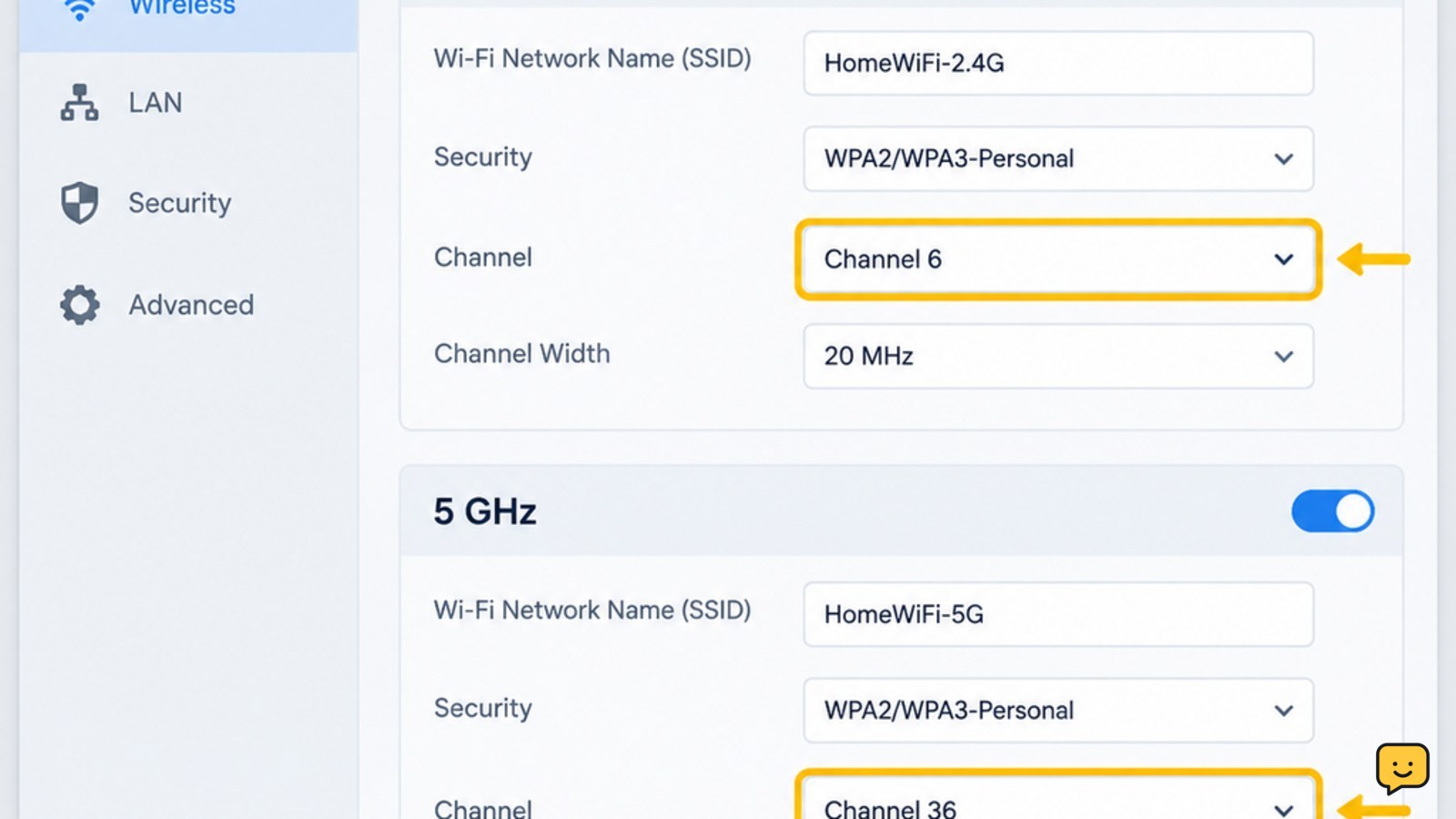
To change your Wi-Fi channel, sign in to your router’s app or web control panel, open Wireless, Wi-Fi, or Advanced Wi-Fi settings, select the 2.4 GHz or 5 GHz band, choose a less congested channel, and save. Reconnect your devices, then check whether the affected room or device has a steadier connection. Router menus vary by model.
For more help with this topic, use the Computers Internet guides.
Check the affected Wi-Fi band before changing a channel
The router band causing the problem determines which channel setting you should change. Connect the affected phone, computer, TV, or smart-home device and note whether it uses a 2.4 GHz or 5 GHz network name. If the router combines both bands under one name, use its device list or Wi-Fi details to identify the connection when possible.
Run a simple comparison first: load the same website or stream in the problem area, note dropouts or slow loading, and repeat near the router. If the connection is poor everywhere, a channel change may not be the cause or cure. Check for an outage, router overheating, or weak broadband service instead.
Open the router’s wireless channel settings
The router’s app or browser control panel is where Wi-Fi channels are changed. In a manufacturer app, look for Wi-Fi, Wireless, or Network, then open advanced wireless settings. TP-Link’s current Deco instructions use More > Wi-Fi Settings > 2.4G & 5G Wireless Network > Advanced; other models use different labels.
For a browser-based panel, connect to the router’s Wi-Fi, open the router address shown in its manual or app, and sign in with the administrator credentials. Open the wireless settings for the specific band. If you see only an automatic channel option, the firmware or managed service may not permit manual selection.
Use the manufacturer’s current instructions when the menu is missing. Do not download an unknown router app or enter administrator credentials into a third-party page.
Choose a less congested channel for the selected band
A less crowded channel can reduce interference when nearby networks are competing on the same radio band. Use the router’s channel scan, if available, or a trusted Wi-Fi analyzer that clearly identifies nearby network activity. Choose the clearest available option for the band you are editing rather than changing several settings at once.
On 2.4 GHz, neighboring networks overlap heavily, so a channel-selection guide may recommend a small set of non-overlapping choices, commonly 1, 6, or 11. Treat that as a starting point, not a universal rule: the least busy option in your location is more useful than a fixed choice. On 5 GHz, available channels and automatic selection depend on the router and local regulatory rules.
Leave channel width on its existing or automatic setting unless you have a specific compatibility reason to change it. A wider channel can increase overlap, and changing width at the same time makes the result harder to identify.
Save the channel and verify the connection
Saving the selected channel applies the change to the router’s wireless radio. Select Save, Apply, or the equivalent control, then wait for the Wi-Fi network to restart. Your devices may briefly disconnect; this is expected during the radio restart.
- Reconnect the test device if it does not rejoin automatically.
- Confirm that the device shows the correct Wi-Fi network and has internet access.
- Repeat the same test in the original problem location.
- Compare stability, loading, and dropouts with your before-change notes rather than relying on a single speed test.
Success means the affected device remains connected and the original interference symptom is reduced. A higher speed-test number is not required if the real problem was recurring disconnection or buffering.
What to do if changing the channel does not help
If the connection is unchanged, restore the original channel and test a different band or location before making another setting change. A channel adjustment cannot improve a signal that is blocked by distance or walls, and it will not repair a failing router, Wi-Fi adapter, or broadband connection.
If only one Windows computer still disconnects, continue with device, driver, power, and router-band checks in this guide to fix recurring Windows 11 Wi-Fi disconnections. If every device loses access after the change, revert to the previous channel and restart the router once. If the setting repeatedly disappears, the router is managed by your provider, or essential devices cannot reconnect, stop and contact the manufacturer or internet-service provider.
For a Windows-only problem, use this guide to fix recurring Windows 11 Wi-Fi disconnections after reverting router changes.
Frequently asked questions
Should I change my Wi-Fi channel from Auto?
You can try a manual channel when Auto leaves you with repeated interference, but Auto is often a reasonable default. Record the current setting first, choose one less-congested channel for the affected band, and compare the same device and location afterward. If performance does not improve, restore Auto or the previous channel.
Which Wi-Fi channel is best for 2.4 GHz?
The best 2.4 GHz channel is the least congested option available in your location. Channels 1, 6, and 11 are commonly used as a starting point because they avoid overlapping with one another, but nearby networks and local interference determine which performs best. Use the router’s scan when available.
Can changing the Wi-Fi channel make my internet faster?
It can improve wireless stability or usable speed when interference is limiting the connection between your device and router. It will not increase the broadband speed supplied by your internet provider, fix weak coverage, or repair faulty equipment. Compare loading and dropouts in the same location before deciding whether the change worked.
Why can’t I find a Wi-Fi channel setting?
The router may manage channels automatically, hide advanced controls in its app, or be controlled by an internet provider. Check the model’s current support instructions and look under Wi-Fi, Wireless, or Advanced settings. Do not alter unrelated network settings or reset the router just to expose a channel control.