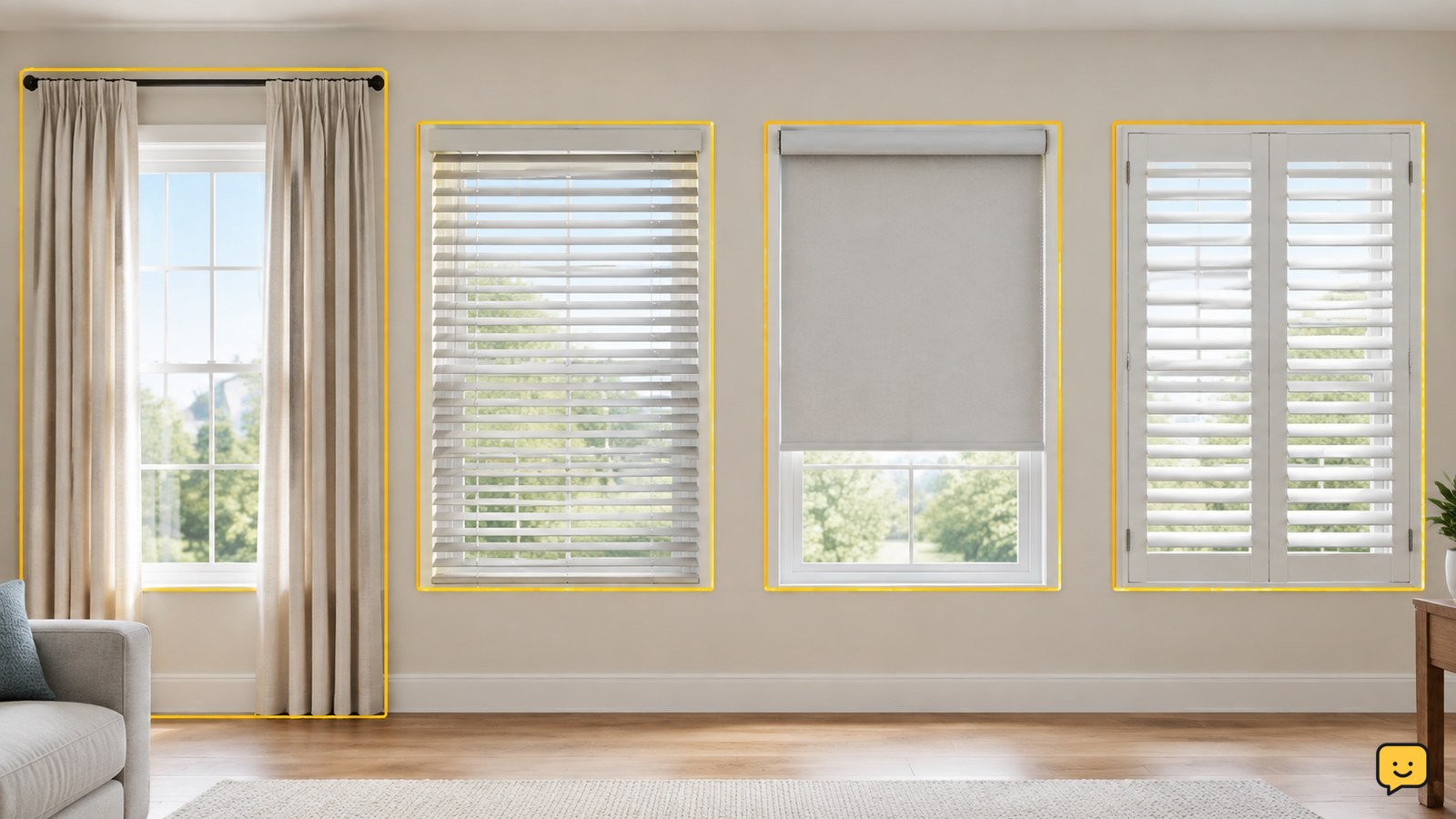
A window treatment is a covering or fitted feature used around a window to control light, privacy, glare, insulation, or appearance. Common examples include curtains, drapes, blinds, shades, shutters, and window film. The right choice depends on the room, window shape, cleaning needs, desired light control, and whether the window must remain easy to open.
For more help with this topic, use the Home Maintenance guides.
Choose the result you need from the window
A window treatment is useful when the bare window does not provide the light, privacy, glare, or appearance you want. Start with the result rather than the product name.
- Privacy: Choose a covering that limits views from outside at the times you need it. A translucent option may admit daylight while reducing clear views; it may not provide full privacy after dark if the room is brighter than outside.
- Light control: Blinds, shades, curtains, and shutters can reduce brightness or redirect light. Check the product’s actual coverage and edge gaps instead of assuming any covering will make a room dark.
- Appearance: Curtains and drapes add visible fabric and softness, while blinds, shades, and shutters generally create a more fitted look.
- Comfort and glare: A treatment can reduce direct sun and screen glare, but its performance depends on coverage, material, orientation, and how tightly it fits the window.
One treatment may serve several purposes, but no single style is automatically best for every room or window.
Compare curtains, blinds, shades, shutters, and film
Window treatment types differ mainly in how they cover the glass, adjust light, and fit the window.
Curtains and drapes are fabric panels hung from a rod or track. They are flexible, removable, and available in many lengths and fullness levels. Drapes often use heavier or lined fabric, but the names can overlap by retailer.
Blinds use slats or vanes that tilt, raise, lower, or sometimes rotate. Their adjustable slats can help direct daylight and limit views, although the mechanism and control style vary.
Shades are usually a continuous fabric or woven panel that rolls, folds, or lifts. They can provide a cleaner visual surface and may be available in light-filtering or room-darkening materials.
Shutters are fitted panels with louvers or solid sections. They can offer a permanent, structured appearance, but they require enough clearance for the panels and hardware.
Window film adheres to the glass rather than hanging over it. It can change privacy or glare without adding a moving covering, but it does not provide the same blackout, insulation, or decorative effect as a full treatment.
A homeowner’s guide from LoConSolo groups blinds, shades, shutters, and drapery as distinct window treatment choices, which is a useful starting point when comparing styles.
Match the treatment to the window and room
The best window treatment matches the window’s movement, surrounding hazards, moisture level, and cleaning demands.
For a frequently opened window, choose a design that does not obstruct the handle or require the treatment to stay fully raised. For a narrow recess or unusual shape, a fitted blind, shade, shutter, or made-to-measure covering may work better than standard curtain panels. For a bathroom or kitchen, confirm that the material is suitable for moisture and can be cleaned without damage.
Bedrooms may benefit from a treatment that limits early light, while living rooms often need adjustable glare control without making the room permanently dark. Near a radiator or baseboard heater, keep fabric and other materials clear of the heat source and follow the heater manufacturer’s clearance guidance.
For curtain width, fullness, panel count, and length, use this curtain measuring guide. It helps prevent a treatment that looks sparse, drags on the floor, or fails to cover the glass.
For curtain width, fullness, panel count, and length, use this curtain measuring guide.
Measure the opening before buying or fitting
Accurate measurements determine whether a window treatment covers the glass and operates without rubbing the frame.
- Decide whether the treatment will mount inside the recess or outside it. Inside mounting usually follows the opening; outside mounting covers part of the wall around it.
- Measure width in more than one place and record the smallest inside dimension if the product will sit inside the recess.
- Measure height at more than one point and record the relevant shortest dimension for an inside fit. For an outside fit, include the extra coverage needed beyond the glass and frame.
- Check handles, locks, vents, trim, curtain rods, and nearby furniture before choosing the final depth and drop.
- Confirm the manufacturer’s measurement and deduction rules. Do not trim or order a made-to-measure product until those rules are clear.
Measurements alone do not confirm that a mounting surface is safe. Inspect the frame or wall, select fixings for the surface, and stop if drilling could contact wiring or plumbing.
Verify coverage, operation, and safety after installation
A correctly chosen window treatment should cover the intended area, move as designed, and leave the window and surrounding room safe to use.
- Close or lower the treatment and check for visible gaps that defeat the intended privacy or light-control goal.
- Open, tilt, raise, lower, slide, or draw it through its full normal range. It should not catch on the frame, handle, sill, furniture, or another treatment.
- Open the window if ventilation is needed and confirm the treatment does not prevent that movement.
- Check that brackets, rods, tracks, cords, and chains are secure. Keep hanging cords and looped controls out of reach of children and pets.
- Look for contact with heaters, flames, hot cooking equipment, damp surfaces, or sharp edges. Relocate or replace the treatment if contact is possible.
If coverage is poor, first check whether the measurement, mounting position, or product type is wrong. If operation is stiff, do not force the mechanism; inspect for an obstruction and follow the product’s care instructions. A damaged cord, loose bracket, cracked shutter, or distorted blind is a replacement or qualified-repair issue, not a reason to keep operating it.
Window treatments also have limits: they do not repair a leaking frame, replace failed glazing, or eliminate every draft. If the window itself is cracked, loose, or visibly letting in water, address the window problem separately. For deteriorated exterior sealant, see this guide to resealing windows safely.
For deteriorated exterior sealant, see this guide to resealing windows safely.
Frequently asked questions
Are curtains and window treatments the same thing?
Curtains are one type of window treatment, not the whole category. The broader term includes curtains, drapes, blinds, shades, shutters, and window film. The right term depends on whether the product hangs as fabric, uses adjustable slats, rolls or folds, mounts as a fitted panel, or adheres directly to the glass.
What is the easiest window treatment to maintain?
The easiest option depends on the room and material, but a simple wipe-clean blind or shade is often less demanding than fabric that must be washed or dry-cleaned. Check the product care label before buying. Dust, moisture, grease, and direct sunlight can affect materials differently.
Can a window treatment improve insulation?
Some window treatments can reduce drafts or heat gain by adding a barrier between the room and glass, but performance varies with the material, fit, coverage, and installation. A treatment cannot fix a failed seal, cracked pane, or leaking frame. Inspect the window separately when comfort or water problems continue.
Should a window treatment go inside or outside the recess?
Inside mounting places the treatment within the window recess and gives a fitted appearance, but it may leave small edge gaps. Outside mounting extends beyond the recess and can provide more coverage, but it needs enough clear wall space. Check handles, trim, vents, and the manufacturer’s mounting requirements before choosing.