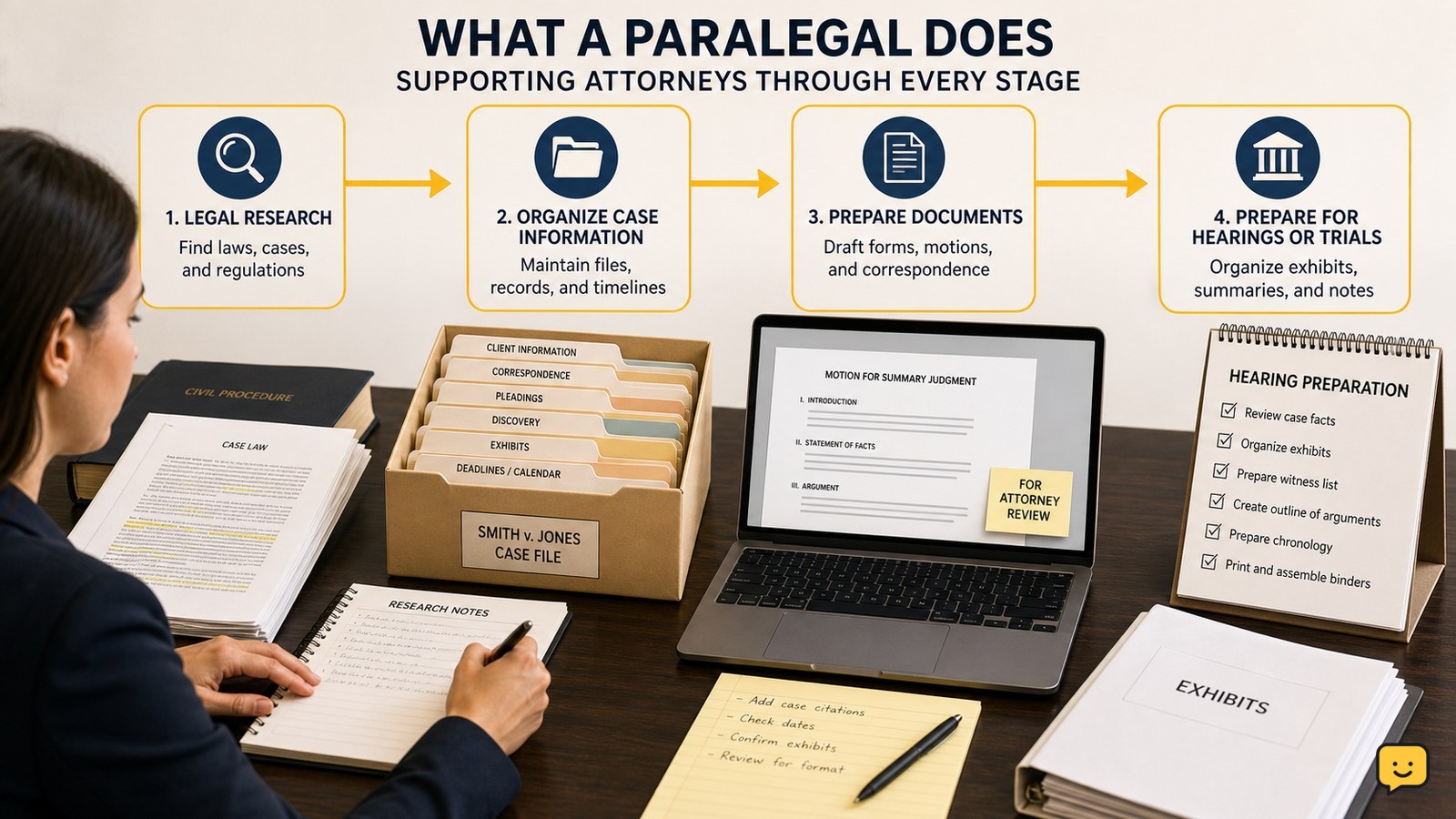
A paralegal supports lawyers with legal research, case-file organization, document preparation, filing coordination, and communication with clients, courts, witnesses, and other parties. Paralegals may help prepare for hearings and trials, but they generally do not act as the lawyer, give independent legal advice, or represent clients in court. Duties vary by employer and jurisdiction.
Identify the main work a paralegal performs
A paralegal performs supervised legal-support work that helps a lawyer prepare a matter and manage its records. The U.S. Bureau of Labor Statistics says paralegals and legal assistants may conduct legal research, write reports, and help lawyers prepare for hearings, trials, and other proceedings.
Common duties include:
- Researching statutes, regulations, court rules, and prior decisions.
- Summarizing research and facts for the supervising attorney.
- Organizing case files, evidence, correspondence, and deadlines.
- Preparing drafts of routine legal documents, forms, letters, and discovery materials for attorney review.
- Coordinating filings, service, records requests, meetings, and hearing preparation.
- Communicating with clients, courts, witnesses, opposing offices, and service providers within the scope set by the lawyer.
The exact mix depends on the practice area, firm size, employer, and local rules. A litigation paralegal may prepare exhibit lists and hearing materials, while a real-estate paralegal may organize transaction documents and closing requirements.
Follow the typical paralegal workflow from intake to filing
A paralegal workflow usually turns scattered facts and deadlines into an organized file that the lawyer can review and act on.
- Receive the assignment. Record the matter name, requested task, deadline, responsible attorney, and source documents.
- Check the file. Look for missing facts, duplicate documents, conflicting dates, unanswered requests, or an unclear version of a form.
- Research or prepare. Locate the requested authority, build a chronology, draft a document, assemble exhibits, or complete a filing package according to the attorney’s instructions.
- Verify details. Compare names, case numbers, dates, citations, signatures, attachments, formatting, and filing requirements against the applicable instructions.
- Route for review. Send the work to the supervising lawyer before it is used as legal advice, filed, or delivered when attorney approval is required.
- Update the record. Save the approved version, note the action taken, record the next deadline, and preserve proof of filing or delivery.
Success is observable: the file has a clear status, the requested document or research summary is easy to locate, required attachments are present, and the attorney can identify what still needs a decision.
Check what a paralegal cannot do independently
A paralegal cannot generally replace a licensed attorney’s legal judgment. The safe boundary is to prepare and support work under attorney supervision rather than independently advise or represent a client.
That means a paralegal should not independently decide a client’s legal strategy, promise a legal result, interpret a client’s rights as personal legal advice, negotiate as though they are the attorney, or appear in court as the client’s lawyer unless a specific rule permits the activity. A paralegal may collect information, explain an administrative process approved by the attorney, or relay an attorney’s instructions, but the supervising lawyer remains responsible for legal advice and representation.
If a client asks, “What should I do legally?” or asks for a prediction about the case, record the question and refer it to the attorney. If a task appears to cross a professional boundary, pause before sending, signing, filing, or advising.
Choose a practice area that matches the daily tasks
A paralegal’s daily work changes substantially by practice area, so compare the recurring tasks rather than relying only on the job title.
| Practice area | Work you may encounter |
|---|---|
| Litigation | Chronologies, discovery organization, exhibits, deposition materials, and hearing preparation. |
| Family law | Client intake, financial records, court forms, calendars, and document coordination. |
| Real estate | Transaction files, title or property documents, closing checklists, and signature coordination. |
| Corporate or business law | Entity records, contracts, compliance calendars, meeting materials, and due-diligence files. |
| Immigration | Application packets, supporting evidence, deadlines, correspondence, and filing logistics under attorney direction. |
Use the employer’s posting and interview questions to verify the actual role. Ask which documents you prepare, who reviews them, how deadlines are tracked, what client contact is expected, and which tasks are outside the position’s scope.
Check the skills and preparation employers expect
Paralegal work depends on accurate writing, organized records, careful reading, deadline control, and professional communication. The Bureau of Labor Statistics describes the occupation as supporting lawyers across varied tasks, so employers may value reliability and attention to detail as much as subject-matter knowledge.
Before applying, compare your preparation with the posting:
- Research: Can you find a controlling source and summarize it without changing its meaning?
- Writing: Can you produce a clear, properly formatted draft for review?
- Organization: Can you maintain consistent file names, versions, calendars, and checklists?
- Confidentiality: Can you handle sensitive client information in approved systems and communications?
- Tools: Can you learn document-management, calendaring, filing, billing, and word-processing systems?
- Verification: Do you check every name, date, case number, citation, signature, and attachment before delivery?
Education and certification expectations are not identical everywhere. Confirm the employer’s requirements and any local rules instead of assuming that one degree or credential applies to every paralegal position.
Verify whether a paralegal role fits your goals
A paralegal role may fit if you want structured legal work that combines research, writing, document control, deadlines, and team communication without practicing law as an attorney.
Review a position by checking four points: the practice area, the proportion of research versus administrative work, the level of attorney supervision, and the training or credential requirements. A strong match has duties you can perform accurately, clear review procedures, realistic deadlines, and a defined route for escalating legal questions.
If the posting is vague, ask for a sample week of tasks and the criteria used to evaluate completed work. If the role expects unsupervised legal advice or hides who is responsible for final decisions, do not accept the description at face value; request clarification before proceeding.
Frequently asked questions
Is a paralegal the same as a lawyer?
No. A paralegal supports a lawyer with research, documents, case organization, and procedural tasks, while a lawyer is licensed to give legal advice and represent clients. A paralegal may communicate information or prepare drafts under supervision, but should refer legal judgment and strategy questions to the attorney.
What does a paralegal do in a law firm?
In a law firm, a paralegal may organize client files, research legal issues, prepare draft documents, coordinate filings, track deadlines, communicate with approved contacts, and assemble materials for hearings or trials. The specific duties depend on the firm’s practice areas and the supervising attorney’s instructions.
Can paralegals go to court?
Paralegals can often attend court proceedings to support the lawyer, organize exhibits, take notes, or manage documents. Attendance does not usually mean they can represent the client, argue the case, or give legal advice. The permitted role depends on court rules, jurisdiction, and the attorney’s direction.
Do paralegals need a law degree?
No, paralegals do not generally need a law degree, but employers may require or prefer a paralegal certificate, associate or bachelor’s degree, relevant experience, or professional certification. Requirements vary by employer and jurisdiction, so check the specific posting and local rules.
For more help with this topic, use the Career Workplace guides.