Answer with a brief, job-focused summary: start with what you do now, mention two or three relevant achievements or strengths from your background, then explain why this role interests you. Keep the response conversational and concise, usually about one to two minutes. End with a detail that gives the interviewer a natural follow-up question.
For more help with this topic, use the Career Workplace guides.
Build the answer around present, past, and future
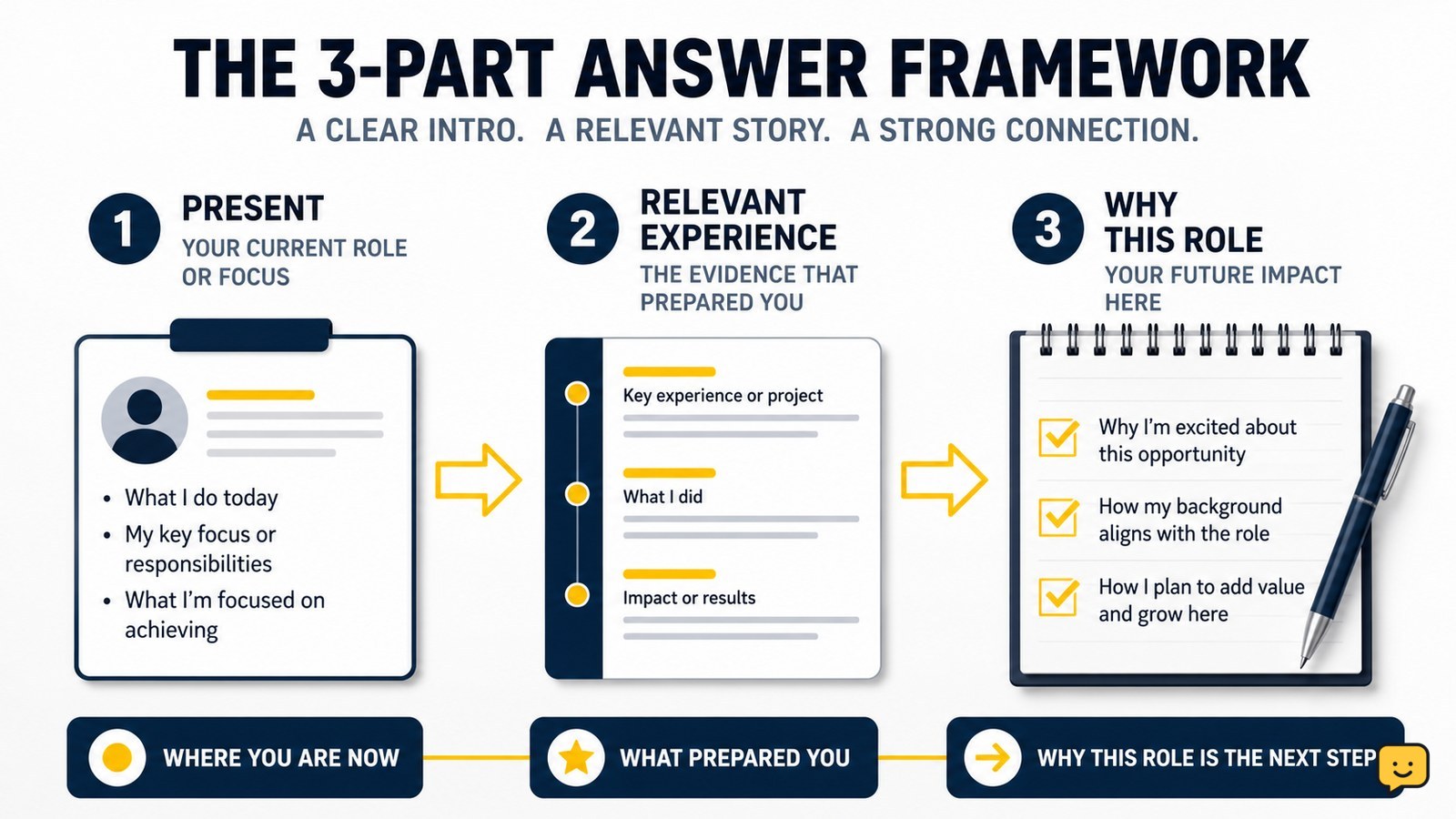
A strong interview introduction connects your current direction, relevant background, and reason for pursuing this role. Use this three-part structure:
- Present: State your current role, course of study, area of expertise, or professional focus.
- Past: Select two or three relevant skills, projects, or achievements that show how you developed.
- Future: Explain what attracts you to this position and how it fits your next step.
This keeps the answer role-related instead of turning it into a complete life story. Harvard’s Office of Career Services recommends treating the question as an opportunity to present relevant qualifications, while San José State University’s iSchool advises emphasizing a concise group of key points and ending with why you are there.
Choose evidence that matches the job description
Choose examples that prove the abilities the employer is asking for. If the position emphasizes customer communication, mention a situation where you clarified a problem, supported a customer, or improved service. If it emphasizes organization, describe how you managed competing deadlines or created a reliable workflow.
Use a simple evidence pattern: responsibility, action, result. For example: “In my current role, I organize weekly client updates, created a shared tracking process, and reduced missed follow-ups.” Replace the result with a verified outcome when you have one. If you do not have a measurable result, explain the observable improvement, such as clearer ownership or faster handoffs.
Use this answer template without memorizing it
Adapt this framework to your own experience:
“I’m currently [role or focus], where I [relevant responsibility]. Before that, I developed experience in [skill or area] through [project, job, course, or achievement]. One result I’m especially proud of is [verified example]. I’m interested in this position because [specific connection to the role], and I’d like to bring my experience with [relevant strength] to your team.”
Write keywords rather than a full script. Memorizing every sentence can make your delivery sound rehearsed and makes recovery harder if the interviewer interrupts. Your notes should remind you of the order, evidence, and role connection.
Adjust the introduction for your career stage
Your structure can stay the same even when your background changes.
- Entry-level candidate: Lead with your field of study, internship, volunteer work, class project, or transferable skill. Connect the example to the duties of the role.
- Career changer: Name the direction you are moving toward, then show which existing skills transfer and what you have done to prepare.
- Experienced professional: Focus on the pattern of work you have done, the outcomes you have delivered, and why this role is the logical next step.
- Returning to work: Briefly acknowledge the transition if useful, then emphasize current skills, recent preparation, and the value you can contribute now.
Do not apologize for being early in your career, changing fields, or returning after a gap. State the situation plainly and move quickly to relevant evidence.
Practice for a clear and conversational delivery
Practice aloud until you can answer without reading. Record one attempt or rehearse with another person, then check four observable points: you answer the question within the first sentence, your examples relate to the job, your delivery does not sound memorized, and you finish with a clear reason for applying.
Pause briefly between the present, past, and future parts. Avoid reciting every position on your résumé, listing unrelated hobbies, or using unexplained jargon. A useful answer gives the interviewer enough context to ask a focused follow-up question.
If your response runs long, remove background details before removing the role connection. If it sounds generic, replace broad claims such as “I’m a hard worker” with one specific responsibility and its result.
Recover when the question catches you off guard
If you need a moment, say, “Certainly. I’ll focus on the experience most relevant to this position,” then begin with your current role or professional focus. This signals that you understand the question and gives you a clear starting point.
If you realize you are rambling, stop at a natural pause and say, “The short version is…” Follow with your strongest skill, one supporting example, and your reason for applying. If you give an example that is not relevant, acknowledge the pivot: “A more relevant example is…”
When the interviewer asks for more detail, expand the example rather than restarting your entire introduction. Stop once you have answered the follow-up and the result is clear.
Verify the answer before the interview
Your introduction is ready when it passes this final check:
- It opens with your current professional direction.
- It includes no more than two or three role-relevant points.
- At least one point includes a concrete responsibility, action, or verified result.
- It explains why this position or organization interests you.
- It ends naturally rather than with “That’s everything about me.”
Ask a trusted person to name the three things they remember after hearing it once. If they cannot identify your role, strongest relevant skill, and reason for applying, revise the opening and closing before adding more detail.
Frequently asked questions
How long should a “Tell me about yourself” answer be?
Aim for about one to two minutes, depending on the interview format and the interviewer’s response. The answer should be long enough to show your professional direction, relevant evidence, and interest in the role, but short enough to leave room for follow-up questions. Practice a concise version so you can finish comfortably if the interviewer signals that they want to move on.
Should I talk about my personal life in this answer?
Usually, keep the answer focused on your professional background, education, relevant projects, and career direction. A brief personal detail is appropriate only when it naturally supports your interest in the field or organization. Avoid sharing sensitive information, unrelated hobbies, family details, or anything that does not help the interviewer assess your fit for the position.
What should a student say when they have little work experience?
A student can lead with their course of study, relevant classwork, internship, volunteer experience, campus responsibility, or project. Explain what you did, which skill you developed, and how it connects to the position. Employers can learn from evidence of teamwork, communication, organization, problem-solving, or willingness to learn even when a candidate has not held a full-time role.
How should I answer if I am changing careers?
State the career direction clearly, identify transferable strengths, and show how you have prepared for the new field. For example, connect project coordination, customer communication, analysis, or training experience to the responsibilities in the target role. End with a specific reason the position fits your next step rather than focusing mainly on why you are leaving your previous field.