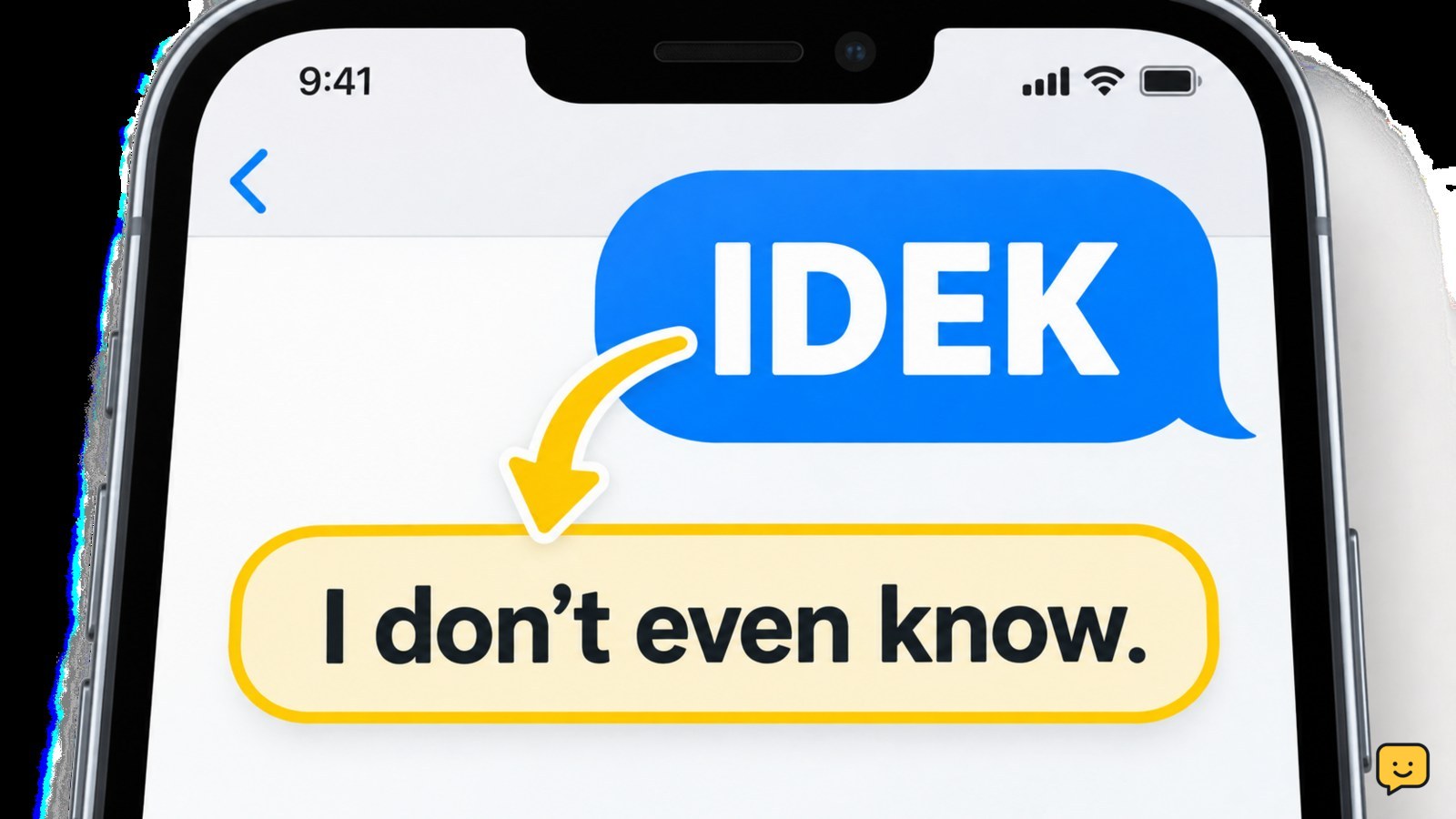
IDEK means “I don’t even know.” People use it in texts, group chats, and social posts to show confusion, disbelief, or mild frustration. Read the message around it to judge the tone. It fits casual conversation, but spell out your meaning in work, school, or other formal communication.
For more help with this topic, use the Writing Communication guides.
Check the plain meaning of IDEK
IDEK means “I don’t even know,” an informal abbreviation used mainly in texting and social media. Dictionary.com describes it as an expression of strong puzzlement, which is why it often carries more emotion than the shorter “IDK” for “I don’t know.”
For example, “IDEK why the meeting was moved” means “I don’t even know why the meeting was moved.” The writer may be genuinely unsure, surprised by the change, or lightly annoyed by it.
Use the surrounding message to identify the tone
IDEK usually signals uncertainty plus a reaction, so the words immediately before and after it reveal the intended tone. Look for the subject being discussed, punctuation, emojis, and whether the sender is joking.
| Message | Likely meaning | Useful response |
|---|---|---|
| “IDEK what that assignment wants.” | Confused and possibly asking for help. | “I read it as asking for two examples. Want to compare notes?” |
| “IDEK 😂” | Amused disbelief or a joking reaction. | “Right? That was unexpected.” |
| “IDek anymore.” | Overwhelmed or frustrated; capitalization is not important. | “What part is unclear? We can sort it out.” |
| “IDEK if I can make it.” | Uncertain about plans or ability to attend. | “No problem—let me know when you decide.” |
You have interpreted it well when your reply addresses the topic the sender is uncertain about rather than treating IDEK as a separate question.
Reply clearly when someone writes IDEK
A good reply to IDEK either offers relevant information, acknowledges the feeling, or asks one focused question. Match the level of informality the other person used.
- Identify what they do not know: the schedule, a task, a decision, or someone’s behavior.
- Share a confirmed detail if you have one. Say “The deadline is Friday” rather than guessing.
- Ask for clarification if the subject is missing: “What part do you mean?”
- Keep the reply brief if IDEK is a casual reaction rather than a request for help.
If you do not know the answer either, say so plainly: “I’m not sure either. I’ll check the course page.” This avoids making an uncertain situation sound settled.
Choose a clearer alternative for work and school
IDEK is best kept to casual chats with people who understand informal English abbreviations. In workplace, academic, client, or administrative messages, write the uncertainty directly so the recipient knows what information is needed.
- Instead of “IDEK when it is due,” write “I cannot find the due date. Could you confirm it?”
- Instead of “IDEK what you mean,” write “Could you clarify which section you mean?”
- Instead of “IDEK if I can attend,” write “I am checking my schedule and will confirm by 3 p.m.”
The clearer version succeeds when it names the missing information and, where appropriate, gives the other person a next action or a time for your reply.
Separate IDEK from similar chat abbreviations
IDEK is not the same as IDK. IDK means “I don’t know,” while IDEK adds emphasis: “I don’t even know.” Use IDK for ordinary uncertainty and IDEK when the situation seems especially confusing, surprising, or hard to explain.
Do not confuse IDEK with an invitation. For example, HMU means “hit me up,” which asks someone to contact the sender; IDEK does not ask for contact or action by itself.
If a message contains several abbreviations and the overall meaning remains uncertain, ask the sender to explain rather than relying on one acronym alone.
Compare it with HMU meaning when a casual message combines uncertainty with an invitation to get in touch.
Frequently asked questions
What does IDEK mean in a text?
IDEK means “I don’t even know.” In a text, it usually shows that the sender is confused, surprised, or frustrated about the topic being discussed.
Is IDEK rude?
IDEK is not automatically rude, but it can sound dismissive if used alone in response to a serious question. A supportive reply or a brief explanation makes the tone clearer.
What is the difference between IDK and IDEK?
IDK means “I don’t know.” IDEK means “I don’t even know,” adding emphasis and often suggesting greater confusion or disbelief.
Can I use IDEK in an email?
Usually no for professional or academic email. Write a complete sentence such as “I am not sure which document you mean; could you clarify?” Casual email to a close friend is the main exception.
How do you respond to IDEK?
Respond to the topic behind the abbreviation. Offer a confirmed answer, acknowledge the confusion, or ask a specific follow-up question if you cannot tell what the sender means.