To write a recommendation letter, confirm what the recipient needs, collect two or three specific examples of the person’s work, and organize the letter around a clear endorsement. Introduce your relationship, explain the person’s relevant strengths, prove them with brief examples, and close with a confident recommendation and your contact information. Check the required format before sending.
For more help with this topic, use the Writing Communication guides.
Confirm the audience, purpose and submission rules
A recommendation letter should be written for a specific reader and opportunity, not reused as a generic character reference. Start by identifying the role, program or award and the qualities it is likely to assess.
Ask the applicant for the official instructions and use them as your checklist. Confirm whether the letter must be uploaded, emailed, placed on letterhead or submitted through a portal. Requirements vary, so do not assume that a format used for a job application will also fit an academic or scholarship application.
Verification: You should be able to answer three questions before drafting: Who is reading this? What decision are they making? How must the letter be delivered?
Choose evidence that proves the person’s strengths
The strongest recommendation letters connect each positive claim to a concrete example. ACT’s guidance on recommendation letters likewise emphasizes choosing the right recommender and using specific examples rather than general praise.
- List two or three qualities that matter for the opportunity, such as analytical thinking, reliability, leadership, communication or persistence.
- Under each quality, write one situation in which you directly observed the person demonstrate it.
- Record the action the person took and the result, using accurate details rather than inflated numbers or unsupported superlatives.
For example, replace “Jordan is an excellent communicator” with “During the client handoff, Jordan turned a complicated project update into a clear one-page brief and answered follow-up questions without losing the key risks.”
Failure path: If your examples are vague, ask the applicant for a project list or accomplishments document. Do not invent details to make the letter sound stronger.
Build the letter around a clear recommendation
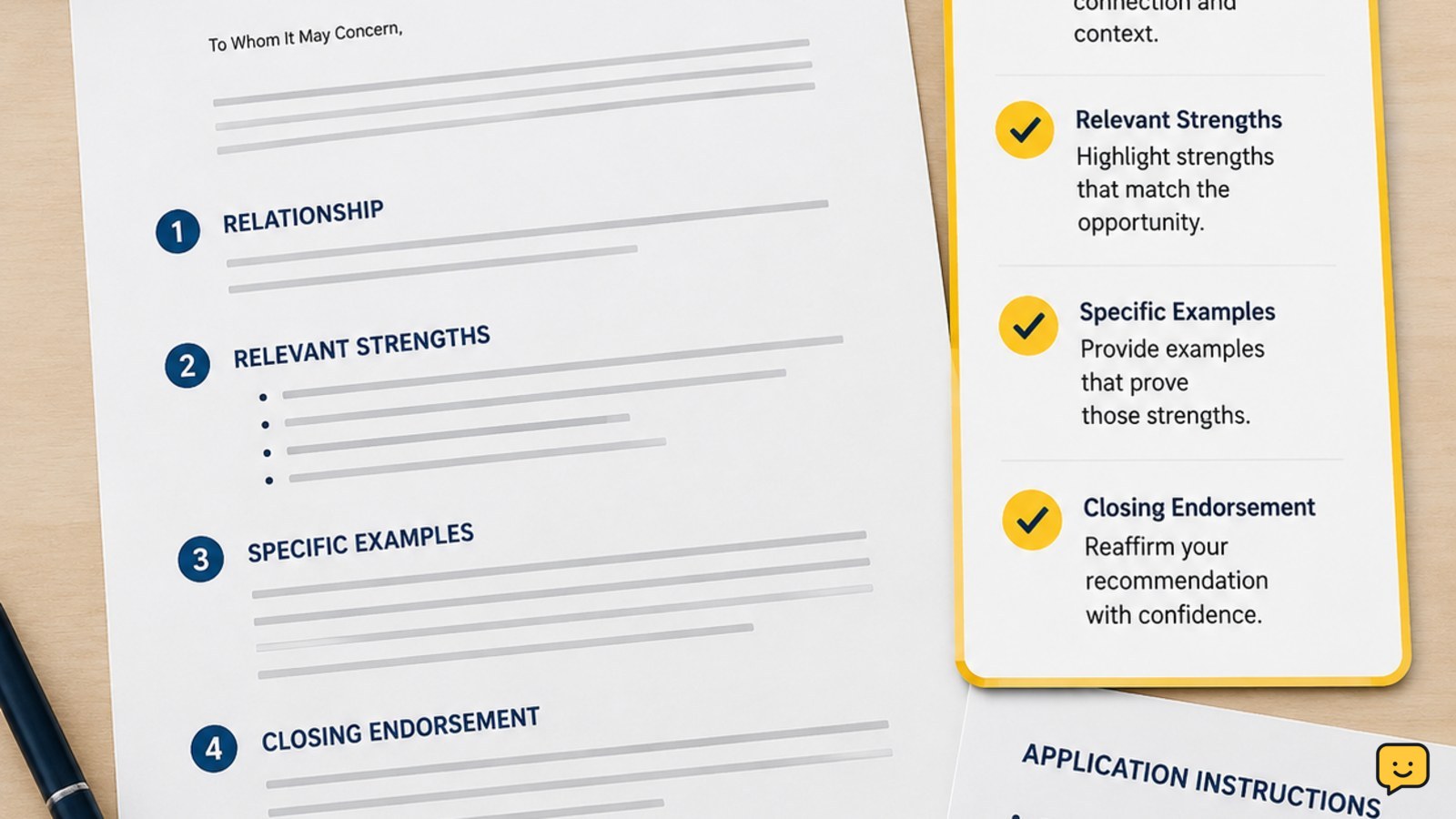
A recommendation letter usually works best when it follows the reader’s decision path: establish your credibility, explain your relationship, present relevant evidence and state your endorsement.
- Opening: State who you are, how you know the person and your overall recommendation.
- Relevant strengths: Name the two or three qualities that connect most directly to the opportunity.
- Evidence paragraphs: Give a short example for each major quality, explaining the person’s action and its significance.
- Fit: Explain why those qualities make the person suitable for this specific role, program or opportunity.
- Closing: Restate your recommendation, offer to provide additional information and sign with your professional contact details.
Indeed’s career guidance describes a similar core structure: an introduction and recommendation, specific reasons, a personal example and a conclusion. Adapt the structure to the recipient’s instructions rather than treating it as a fixed formula.
Turn general praise into credible examples
Each body paragraph should make one main claim and support it with an observable event. A useful pattern is quality, situation, action, result.
Quality: Identify the trait. Situation: Explain when or where you observed it. Action: Show what the person did. Result: State what changed, improved or became possible.
Keep the examples relevant to the application. A story about organizing a team may support a leadership claim, while a story about checking a difficult report may better support accuracy or judgment. Avoid repeating the same example under several labels.
Use measured language when you lack a formal comparison. “In my experience, Priya was among the most dependable project coordinators I supervised” is more credible than an absolute ranking you cannot substantiate.
Draft a professional opening and closing
The opening should establish context quickly. A practical model is: “I am [name and role], and I worked with [applicant] for [context]. I am pleased to recommend [applicant] for [opportunity].” Replace the placeholders with accurate information and avoid claiming a title or relationship you did not hold.
End by making the decision easy for the reader: state your recommendation, identify the qualities you are endorsing and provide a way to contact you. For example: “I recommend Casey for the program because of Casey’s careful research, steady collaboration and ability to explain complex findings. I would be glad to provide further details at [email or phone].”
For academic letters, expectations can differ by department and institution. Specialist guidance from The Professor Is In discusses longer, more detailed academic letters, but its format should not be applied automatically to a short workplace reference.
Verify the letter before submitting it
A finished recommendation letter is ready only when its facts, audience and delivery method have been checked. Use this final review:
- Confirm the applicant’s name, pronouns, role, organization and dates.
- Check that every major compliment has a specific example or a clear basis in your experience.
- Remove private details, speculation, coded language and claims you cannot defend.
- Make sure the letter names the correct opportunity and recipient.
- Follow the requested file type, length, naming convention, signature and submission route.
- Read it once as the recipient: can they see what the person did and why it matters?
Expected result: The reader can identify your relationship to the applicant, the applicant’s relevant strengths, at least two supporting examples and your final recommendation without searching through filler.
If the letter does not meet those checks, return to the evidence list or ask the applicant to clarify the instructions. If the deadline has passed or the submission portal rejects the file, contact the program or employer directly rather than bypassing its process.
Frequently asked questions
How long should a recommendation letter be?
A recommendation letter should be long enough to support its main claims with specific examples, but the recipient’s limit comes first. If no limit is provided, use a focused letter with an introduction, two or three evidence-based points and a concise closing. Academic, job and scholarship applications may expect different levels of detail.
What should I include in a recommendation letter?
Include your role and relationship to the applicant, the opportunity they are pursuing, two or three relevant strengths, specific examples that demonstrate those strengths, an explanation of fit and a clear closing endorsement. Add your professional contact information if the recipient may need to verify the recommendation.
Can I use a template for a recommendation letter?
Yes, a template can help with structure, but the examples and wording must be specific to the person and opportunity. Replace every placeholder, remove irrelevant sections and check the recipient’s instructions. A generic letter with broad praise is less useful than a shorter letter grounded in direct observations.
What should I do if I cannot strongly recommend the person?
Decline honestly instead of writing an inflated endorsement. Explain that you are not the right person to provide a strong recommendation and, when appropriate, suggest someone who has more relevant experience with the applicant’s work. Do not include damaging personal comments or disclose private information.