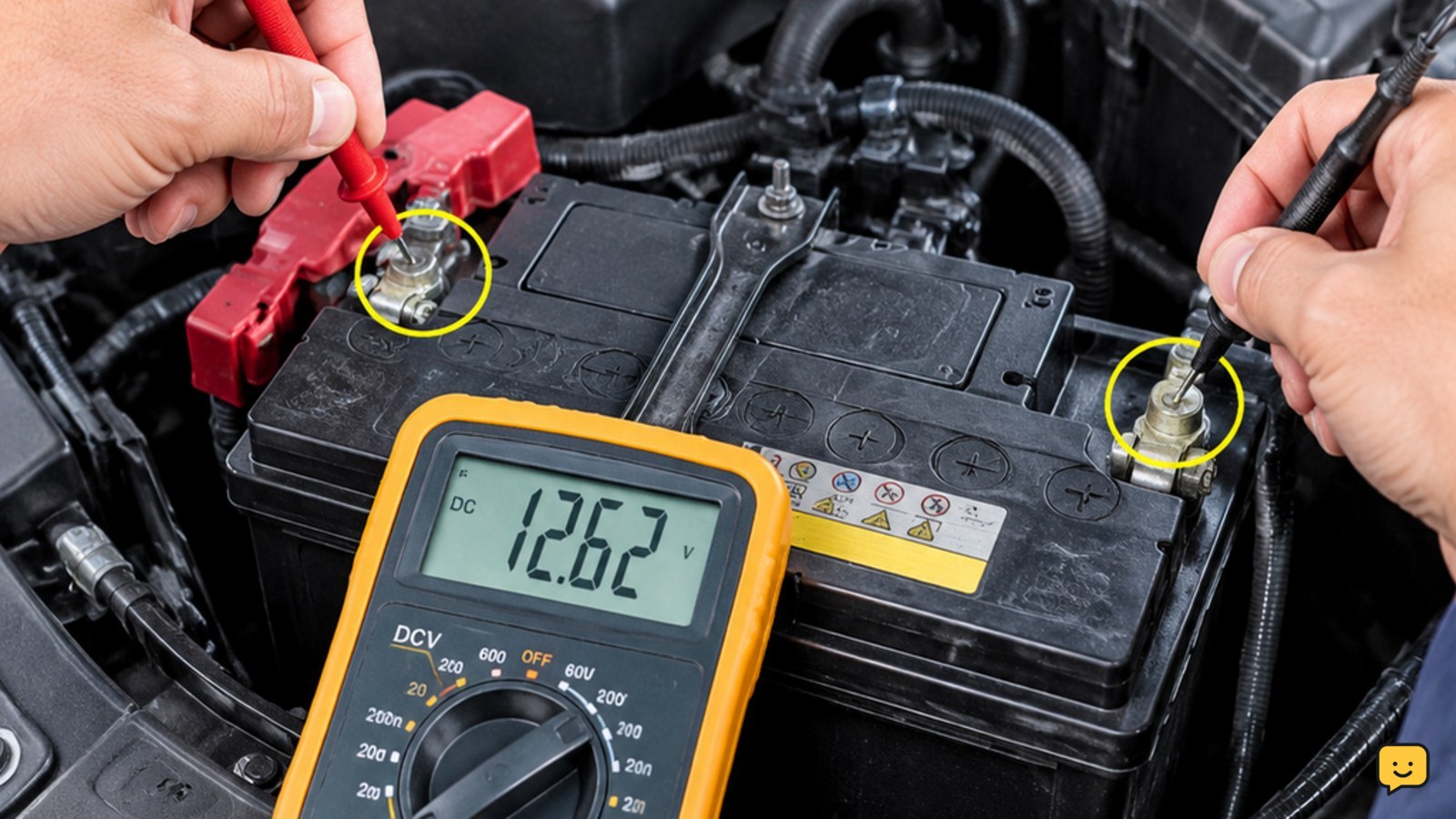
To test an alternator, measure voltage directly at the battery with a digital multimeter. A healthy battery is usually near 12.6 volts with the engine off; with the engine running, charging voltage commonly rises into the mid-13s to mid-14s. Repeat the test with headlights and the blower on. If voltage stays near resting voltage, fluctuates sharply, or exceeds the vehicle’s specified range, stop and inspect the belt, cables, battery, and charging system.
For more help with this topic, use the Maintenance Repair guides.
Prepare the battery and multimeter safely
Before testing an alternator, confirm that the battery and meter can provide a meaningful baseline. Turn the engine off and switch off the headlights, climate fan, radio, and accessories. Let the vehicle sit for several minutes if it was recently driven.
Set the meter to DC volts. Touch the black probe to the battery’s negative terminal and the red probe to the positive terminal. Hold the probe tips on clean metal without bridging the terminals.
A fully charged, rested 12-volt battery is commonly around 12.6 volts. A lower reading may mean the battery is discharged or weak, so it can confuse the alternator test. If the reading is below about 12.2 volts, charge or professionally test the battery before judging alternator performance.
AutoZone’s alternator procedure also begins with the vehicle off and the probes placed across the negative and positive battery terminals. Use the vehicle manual when its specifications differ from general voltage ranges.
Measure charging voltage at idle
With the probes still connected, start the engine and keep your hands clear of moving components. The meter should rise above the battery’s resting voltage if the alternator is charging.
Many conventional charging systems show roughly 13.5 to 14.7 volts at idle, but the correct range depends on the vehicle, temperature, battery type, and charging strategy. The useful result is a clear increase that remains within the manufacturer’s stated range, not one universal number.
Record the reading after the engine settles at idle. Then gently raise engine speed to about 1,500 rpm only if the area is safe and the manufacturer’s instructions do not prohibit it. Moss Motors describes using approximately 1,500 rpm for a voltmeter alternator check. Voltage should remain reasonably steady rather than dropping toward the battery’s resting reading.
If the reading stays around 12 volts, the alternator may not be charging. Check the belt, battery terminals, ground cable, alternator plug, and main output cable before condemning the alternator. A discharged or failed battery can also affect the result.
Apply an electrical load and verify recovery
To test alternator performance under demand, turn on the headlights and set the heater or climate-control blower to high. Holley’s charging-system procedure uses the headlights and blower as a load before measuring with a digital multimeter.
Watch the meter for several seconds. A working charging system may show some voltage change when the load is applied, but it should remain within the vehicle’s specified operating range and should not steadily fall toward battery voltage. Turn the accessories off and confirm that the reading recovers and stabilizes.
Do not use every accessory at once just to force a result, and do not hold the engine at high speed to hide a low-idle problem. If voltage collapses under a normal load, fluctuates sharply, or never recovers, the fault may involve the alternator, voltage regulator, belt drive, wiring, grounds, or battery.
Separate alternator faults from battery and wiring faults
A low charging reading does not prove that the alternator itself has failed. Inspect the serpentine belt for missing ribs, contamination, looseness, or obvious damage. With the engine off, check that the battery terminals are tight and clean and that the negative cable has a secure connection to the body and engine.
Compare the voltage at the battery with the voltage at the alternator’s output terminal only if the terminal is safely accessible and the manual permits that test. A large difference between the alternator terminal and battery terminal suggests cable, fuse, fusible-link, or connection resistance rather than an alternator output problem. Do not probe an exposed terminal near moving parts.
If the battery repeatedly dies overnight, alternator output may be only one part of the problem. A battery drain while parked can discharge a correctly charging battery; the related battery drain guide covers that separate diagnosis.
If the battery dies while parked, use the battery drain guide to check for a separate parasitic drain.
Decide what to do when the reading is abnormal
If voltage is low, first retest with a charged battery and secure connections. If it remains low with the belt turning correctly, arrange a charging-system test or alternator repair. If voltage is too high, stop driving until the regulator and charging system are checked because excessive voltage can damage the battery and electronics.
If the car will not crank, do not assume the alternator caused the problem. A single click can point to the battery, cables, or starter as well as a prior charging failure. Use the guidance for a single-click no-start before repeatedly attempting to start the vehicle.
Stop and arrange professional service if the battery warning light stays on, the belt squeals, lights brighten and dim noticeably, the engine stalls, or electrical odors and smoke appear. A parts-store bench test can help, but it should follow the basic battery, belt, and connection checks rather than replace them.
A no-crank symptom may involve the starter or battery, so check the single-click no-start before blaming the alternator.
Frequently asked questions
What voltage should an alternator produce?
Many conventional systems measure about 13.5 to 14.7 volts at the battery with the engine running, but the correct range varies by vehicle, temperature, battery type, and smart-charging strategy. Use the owner’s manual as the final specification. A reading near 12 volts while running usually indicates that the battery is not receiving normal charging, but wiring, belt, battery, and regulator faults can produce the same symptom.
Can I test an alternator without removing it?
Yes. A digital multimeter can test charging voltage at the battery while the alternator remains installed. Measure with the engine off, then at idle, and again with the headlights and blower operating. Keep the probes and hands away from belts and pulleys. This test checks system voltage; it does not identify every internal alternator fault.
Can a bad battery make an alternator test look bad?
Yes. A deeply discharged, damaged, or internally shorted battery can distort charging results and place unusual demand on the alternator. Charge and test the battery first when its resting voltage is low, then repeat the alternator check. If the battery is swollen, leaking, hot, or strongly sulfur-smelling, stop and arrange professional service instead of charging it.
Should I disconnect the battery to test the alternator?
No. Keep the battery connected while testing. Disconnecting it with the engine running can create voltage spikes that damage electronic modules and does not accurately represent normal charging conditions. Use a digital multimeter across the battery terminals and follow the vehicle manufacturer’s testing procedure.