A single solid click usually means the start signal reaches the starter, but high current is not reaching the motor. The most common causes are a weak battery, loose or corroded battery cables, or a failing starter or solenoid. Check the battery and terminals first, then compare voltage before and during a jump-start attempt. Stop if cables heat up, smoke, spark heavily, or the engine is locked.
What one click tells you
First confirm that the engine is not cranking. A single click followed by silence is different from rapid clicking, a slow crank, or an engine that cranks normally but does not fire.
A solid click commonly comes from the starter solenoid or relay. That tells you the control side may be working, but it does not prove the starter itself is good. The battery, battery cables, engine ground, starter cable, solenoid, and starter motor still need to deliver current under load.
Rapid clicking usually points more strongly toward low battery voltage or a poor connection. If the dashboard goes very dark or resets when you turn the key, suspect insufficient battery power or excessive resistance in a connection.
1. Check the battery before replacing the starter
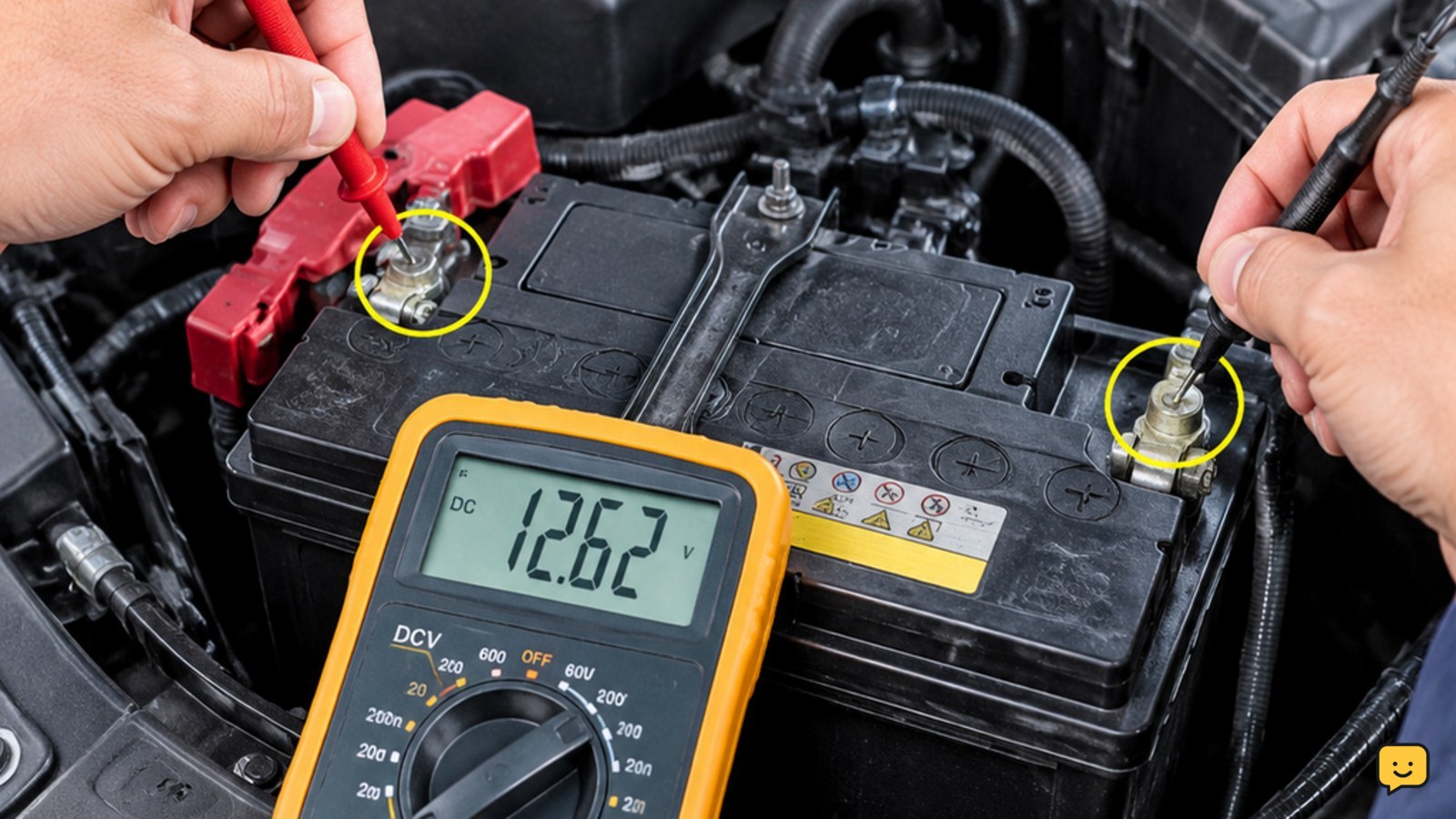
Turn on the headlights for about 30 seconds, switch them off, and wait a few minutes. With the engine off, place the multimeter probes directly on the battery posts, not on the cable clamps.
A healthy, fully charged 12-volt battery often reads about 12.6 volts at rest. Around 12.4 volts suggests partial charge, while a reading near 12.2 volts or lower indicates a low state of charge. These readings are clues rather than a complete battery test; a battery can show acceptable resting voltage and still fail under starter load.
Now watch the meter while a helper turns the key to Start for no more than a few seconds. If voltage drops sharply and the engine does not crank, charge and test the battery before condemning the starter. If the reading stays fairly strong but there is only one click, move to the cable and starter checks.
Verify the result: Repeat the resting measurement at the battery posts after the attempt. A low reading after one short attempt supports a discharged or weak battery, but a battery tester is needed to confirm its condition.
2. Inspect and test the battery connections
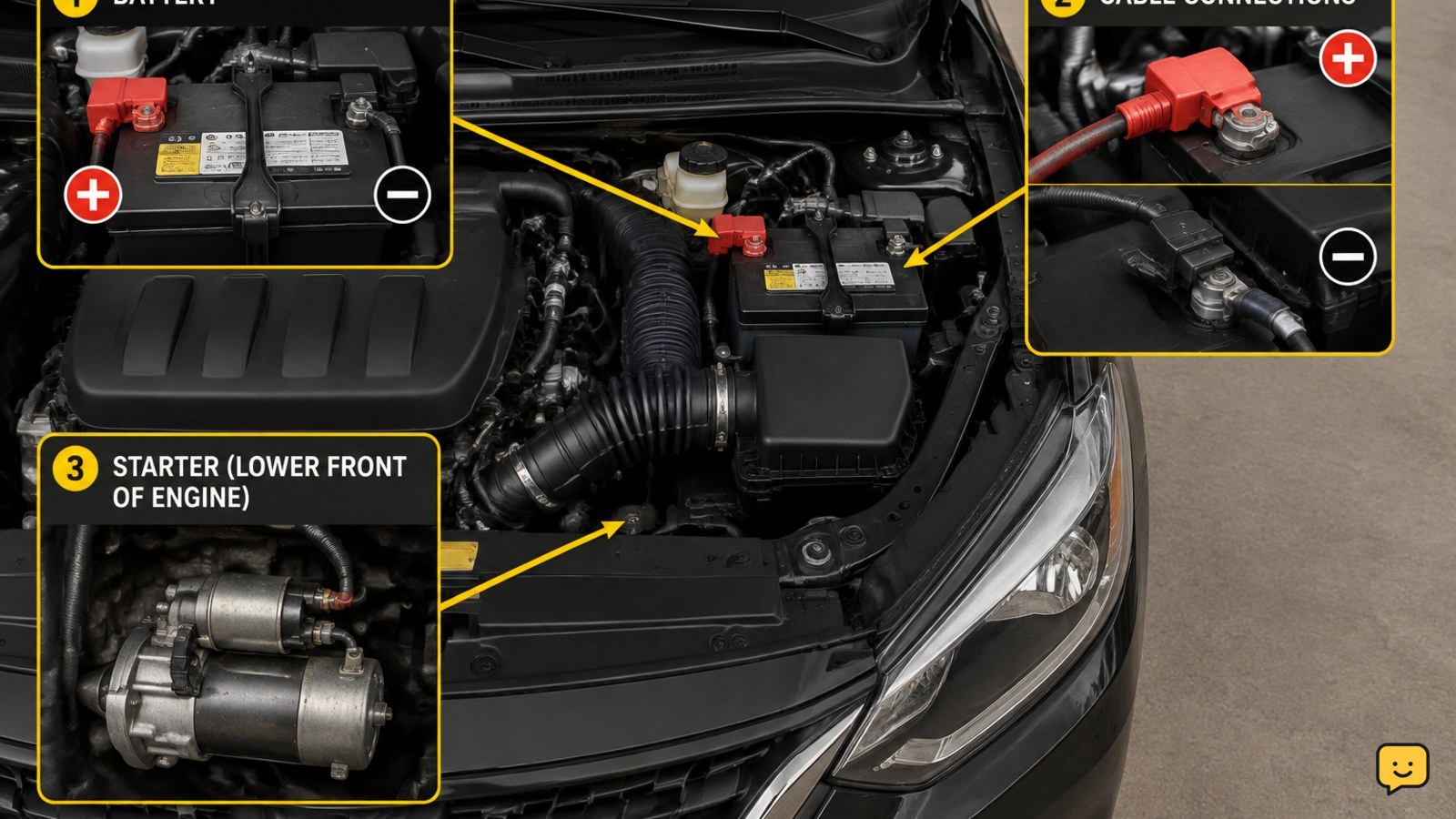
With the ignition off, try to rotate each battery cable clamp by hand. It should not move on the battery post. Look for white, blue, or green corrosion, loose fasteners, damaged cable insulation, and a ground cable that is loose where it attaches to the body or engine.
Do not rely on a clean-looking top surface. A connection can appear sound while resistance remains between the post and clamp. If the manual permits it, disconnect the negative cable first, then the positive cable. Clean corrosion with a suitable battery-terminal brush, reconnect positive first and negative second, and tighten the clamps without forcing them.
For a more useful connection test, measure voltage drop while the engine is being started. Place one probe on the positive battery post and the other on the starter’s main power terminal. A noticeable reading indicates resistance on the positive side. Repeat from the starter housing or engine metal to the negative battery post to check the ground path. Exact acceptable limits vary, so compare the result with the service information for the vehicle.
Failure path: If tightening or cleaning changes the symptom, the connection was part of the fault. If there is no change and the battery passes a load test, continue to the jump-start comparison.
3. Use a safe jump-start comparison
Check both vehicles’ manuals first. Use a known-good 12-volt donor vehicle or an approved jump pack, and keep the vehicles from touching. Confirm both systems use the same voltage and identify the correct positive and negative jump points.
Connect the positive cable to the dead vehicle’s positive point, then to the donor’s positive point. Connect the negative cable to the donor’s negative point, then to a clean, solid engine or chassis ground on the disabled vehicle away from the battery. Start the donor vehicle if the instructions allow it, wait briefly, and try the disabled vehicle once. Remove the cables in reverse order.
If the engine now cranks normally, the original battery may be discharged or weak. Have it charged and load-tested, and check why it became discharged. If the click remains exactly the same despite a properly connected, known-good power source, the starter, solenoid, ground path, or a high-current cable becomes more likely.
Do not keep trying: A jump-start is a diagnostic comparison, not proof that the battery is the only problem. Incorrect polarity can cause severe electrical damage.
4. Separate a starter fault from a connection fault
If battery voltage remains adequate, the terminals are tight, voltage-drop testing shows excessive resistance, or the jump makes no difference, the starter circuit needs closer inspection. The starter’s main cable must be secure, and the engine ground strap must have clean, tight contact at both ends.
A single click with good battery voltage at the starter input and a good ground path points toward a worn starter motor, starter solenoid, or an internal starter contact problem. Intermittent operation can fit a starter fault, but it is not conclusive by sound alone.
Some vehicles also require a valid Park/Neutral or clutch-switch signal. If safe and permitted by the manual, try starting in Neutral or fully depress the clutch. If the vehicle starts only in one selector position, arrange diagnosis of the range or clutch safety circuit.
Verification: A technician can confirm the fault by testing voltage at the starter control terminal while the key is held in Start, checking voltage drop on both high-current cables, and testing the starter under load. Replace the starter only after those checks support it.
5. Know when the symptom is not a battery, starter, or cable problem
If the engine cranks at normal speed but does not run, this guide is no longer focused on the right fault. The problem may involve fuel, ignition, immobilizer authorization, or engine-management systems.
If there is no click at all, check the battery state, fuses, ignition switch, Park/Neutral or clutch switch, and starter-control circuit. If the engine stops abruptly with a heavy mechanical sound or cannot rotate, do not continue starting attempts; internal engine or accessory seizure requires professional diagnosis.
After a successful start, do not assume the repair is complete. Check whether the battery warning light stays on, and have the charging system tested if the battery repeatedly goes flat. Repeated overnight battery failure can have causes beyond the battery itself.
Quick diagnosis summary
Battery likely: low resting voltage, lights dim dramatically, voltage collapses during starting, or the engine cranks normally after a proper jump.
Connection likely: loose or corroded terminals, damaged grounds, visible cable damage, or excessive voltage drop across a cable or ground path.
Starter likely: one solid click remains with a charged, load-tested battery, secure connections, acceptable voltage drop, and strong voltage reaching the starter.
These are diagnostic patterns, not guarantees. Use the vehicle’s service information for exact test points and limits.
Frequently asked questions
Can a bad battery cause one click but no start?
Yes. A weak battery can have enough voltage to operate the dashboard and trigger one starter click but not enough reserve current to turn the starter motor. Confirm by measuring voltage at the battery posts, observing the reading while attempting to start, and trying one properly connected jump-start. A battery that repeatedly needs a jump should be charged and load-tested rather than replaced based on the click alone.
How do I know if the starter is bad when the car clicks once?
A starter becomes more likely when the battery passes a load test, terminals and grounds are secure, cable voltage-drop results are acceptable, and a known-good jump source does not change the single click. A technician should then confirm that the starter receives both its main power feed and start signal. Do not replace the starter from sound alone.
Should I clean battery terminals if the car clicks once?
Yes, if the terminals are loose or show corrosion. Turn the vehicle off, follow the battery-disconnection order in the manual, clean the contact surfaces with a suitable terminal brush, and tighten the clamps. A terminal that still moves by hand is not secure. If cleaning makes no difference, test battery voltage and voltage drop instead of repeatedly attempting to start.
Will a jump-start prove the battery is bad?
No. If a jump-start restores normal cranking, the battery may be discharged or weak, but the charging system or a drain may have caused the low charge. If a correctly connected jump source changes nothing, the starter or a high-current connection becomes more likely. Have the battery and charging system tested after the vehicle starts.
Is it safe to keep turning the key when the car only clicks?
No. Limit each attempt to a few seconds and allow the cables and starter to cool. Repeated attempts can discharge the battery further and overheat a poor connection or starter. Stop immediately for smoke, melting, strong chemical odor, heavy sparking, a swollen battery, or a mechanical locking sound.
Browse more Maintenance & Repair guides for help with this topic.