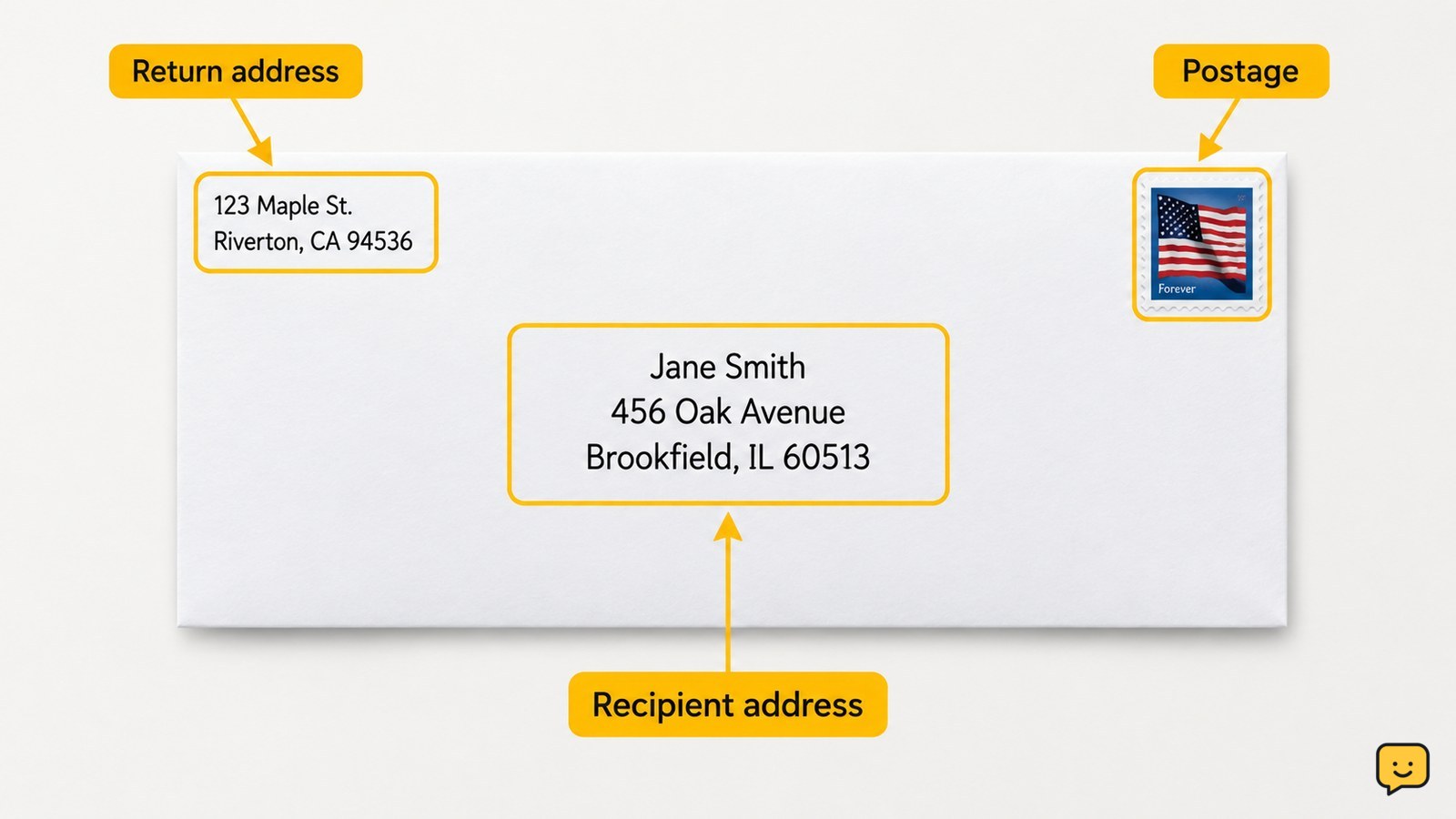
Write the recipient’s name and full mailing address in the center of the envelope’s front. Put your return address in the upper-left corner, then place the stamp in the upper-right corner. Keep the writing legible, leave clear space around the stamp and addresses, and check the address against your source before sealing or mailing.
For more help with this topic, use the Writing Communication guides.
Place the recipient’s address in the center
The recipient’s address belongs in the central area of the envelope’s front, where postal workers and sorting equipment can read it easily. StampsForever and Attorney at Work both identify the center-front area as the standard location for the delivery address.
- Write the recipient’s name on the first line.
- Write the street address on the next line.
- Add the city, state or region, and postal code on the following line.
- Add the country on its own final line when mailing internationally.
Keep the lines aligned and avoid writing so high that the stamp area becomes crowded. The finished address should be easy to distinguish from every other mark on the envelope.
Add the return address in the upper-left corner
The return address goes in the upper-left corner of the envelope’s front and identifies where the letter should be returned if delivery fails. This placement is supported by StampsForever and Attorney at Work.
Use the same line order as the recipient address: sender name, street address, and city, state or region, and postal code. Keep it noticeably smaller or more compact than the recipient block, but still legible. Leave enough separation between the return address and the centered delivery address so the two cannot be confused.
If you are sending a workplace letter, use the sender or organization name that will help the recipient recognize the mail. Do not add private information that is unnecessary for return delivery.
Leave the stamp area clear in the upper-right
The stamp belongs in the upper-right area of the envelope, with clear space around it for postal processing. Crossroads Calligraphy specifically advises leaving enough room near the top for the stamp to fit and be cancelled.
Place the stamp straight, without covering the envelope’s edge or folding it over a corner. If using multiple stamps, keep them together in the upper-right area rather than scattering them across the envelope. Do not write the recipient’s address through this space.
Use postage appropriate to the envelope’s size, weight, destination, and service. If you do not know the required postage, weigh the sealed envelope or ask a postal counter worker before mailing instead of guessing.
Format the writing for quick verification
A correctly placed address can still fail if its characters are hard to read, so review the envelope as a separate document before sending it. Emily Post’s correspondence guidance also supports using clear, current naming conventions rather than relying on older assumptions about how people should be listed.
- Use the recipient’s preferred name when you know it.
- Keep names and address lines in a consistent left-to-right layout.
- Write numbers, letters, and the postal code distinctly.
- Avoid decorative lettering, stickers, tape, or marks near the address block.
- Check that the envelope is facing the correct way and that the flap is not on the address side.
For a formal couple or household, address the envelope using the names and formality appropriate to the relationship. If you are unsure how someone wishes to be addressed, confirm it rather than relying on an outdated title or assumption.
Verify the envelope before sealing or mailing
Verification is complete when the recipient block, return address, stamp area, contents, and envelope seal all pass a final visual check. Read the address from the envelope itself, not from memory.
- Compare every address line with the original message, form, contact record, or address supplied by the recipient.
- Confirm the recipient’s name and postal code.
- Check that the return address is in the upper-left and the stamp is in the upper-right.
- Make sure the contents fit without bending, tearing, or forcing the seal.
- Seal the flap and confirm that no writing is hidden or smeared.
If the writing is unclear or a correction would leave conflicting information, use a fresh envelope. Crossing out one address and writing another beside it can make the delivery instructions ambiguous.
Choose an alternative when handwriting is unsuitable
Typing and printing the address is a suitable alternative when handwriting is small, inconsistent, or difficult to read. Print the recipient and return addresses on plain labels or directly on the envelope, then keep the same placement: recipient in the center, return address in the upper-left, and stamp in the upper-right.
Before attaching a label, check that it lies flat and does not cover the stamp area or the envelope’s edge. If the envelope uses a window, position the address so the complete delivery block is visible through the window and does not shift when the envelope is handled.
For international mail, do not assume that a domestic layout is sufficient. Follow the destination country’s postal instructions and write the country name clearly on the final line.
Frequently asked questions
Where does the recipient’s address go on an envelope?
The recipient’s address goes in the center of the envelope’s front. Keep the name and delivery lines together, clearly aligned, and separated from the return address and stamp area.
Where do you put the return address?
Place the return address in the upper-left corner of the envelope’s front. Include the sender’s name and complete return mailing address so undeliverable mail has a clear destination.
Can I type and print an envelope address?
Yes. A printed address is useful when handwriting may be difficult to read. Keep the recipient block centered, the return address in the upper-left, and the stamp area unobstructed.
How should I address an envelope to a couple or household?
Use the names and level of formality that fit the recipients and your relationship. When preferences are unclear, confirm the names or titles instead of assuming an older convention.
How should I address an international envelope?
Use the recipient’s complete local address and place the destination country on the final line. Check the destination country’s postal format before mailing because address order and required details can vary.