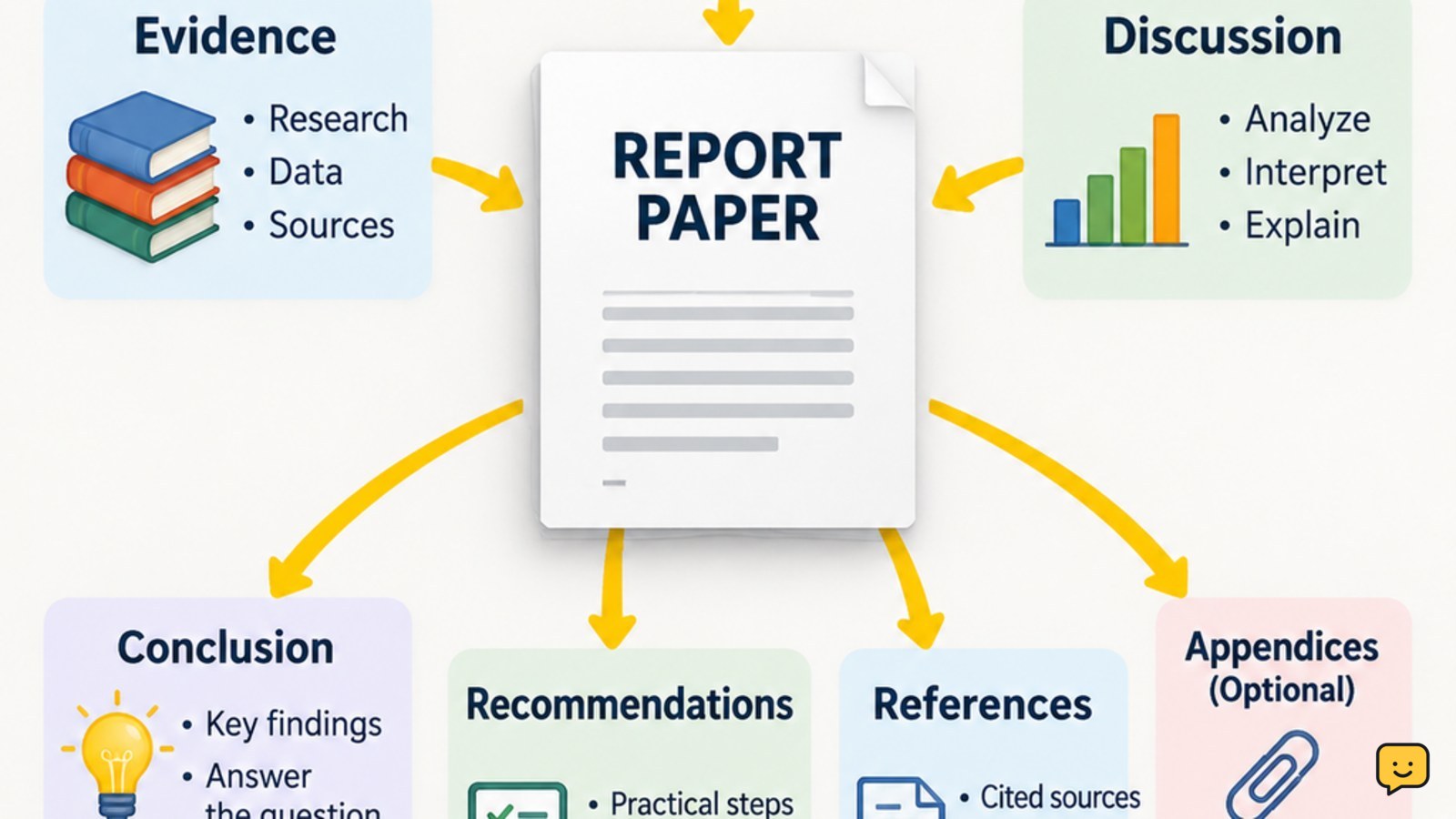
To write a report paper, first identify the question, audience, required format, and evidence standard. Research reliable sources, form a focused main finding, outline the introduction, discussion, conclusion, recommendations, and references, then draft each section around evidence. Revise for clarity, add accurate citations, and compare the finished paper with the assignment instructions before submitting.
For more help with this topic, use the Learning Study guides.
Define the report question and reader
A strong report paper begins with a defined question, audience, and purpose. Turn the assignment into one sentence that states what the report must investigate, compare, evaluate, or recommend.
For example, a workplace task might become: “How can a small office increase recycling participation without raising operating costs?” The audience is the office manager, so the report should emphasize practical findings and recommendations rather than general background.
- Underline the task verb, such as analyse, evaluate, or recommend.
- List the decision the reader needs to make.
- Write a provisional main finding, such as: “Clear bin labels and a short staff reminder are the lowest-cost starting measures.”
Verify this step when you can explain the report’s purpose in one sentence and identify what the reader should know or do after reading it.

Choose evidence and form a focused finding
Research for a report paper should answer the question rather than fill space. Gather facts, examples, data, and expert or institutional guidance that directly support the report’s purpose.
Grammarly’s report-writing guidance identifies topic selection, research, a thesis or central statement, outlining, drafting, revising, and editing as core parts of the process. Use that sequence as a planning model, but follow your assignment’s required method if it differs.
- Search for sources from universities, government bodies, professional organizations, original research, or the organization being studied.
- Record the author, title, date, URL or publication details, and the exact claim each source supports.
- Group notes by issue instead of by source. For the recycling example, groups might be current barriers, possible interventions, and cost or feasibility.
- Replace a broad topic with a focused finding that your evidence can actually support.
If sources disagree, do not hide the disagreement. Explain the difference in methods, dates, populations, or assumptions, then state which evidence best fits your report question.
Build the report paper outline
The outline gives each report paper section a distinct job. A common structure is an introduction, discussion or findings section, conclusion, recommendations, references, and appendices; QUT’s report-writing guide presents this sequence as an example structure.
- Introduction: State the topic, purpose, scope, and the question being addressed. Preview the main finding or the report’s organization.
- Discussion or findings: Present the relevant evidence under descriptive subheadings. Explain what each source, observation, or result means.
- Conclusion: Answer the report question using only the evidence developed in the body.
- Recommendations: Give specific actions when the assignment asks for them. Connect each action to a finding.
- References: List every cited source in the required style.
- Appendices: Place supporting material such as a questionnaire, full data table, or detailed calculation here if it helps verification but interrupts the main discussion.
Not every report needs every section. Remove or rename a section when the assignment template says otherwise. A useful check is to write one sentence beside every heading explaining the evidence or decision that belongs there.
Draft each section with evidence
Draft the report paper from the outline by making each paragraph answer a smaller part of the main question. Start paragraphs with a clear claim, add supporting evidence, and explain the evidence’s relevance.
Here is a short illustrative report paper example:
Title: Increasing Recycling Participation in a Small Office
Introduction: This report examines practical ways to increase recycling participation in a 40-person office. It considers communication, bin placement, and implementation effort. The report focuses on low-cost measures that can be introduced without changing the building’s waste contractor.
Discussion: Confusing labels can make correct disposal harder because staff must decide which container to use. A clearer system should place plainly worded labels beside each bin and show common examples. A brief reminder at the start of the trial can explain the change without making the process dependent on repeated training.
Conclusion: Clear labels and a short staff reminder are the most practical starting measures within the report’s stated scope. Their usefulness should be checked during a defined trial rather than assumed.
Recommendation: Introduce consistent labels, explain them in one staff message, and review disposal results after the trial period.
The example is a model of structure, not evidence that the proposed measures will work in every office. Replace its general claims with findings from your own sources, observations, survey, or approved data.
For guidance on making a recommendation specific and evidence-based, see how to write a credible recommendation.
Cite sources and separate fact from interpretation
Accurate citations show which information comes from a source and which interpretation is yours. Cite statistics, findings, definitions, distinctive ideas, quotations, and recommendations based on external evidence.
- Place an in-text citation where the sourced information appears, not only at the end of a long section.
- Use quotation marks for exact wording and include the required page or location details when your style guide asks for them.
- Paraphrase the idea fully in your own sentence, then cite the source.
- Check that every in-text citation has a matching reference-list entry and that every reference is used in the paper.
Keep interpretation visible. For example, “The survey reported that 18 of 25 respondents found the labels unclear” is a result; “This suggests label wording is the first barrier to address” is an interpretation. Do not present the second sentence as a measured fact unless the evidence directly tested it.
If your institution specifies APA, MLA, Harvard, Chicago, or another style, use its current instructions instead of combining formats.
Revise for clarity, balance, and compliance
Revision turns a complete draft into a report paper that a reader can check and use. Read once for reasoning before correcting grammar or layout.
- Confirm that every body section supports the report question and that no paragraph introduces an unrelated topic.
- Check that the conclusion follows from the findings and does not introduce new evidence.
- Make recommendations measurable or specific where possible: name the action, responsible person or group, resources, and review point if the assignment requires them.
- Replace vague claims such as “everyone agrees” with precise, sourced statements.
- Check headings, tables, figures, page numbers, word count, spacing, file type, and naming instructions.
- Read the paper aloud or use a line-by-line check for repeated words, missing transitions, and sentences that contain several unrelated ideas.
Success is observable: the reader can locate the purpose, evidence, conclusion, recommendations, and references without guessing. If the paper feels repetitive, combine paragraphs that make the same point; if a conclusion feels weak, return to the evidence rather than adding unsupported language.
Frequently asked questions
What is the difference between a report paper and an essay?
A report paper usually organizes information under labeled sections and may include findings, recommendations, references, tables, or appendices. An essay more often develops a connected argument through paragraphs without the same formal reporting structure. The assignment instructions decide which format applies, so check the required headings and assessment criteria before drafting.
How long should a report paper be?
The required length depends on the assignment or workplace brief. Treat the word count as a limit that helps you control scope, not as a target for padding. Allocate space according to the question: give enough room to explain the evidence and reasoning, then shorten background material that does not support the report’s decision or conclusion.
Can a report paper use first person?
A report paper can use first person only when the required style permits it, such as when describing your research process or limitations. Otherwise, use direct, objective wording and focus on the evidence. Do not remove responsibility from a claim by using passive language when naming the method or source would make the sentence clearer.
What should I do if I cannot find enough reliable sources?
Narrow the report question before lowering your evidence standard. Search library databases, university or government publications, professional organizations, and original studies relevant to the exact topic. If important evidence remains unavailable, state the limitation and ask the instructor or supervisor whether the scope or method can change. Do not invent data or treat an unverified page as authoritative.