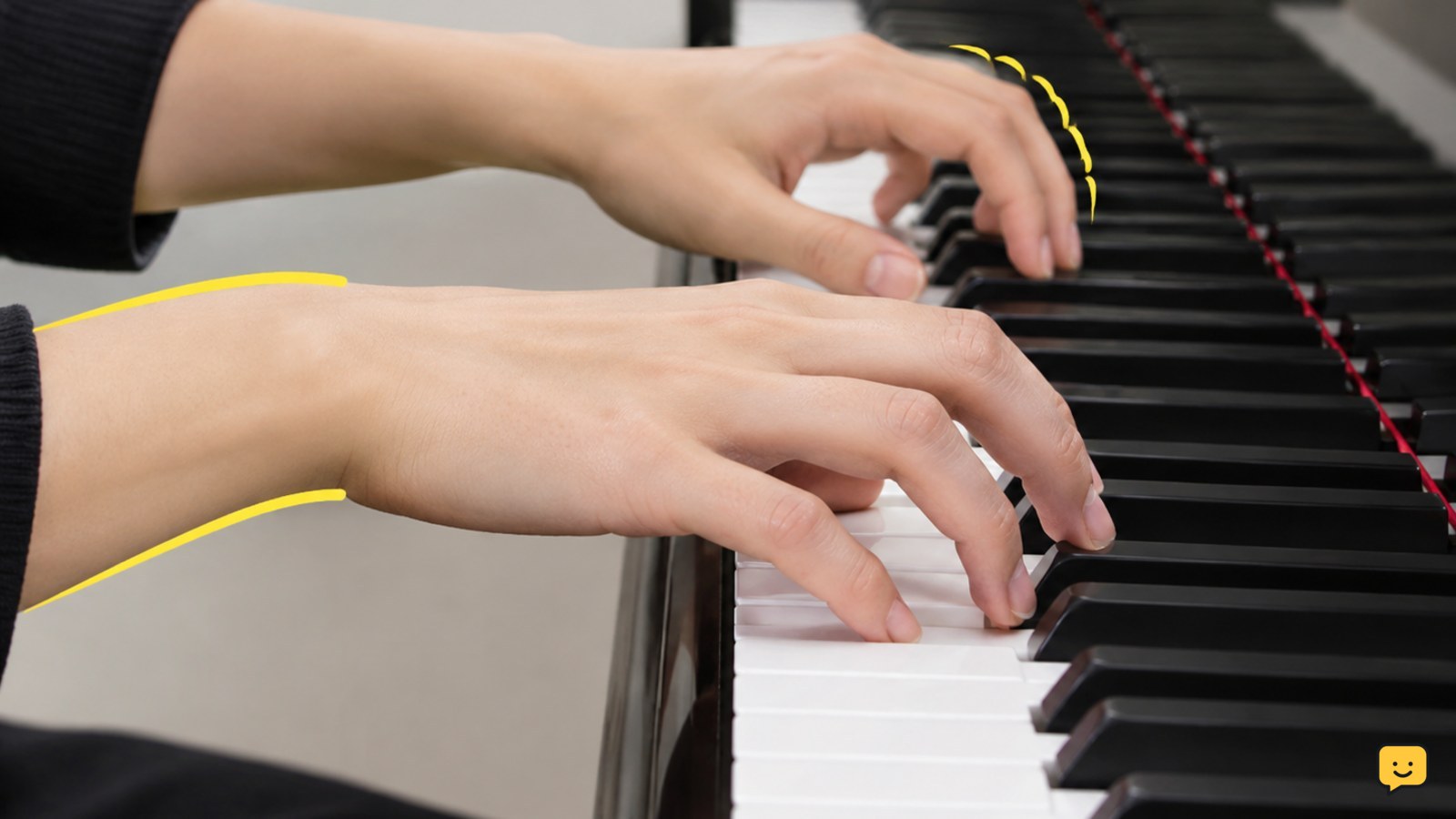
To improve piano finger speed and dexterity, practice short passages slowly and accurately, keep your fingers close to the keys, and stay relaxed through the wrists and forearms. Add scales, arpeggios, rhythmic variations, and gradual metronome increases. Stop for pain, numbness, or persistent tension; speed should follow control, not replace it.
For more help with this topic, use the Learning Study guides.
Start with slow, relaxed repetitions
Slow practice improves piano finger control because it lets you observe each finger movement before speed hides mistakes. Play a two- to four-beat fragment with relaxed shoulders, flexible wrists, and fingers close to the keys.
- Play the fragment slowly five times without stopping.
- Check that each note has a clear attack and similar volume unless the music requires accents.
- Pause, release your hands, and repeat only if the movement still feels loose.
Your first checkpoint is not a fast tempo. It is five clean repetitions with no skipped notes, accidental key presses, or rising tension. If the passage breaks down, shorten it to two notes or one beat and rebuild from there.
Build finger independence with scales and arpeggios
Scales and arpeggios train coordinated movement across different finger patterns, making them useful for developing dexterity and speed. Miller Piano Studio identifies both exercises as practical ways to work on finger independence and faster playing.
Practice one octave first, hands separately if necessary. Keep the thumb passage smooth instead of lifting the hand abruptly. For arpeggios, prepare the hand for the next position before the current note is released, but do not twist the wrist to force the reach.
Verify the exercise by listening for an even tone and watching for unnecessary finger lifting. If one finger repeatedly misses, slow down and isolate the transition around that finger rather than repeating the entire scale at a higher speed.
Raise tempo only after accuracy holds
Increase piano speed only when the current tempo remains accurate, even, and physically relaxed. Use a metronome as a checkpoint, not as a reason to force the hands forward.
- Choose a tempo at which you can complete the passage cleanly several times.
- Increase the setting by a small amount only after the same fingering and movement remain reliable.
- Return to the previous tempo as soon as mistakes or tension appear.
A successful increase sounds steady rather than rushed. If the notes become uneven at the faster setting, practice the difficult two- or three-note group in isolation, then reconnect it to the surrounding notes. Do not compensate by pressing harder; extra force usually makes quick release and recovery more difficult.
Use rhythms and small groups to unlock difficult patterns
Rhythmic variations can make a repeated finger pattern easier to control because they shift attention to different parts of the movement. For a run of even notes, try a long-short rhythm, then reverse it to short-long.
Keep the hand position and fingering unchanged while you vary the rhythm. After both versions feel controlled, return to even notes and compare the result. This method is especially useful when one section consistently lags or when two adjacent fingers collide.
If rhythm changes create more tension, the group is too large or the tempo is too high. Reduce the pattern to three or four notes, play it softly, and reconnect it only when the fingers can release each key cleanly.
Verify progress without chasing maximum speed
Progress in piano dexterity is shown by cleaner, more repeatable movement—not simply by reaching a higher number on the metronome. At the end of a session, replay the same short passage at the starting tempo.
- Accuracy: no repeated wrong notes or skipped notes.
- Evenness: no sudden gaps, accents, or rushed groups.
- Relaxation: shoulders, wrists, and forearms remain comfortable.
- Repeatability: the result holds across several attempts, not just one lucky run.
Pianote recommends taking breaks as needed during dexterity work. Use a short pause between exercises, and end the session if relaxation does not return. The safest adjustment is less volume, a slower tempo, a smaller passage, or a different day—not more force.
Frequently asked questions
How long should I practice piano finger exercises each day?
Practice for about 15 to 25 focused minutes, then reassess your accuracy and comfort. Short, regular sessions are more useful than one long session in which your fingers become tense. Divide the time between slow passage work, a scale or arpeggio, and a final relaxed review.
Should I practice piano scales with both hands together?
Not always. Practice hands separately when the fingering, thumb passage, or rhythm is unclear. Combine the hands once each part is accurate and relaxed at a slow tempo. If coordination breaks down, separate the hands again instead of forcing the combined pattern.
Why are my fingers still uneven when I play faster?
Unevenness usually means the tempo has exceeded your current control of a transition, fingering pattern, or release. Slow down, isolate the smallest problem group, and use contrasting rhythms before returning to even notes. Keep the fingers close to the keys and avoid pressing harder.
Can piano finger exercises cause pain?
They should not cause sharp pain, numbness, tingling, burning, or persistent soreness. Stop if those symptoms appear, rest, and seek professional assessment if they continue or return. Do not treat pain as evidence that the exercise is working or try to push through it.