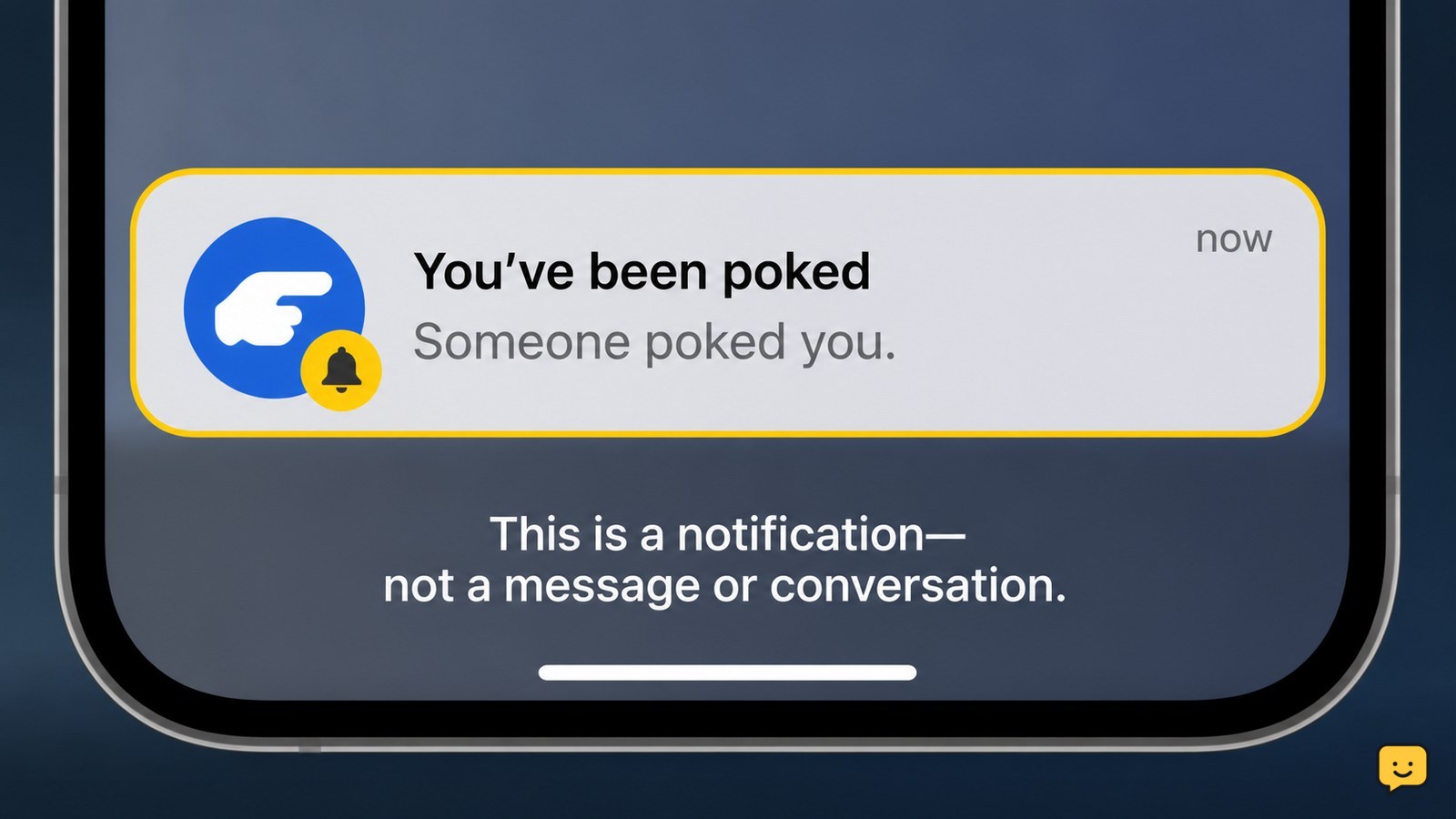
On Facebook, a poke is a lightweight alert: the person you poke receives a notification. It does not include a written message or carry one fixed meaning. Someone may use it as a casual hello, a prompt to interact, or a playful exchange. Only the sender can tell you what they intended.
Know what a Facebook poke actually does
A Facebook poke sends the recipient a notification. Facebook’s Help Center confirms that people can poke friends and friends of friends, and that the recipient receives an alert.
That confirmed function is much narrower than a message: a poke gives you a name and a notification, but no explanation. It does not tell you why the person chose to poke you, what they want to discuss, or how seriously they expect you to take it.
Think of it as a digital tap on the shoulder. It can invite attention, but the meaning comes from the relationship and any follow-up conversation—not from the feature itself.
Use the relationship and timing to read the likely intent
The most useful way to interpret a Facebook poke is to check who sent it and what has recently happened between you. A poke from a close friend after a shared joke may be playful; one from an acquaintance may simply be a casual attempt to get noticed.
- Check the sender. Consider whether you know the person well, have recently connected, or expected to hear from them.
- Check the timing. A poke shortly after a post, event, or conversation may relate to that interaction.
- Look for other context. A recent message, comment, or invitation gives the poke more meaning than the notification alone.
Do not assume a poke is romantic interest, a complaint, or an urgent request. Those interpretations are possible in some relationships, but Facebook does not assign a standard meaning to a poke.
Choose a response that matches your comfort level
A Facebook poke does not require a response. Choose the smallest response that clearly matches what you want to communicate.
- Reply with a poke if you recognize the sender and want to return a casual greeting. Facebook notes that mutual pokes can build milestones as people continue poking each other.
- Send a short message if you want clarity. For example: “Hey, I saw your poke—did you want to catch up?”
- Do nothing if you do not want to start a conversation. Silence is a valid response to a low-context notification.
Success looks simple: after responding, you have either acknowledged the interaction or asked for the context you need. If the sender does not explain further, there may be nothing more to interpret.
Use a message instead when the topic is work or study
A Facebook poke is not a suitable substitute for a clear work, class, or project message. It gives no subject, deadline, task, or record of what needs to be done.
If you need an answer about a meeting, assignment, document, or group task, send a direct message with the specific request. For example: “Could you confirm whether you can review the outline by Thursday?” This gives the other person enough information to respond accurately.
If a colleague or classmate pokes you and you are unsure why, a neutral reply is usually enough: “Hi—did you need something related to the project?” Stop there if they do not provide a clear reason or if you would rather keep communication on an approved work or school channel.
Handle an unwanted or repeated poke safely
An unwanted Facebook poke does not create an obligation to engage. You can leave the notification unanswered rather than returning the poke or opening a conversation.
If the same person repeatedly uses pokes to pressure you into contact, do not try to settle the issue through more pokes. Keep any response brief, or do not respond at all. Use Facebook’s available account safety controls if you need to limit contact, and seek immediate local help if a message or interaction includes a credible threat.
The appropriate stopping point is when you have made your boundary clear—or chosen not to engage—and no practical information remains to be gained from interpreting the notification.
Frequently asked questions
Can someone poke you on Facebook if you are not friends?
Yes, Facebook says people can poke their friends or friends of friends. A poke does not by itself explain how well the sender knows you, so check the person’s profile and your shared context before deciding whether to respond.
Does a Facebook poke mean someone likes you?
No, a poke does not reliably mean romantic interest. It may be playful, friendly, accidental, or simply an attempt to get your attention. If the distinction matters, ask the sender directly instead of relying on the notification.
What happens when you poke someone back on Facebook?
The other person receives a notification that you poked them. Facebook also says that friends who exchange pokes can reach milestones as they continue poking each other, making a returned poke a casual way to acknowledge the interaction.
Should you respond to a Facebook poke?
No, you do not need to respond. Return the poke if you welcome a casual interaction, send a message if you need context, or ignore it if you do not want contact. A poke alone is not an urgent request.
For more help with this topic, use the Writing Communication guides.