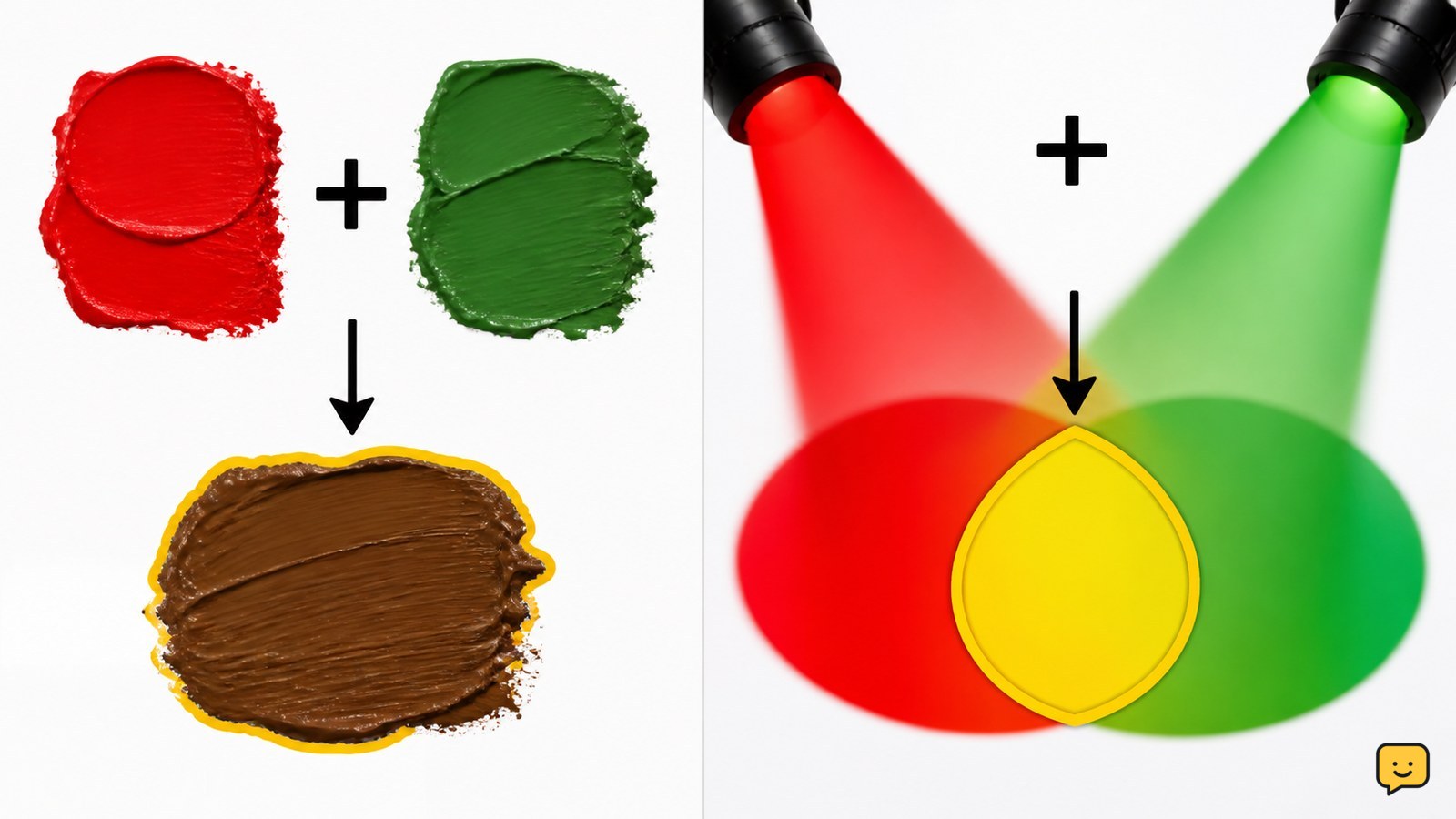
Red and green usually make brown when mixed as paint, ink, or other pigments. They make yellow when combined as light on a screen or in an additive color system. If a worksheet asks about traditional paint mixing, answer brown; if it asks about colored light or RGB, answer yellow.
Check whether you are mixing pigment or light
Red and green make different results because pigments and light combine in different ways. Paint, crayons, colored pencils, and ink usually produce a brown or muddy neutral when red and green overlap. Red and green light combine to produce yellow, which is why the answer for an RGB screen differs from the answer for an art exercise.
Use this decision rule before answering:
| What you are combining | Typical result | Use this answer |
|---|---|---|
| Paint, ink, crayons, or colored pencils | Brown or a muted brown | Answer brown |
| Red and green light | Yellow | Answer yellow |
| Digital RGB color channels | Yellow | Answer yellow |
Mix red and green paint to get brown
Red and green paint usually make brown because the pigments absorb and reflect overlapping parts of the visible spectrum. The exact brown depends on the paint colors, their strength, and the amount of each pigment.
- Place a small amount of red paint on a palette or mixing surface.
- Add a smaller amount of green and blend slowly.
- Check the mixture under neutral or white light.
- Add more red for a warmer, reddish brown or more green for a cooler, earthier brown.
The result is successful when the mixture looks brown or muted brown rather than clearly red or green. A paint-mixing reference from Drawings Of describes the usual pigment result as brown.
Combine red and green light to get yellow
Red and green light make yellow in an additive color system. On a screen or in an RGB color lesson, the red and green channels are added together, so the combined light appears yellow.
- Open a color or light demonstration that uses separate red, green, and blue channels.
- Turn on red light first and confirm that the red area is visible.
- Turn on green light over the same area.
- Look at the overlap, which should appear yellow when the red and green light levels are balanced.
This result is different from mixing physical paint. A color reference describing light combinations identifies red plus green light as yellow.
Verify the answer when the result looks different
A red-and-green mixture that does not look brown or yellow usually indicates that the medium, balance, or lighting is different from the expected example.
- It looks nearly black or very dark: You are probably mixing pigments, and the colors may be too strong or too close to equal parts. Add a little white only if the assignment permits tinting.
- It looks olive or gray-green: Add a small amount of red to warm the mixture, then blend again.
- It stays bright red or bright green: The colors are not balanced. Add the other color in small increments.
- A screen shows yellow: That is expected for red and green light or RGB channels, not physical paint.
For a classroom or study question, check the wording around the prompt. Words such as “paint,” “pigment,” or “traditional color mixing” point to brown; “light,” “RGB,” or “screen” points to yellow.
Choose a controlled alternative for practice
A color-wheel or digital swatch exercise lets you compare the two systems without using much material. Create one sample with red and green paint, then view a second sample made by overlapping red and green digital light or RGB areas.
Label the samples pigment and light. The pigment sample should be brown or muted, while the RGB sample should be yellow. If the samples do not match those descriptions, first confirm the medium and lighting before changing the colors.
Frequently asked questions
Do red and green make brown or yellow?
Red and green make brown when you mix physical pigments such as paint or ink. They make yellow when you combine red and green light, including RGB color channels on a screen. The correct answer depends on the medium named in the question.
What do red and green make with paint?
Red and green usually make brown with paint. The shade may range from warm reddish brown to a dull olive-brown because different pigments have different strengths. Add one color gradually if you want to shift the temperature or darkness.
Why do red and green light make yellow?
Red and green light make yellow because light uses additive color mixing. When both wavelengths reach your eyes together, the combined light is perceived as yellow. This is the same basic principle used by RGB screens.
What does red and green make with crayons or colored pencils?
Layering red and green crayons or colored pencils usually creates a dark, muted brown or brownish neutral. The result depends on the brands, pressure, paper, and which color is applied first. Test lightly before building up darker layers.
For more help with this topic, use the Learning Study guides.