If your car window goes down but will not roll up, first try the window switch from both control locations and listen for motor noise. A silent window often points to the switch, fuse, relay, or up-direction wiring. A humming or clicking motor suggests a regulator or mechanical fault. Stop using the switch if the glass is crooked, loose, or binding.
What this diagnosis applies to
These checks apply to a conventional electric power window that still moves downward but will not move upward. They do not apply to a manual crank window, a window disabled by a child-lock-style control, or a vehicle with a fully integrated door-control module unless its manual supports the same tests.
A power window reverses motor direction by changing the electrical path. That means one direction can fail while the other still works. The fault may be limited to the switch or the wiring that carries the upward command, rather than the entire window system.
1. Confirm the symptom and try every control
- Turn the ignition to the position specified in the owner manual. Some vehicles require the engine to be running or a retained-accessory-power setting.
- Press the affected window switch down, then release it. Confirm that the glass moves down normally.
- Press the same switch up while listening closely. Note whether the window is silent, clicks, hums, or tries to move.
- If the window has a separate driver-door control, try raising it from there. For a passenger window, test both the passenger switch and the driver master switch.
- Check whether the window-lock button is active, then test another window. If other windows also fail, inspect the shared fuse, relay, power supply, or master switch.
Verification: If the window rises from one switch but not the other, the failed switch or its connector is the leading suspect. If it will not rise from either control, continue with the power, wiring, motor, and regulator checks.
Failure path: If no windows work, do not replace the affected window motor first. Find the shared power-window fuse or control issue before removing the door panel.
2. Use the sound and glass movement to narrow the fault
The symptom while you press the up switch is useful because the motor and regulator do not fail in exactly the same way.
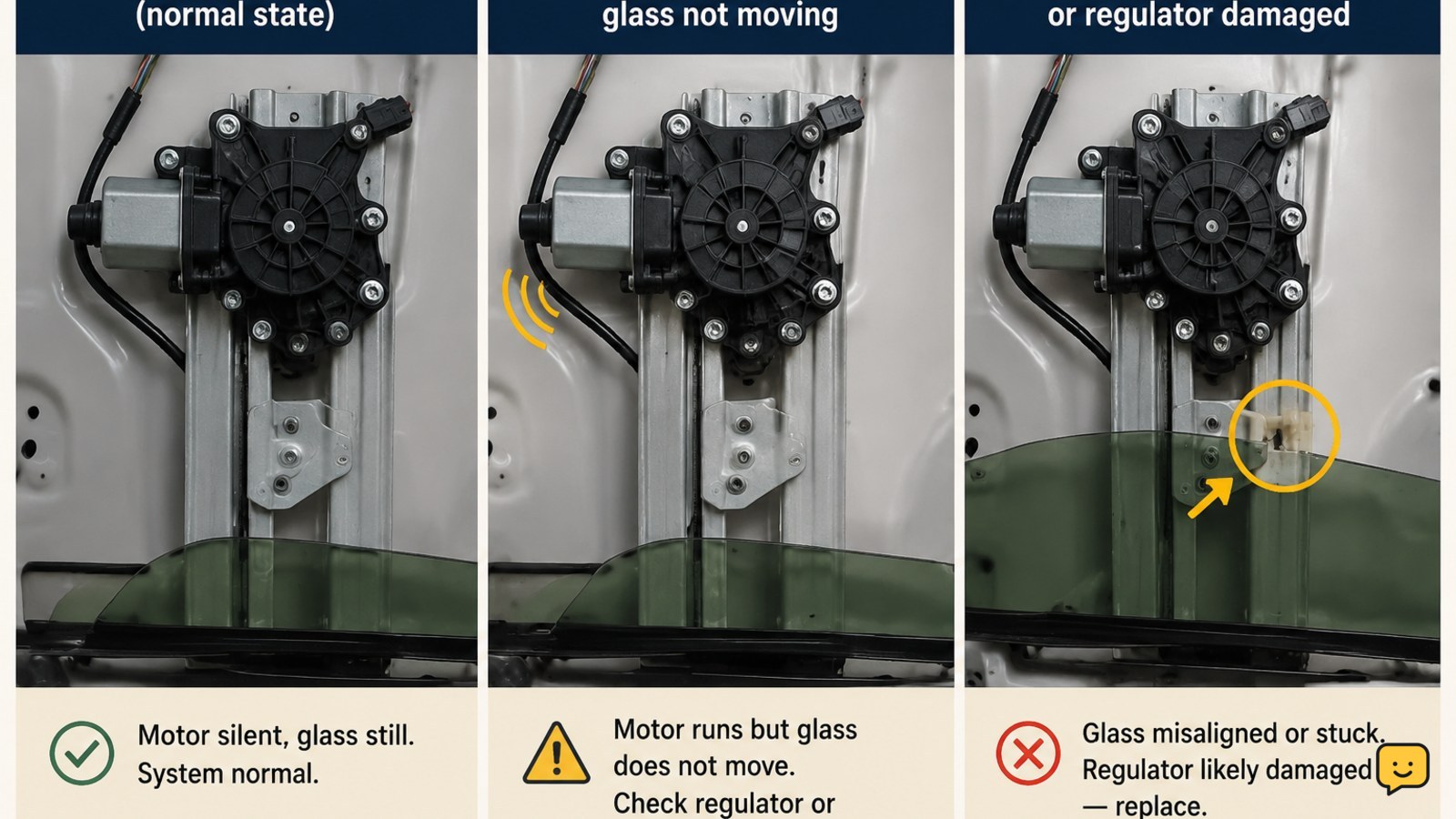
- No sound at all: Suspect the up contact inside the switch, a blown fuse or relay, a disconnected connector, or a break in the upward-direction wiring.
- A click but no movement: Suspect a weak electrical connection, a motor that cannot produce enough torque, or a regulator that has seized.
- A hum or whir with no glass movement: The motor is receiving a command, but the regulator, cable, gear, or glass attachment may be damaged or disconnected.
- Grinding, popping, or uneven movement: Stop cycling the window. A damaged regulator or glass guide can worsen quickly and may let the glass drop.
- Slow upward movement that improves when the glass is helped by hand: Binding in the seal or guide, excess friction, a weak motor, or regulator wear is more likely than a simple switch fault.
Do not pull hard on the glass while operating the switch. A helper may provide only light, even support during a brief test, provided the glass is stable and not cracked or loose.
3. Check the easy electrical causes first
- Locate the power-window fuse and, if listed separately, the window relay using the owner manual. Inspect the fuse and replace it only with the specified rating.
- If the replacement fuse fails again, stop. A repeated failure indicates a short, damaged motor, seized regulator, or wiring problem that needs further diagnosis.
- Inspect the affected door’s wiring where it passes through the flexible rubber boot between the door and body. Look for crushed insulation, broken conductors, corrosion, or a connector that is not fully seated.
- Operate the switch while gently observing the harness. Do not tug, pierce, or short the wires. A change in behavior when the harness moves supports a wiring fault.
- If the vehicle has a window reset or initialization procedure, follow the exact owner-manual steps. Some vehicles can lose automatic window operation after battery service, although a lost setting usually does not explain a completely silent manual up command.
Verification: A correct fuse, intact visible wiring, and no response from either switch move suspicion toward the switch, motor, or a break hidden inside the door harness.
Failure path: If the fuse, connector, or harness is hot, melted, wet with corrosion, or visibly damaged, repair that fault before testing the motor.
4. Decide whether the switch or motor circuit is at fault
Many power-window systems reverse polarity at the motor: one pair of motor wires receives one direction for down and the opposite direction for up. Because wiring layouts vary, use the vehicle’s wiring diagram rather than assuming terminal positions.
- Remove the door trim only if the manual gives a safe procedure and you can identify all fasteners and electrical connectors.
- Inspect the window-switch connector for bent terminals, moisture, looseness, or heat damage.
- With a multimeter set as directed by the meter instructions, compare the motor-circuit readings during a down command and an up command. The down command working normally gives you a useful comparison.
- If the down command reaches the motor but the up command does not, the switch, connector, or up-direction wire is the likely fault.
- If both commands reach the motor connector but the motor responds only downward, the motor may have an internal one-direction failure.
Use the model-specific wiring diagram for the test points and expected readings. Do not apply battery power directly to unknown terminals, bypass a control module, or test an airbag connector.
Verification: The switch is strongly indicated when its output differs between the working down command and failed up command. The motor is more likely when the correct up command reaches its connector but it remains silent.
5. Inspect the regulator and window guides
If the motor hums, the glass tilts, or the window makes grinding noises, inspect the mechanical assembly rather than repeatedly changing switches or fuses. The regulator links the motor to the glass and can fail even when the motor still runs.
- Support the glass before loosening any regulator or glass fasteners. Use a stable, non-marring support approved for the vehicle’s door design.
- Look for a detached glass clamp, a loose fastener, a frayed or tangled cable, a broken plastic guide, or a regulator arm that is out of its track.
- Check whether the glass moves freely in both vertical guides with the motor disconnected only when the service procedure permits it.
- Clean visible dirt from the rubber run channels. Use only a lubricant specified for window channels; avoid spraying an unknown product into the switch or motor.
- Replace the regulator, motor, or combined motor-and-regulator assembly according to the vehicle’s parts configuration. Confirm the exact fitment before ordering.
Stop condition: Do not continue if the glass cannot be held securely, the regulator is under spring tension, or the door contains an airbag you cannot safely isolate. Secure the window temporarily and use a qualified repair shop.
6. Verify the repair
- Reinstall connectors and trim panels, keeping wiring clear of the regulator and glass path.
- With the door closed or positioned as specified by the manual, test the window down and up several times.
- Check operation from every available switch, including the driver master control and the window-lock function.
- Confirm that the glass remains level, seals evenly, reaches the full closed position, and does not bind or make abnormal noise.
- Perform the manufacturer’s initialization procedure if automatic or one-touch operation is missing after repair.
The diagnosis is complete when the window raises smoothly from the correct controls, the fuse remains intact, and the glass stays aligned after repeated cycles. If it works only intermittently, returns to one-direction operation, or causes another window to fail, stop replacing parts and have the circuit tested with the vehicle wiring diagram.
Frequently asked questions
Why does my car window go down but not up?
The most common possibilities are a failed up contact in the window switch, a break in the up-direction wiring, a motor with an internal one-direction fault, or a damaged regulator. Try both window switches and listen for sound. Silence points toward the control circuit; humming, grinding, or a tilted glass points more strongly toward the motor or regulator.
Can a bad window switch make the window work in only one direction?
Yes. A power-window switch can fail on only its upward contact while the downward contact continues to work. If the window raises from one switch but not another, replace or test the switch that fails. If neither switch can raise it, check the fuse, wiring, motor command, and regulator before buying a switch.
How do I know if the power-window motor or regulator is bad?
A humming or whirring sound with no glass movement often indicates a regulator, gear, cable, or glass-attachment problem. A silent motor when the correct up command reaches its connector suggests a motor fault. A crooked, grinding, popping, or falling window is a mechanical warning; stop operating it and secure the glass.
Will replacing the fuse fix a window that only goes down?
It may fix the problem if the fuse is open, but a fuse does not normally explain only one direction by itself because the same window circuit may use both directions. Replace a fuse only with the specified rating. If it fails again, stop: a short, seized regulator, damaged motor, or wiring fault needs diagnosis.
Browse more Maintenance & Repair guides for help with this topic.