Squeaking alone does not prove that car brakes are unsafe, but persistent or worsening noise needs inspection. Stop driving and arrange recovery if the sound becomes grinding, the car stops less effectively, the brake pedal feels abnormal, the vehicle pulls, strong vibration appears, or a brake warning light comes on. A quiet test does not confirm the brakes are safe.
Check whether the sound is squeaking or grinding
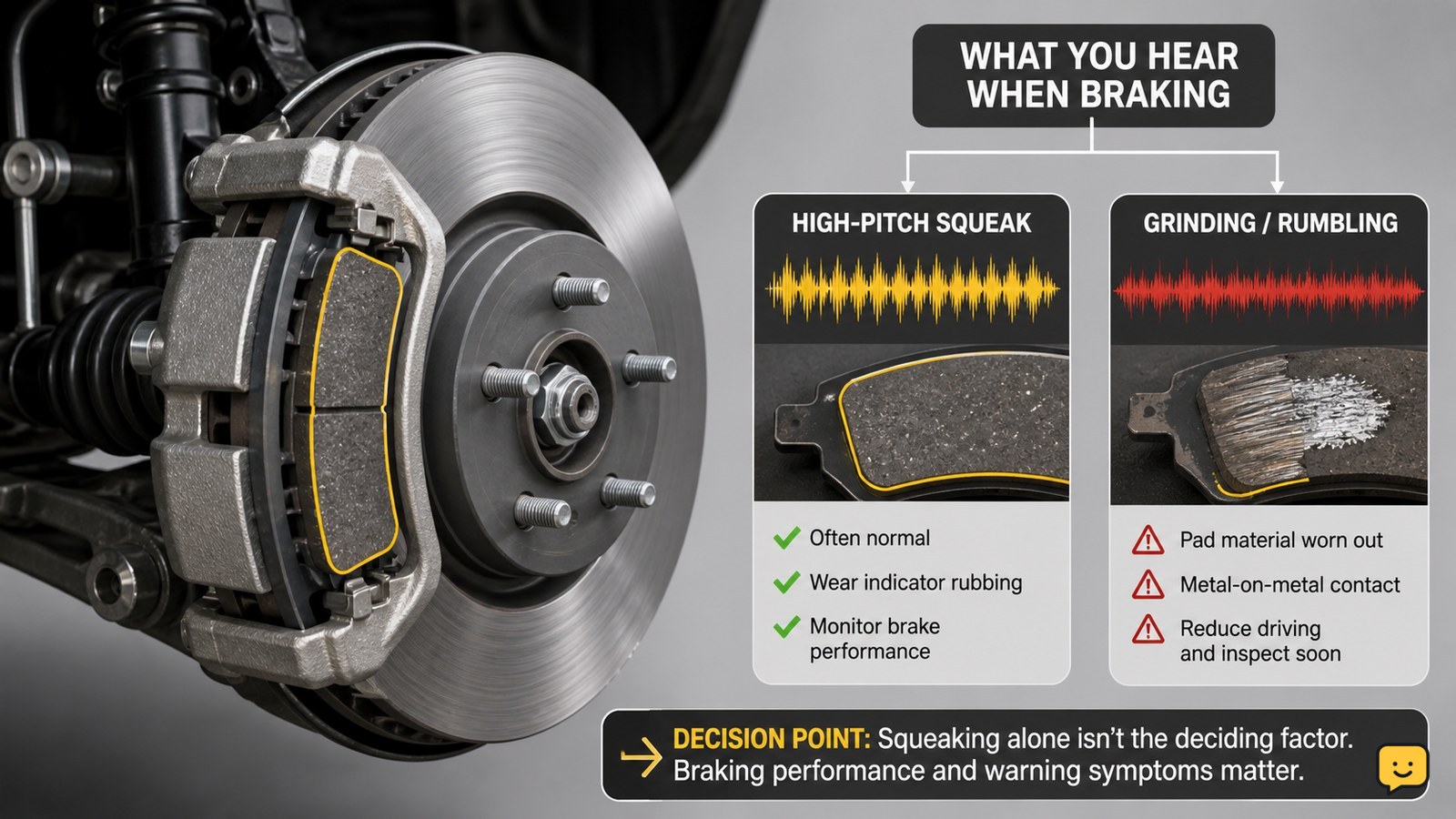
Car brakes that make a high-pitched squeak during a normal stop may have a noise issue, but a grinding or scraping sound is a different safety decision. CRC Industries lists worn pads, brake dust, moisture, and brake hardware among possible causes of squeaking, while grinding can indicate metal-on-metal contact.
- Notice when the sound occurs: only during light braking, during every stop, or even when the brake pedal is released.
- Compare the sound at low and moderate speeds without creating traffic risk.
- Stop the check if the noise is harsh, metallic, continuous, or suddenly worse than before.
A brief squeak does not clear the brakes, and a quiet moment does not prove that the pads, rotors, hardware, or caliper are in good condition.
Verify that the car still stops normally
The most useful safety checkpoint is whether the vehicle stops predictably with normal pedal pressure. Only perform a low-speed check in an empty, dry, controlled area; do not test on public roads, downhill, or near other vehicles.
- Apply the brake gently and note whether the pedal feels firm and consistent.
- Check whether the car tracks straight instead of pulling left or right.
- Notice whether stopping feels smooth or includes pulsing, shaking, or a sudden change in pedal effort.
- Release the test if the car does not respond normally.
If braking is weaker, delayed, uneven, or difficult to control, treat the squeak as a safety fault rather than a noise nuisance. Arrange an inspection or recovery instead of driving to a repair shop.
Look for warning lights and worsening symptoms
A brake-related warning light or a combination of new symptoms makes squeaking more concerning. Check the instrument panel after starting the vehicle and note whether a brake or ABS warning remains illuminated.
- Record which warning light is on and whether it appeared before or after the noise began.
- Look for a change in pedal height, softness, travel, or effort.
- Check whether the vehicle pulls, vibrates strongly, or needs noticeably more distance to stop.
- Compare the latest noise with its previous frequency and volume.
Persistent or worsening squeaking should be checked, according to Firestone Complete Auto Care’s safety guidance. Do not dismiss a noise that is joined by a warning light or changed braking behavior.
Decide whether to drive or stop
Drive only when the noise is occasional, braking remains firm and predictable, no warning light is present, and there is no grinding, pulling, unusual vibration, or reduced stopping performance. Even then, schedule a brake inspection rather than waiting for the noise to disappear.
| Observed condition | Safest action |
|---|---|
| Brief squeak with normal braking and no warning signs | Limit driving, avoid hard stops, and arrange an inspection soon. |
| Persistent or worsening squeak | Have the braking system checked before relying on the car for regular driving. |
| Grinding, scraping, weaker braking, pulling, or abnormal pedal feel | Stop driving and arrange professional recovery. |
| Brake or ABS warning light remains on | Follow the owner’s manual warning guidance and seek inspection; stop if braking is affected. |
The exact cause cannot be confirmed from sound alone. A technician may need to inspect pad thickness, rotor condition, caliper operation, and brake hardware.
Verify the repair before returning to normal driving
After brake service, verify that the noise and braking behavior have both improved. A successful result is not simply a quieter brake; the pedal should feel consistent, the car should stop straight, and no warning light should remain on without an explained cause.
- Ask what component caused the noise and what was replaced, cleaned, or adjusted.
- Confirm that the repair addressed both sides of the axle when the technician identifies a paired brake issue.
- Perform a gentle, low-speed check away from traffic.
- Stop and return for inspection if grinding, pulling, vibration, warning lights, or abnormal pedal feel remains.
If the squeak returns shortly after service, do not assume the repair failed or that the noise is harmless. Report when it occurs, how loud it is, and whether stopping performance changed.
Frequently asked questions
Are squeaky brakes always unsafe?
No. A squeak can come from brake dust, moisture, worn pads, or hardware, so the sound alone does not prove a dangerous fault. However, persistent or worsening noise should be inspected, especially when it appears with grinding, weaker braking, pulling, vibration, a changed pedal feel, or a warning light.
Can I drive with brakes that squeak when stopping?
Only for limited driving when braking remains firm and predictable, the car tracks straight, no warning light is present, and the noise is not grinding or worsening. Arrange an inspection soon. Do not drive if stopping performance changes or the pedal feels soft, sinks, or behaves inconsistently.
What does grinding when braking mean?
Grinding can indicate metal-on-metal contact between brake components. CRC Industries treats grinding as requiring immediate attention. Stop driving, avoid repeated testing, and arrange professional recovery because continuing can worsen the braking fault and reduce stopping safety.
Does brake vibration make squeaking unsafe?
Strong vibration changes the decision because it can indicate a braking or related wheel-end problem that needs inspection. Stop driving if vibration is severe, new, or accompanied by pulling, weaker braking, a warning light, or an abnormal pedal. Mild recurring pulsing still deserves a prompt brake check.
Browse more Maintenance & Repair guides for help with this topic.