If your car windshield washer fluid is not spraying, first confirm the reservoir has fluid and the nozzles are not blocked. Listen for the washer pump when you activate the control. A humming pump with no spray points to frozen or disconnected lines or clogged nozzles; silence points toward the fuse, switch, wiring, or pump. Stop if fluid leaks or electrical testing is outside your skill level.
Check the washer-fluid reservoir and weather conditions
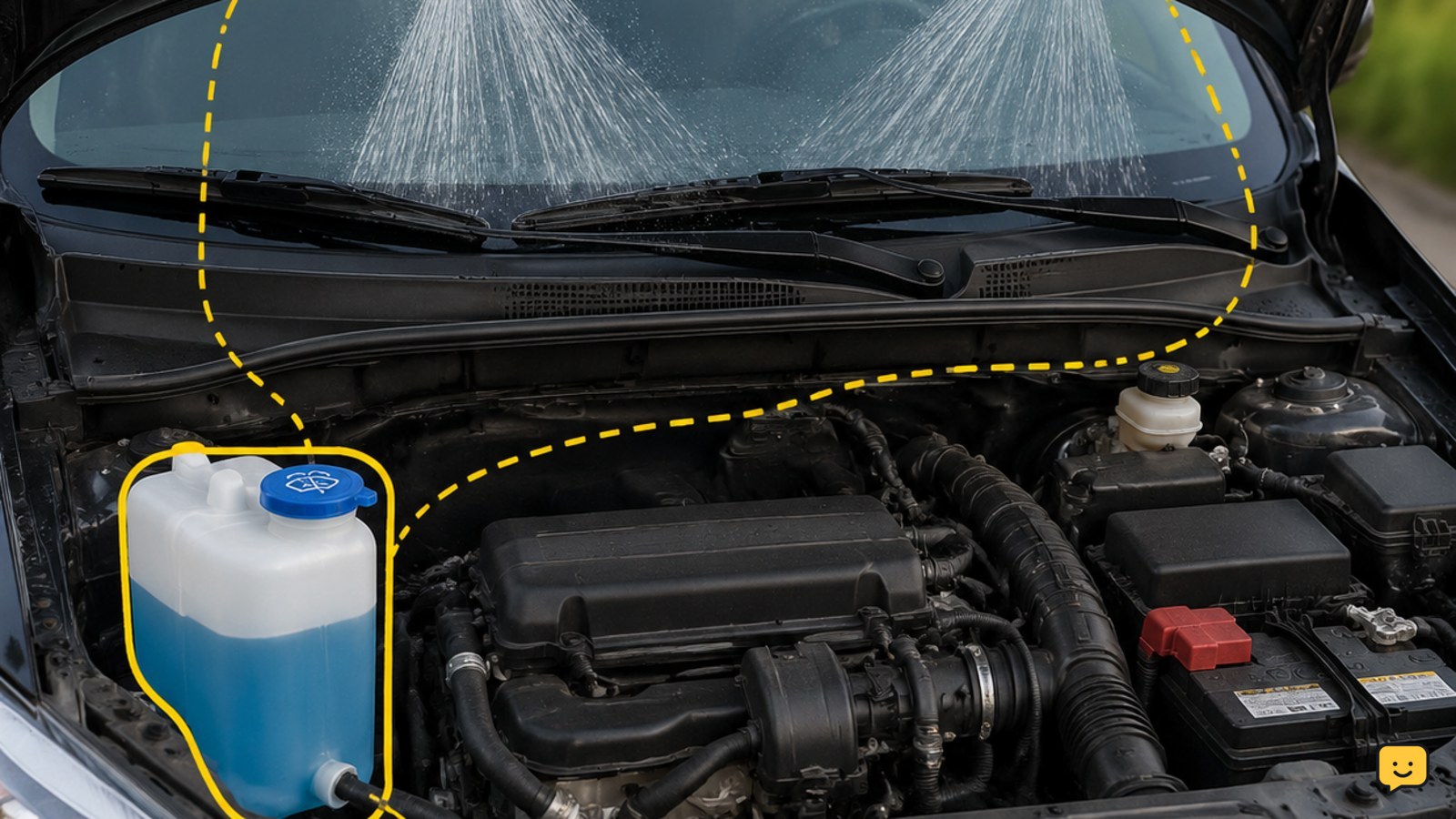
Start with the simplest failure: an empty reservoir. Find the washer-fluid tank under the hood using the owner’s manual or the washer-fluid symbol on the cap. Fill it to the marked level with suitable washer fluid, then close the cap securely.
If the problem appeared after freezing weather, the fluid, hose, pump, or nozzle may be frozen. Do not force repeated sprays or pour boiling water over the system. Move the vehicle into a warmer place and allow the system to thaw naturally. Test again only after the fluid is liquid.
Expected result: the pump should run and fluid should reach the windshield. If the reservoir level drops quickly without spray, stop and look for a leak rather than continuing to operate the pump.
Listen for the washer pump when you activate the control
With the vehicle stationary and the ignition in the normal operating position, briefly activate the windshield-washer control. Listen near the washer-fluid reservoir for a short humming sound. Keep each test brief so you do not overheat a struggling pump or empty the reservoir.
- Humming sound, no fluid: focus on frozen or blocked lines, a loose hose, or clogged spray nozzles.
- Humming sound and weak spray: check for low fluid, partial nozzle blockage, a restricted hose, or a pump that is losing pressure.
- No sound: check the relevant fuse in the owner’s manual before suspecting the pump, switch, connector, or wiring.
This sound check separates a fluid-flow problem from a control or power problem. If you cannot safely identify the fuse or electrical connector, stop at this checkpoint and arrange service.
Inspect the washer hoses and connections for a leak
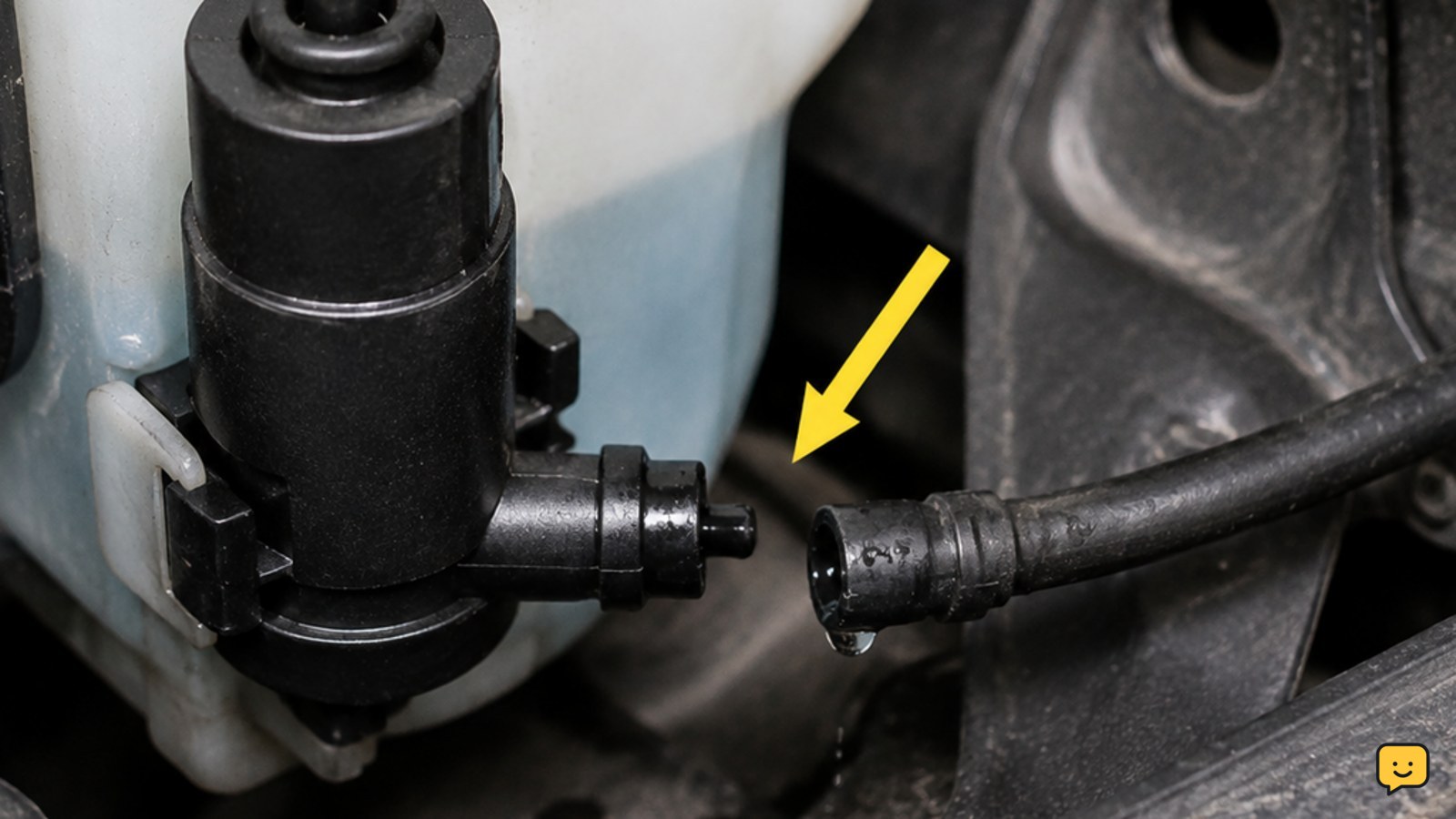
Trace the small washer-fluid hose from the reservoir and pump toward the hood and spray nozzles. Look for a hose that has pulled off a connector, split, kinked, or become wet while the washer control is activated. Use a flashlight and a cloth to identify fresh fluid.
A pump that hums while fluid appears under the hood usually has a disconnected or damaged line. Reconnect a loose hose only if the fitting is clearly accessible and undamaged. Replace a split hose or damaged connector instead of sealing it temporarily.
If the hose looks dry but the pump runs, the line may still be frozen or blocked. Thaw the system fully before removing parts. Do not use force to pull frozen tubing from a brittle connector.
Clean blocked windshield washer nozzles carefully
When the pump runs and the hoses remain connected, inspect the spray openings on the hood or wiper arms. Road dirt, wax, and dried washer fluid can block the small nozzle openings. Wipe the surrounding area with a clean damp cloth and remove visible debris gently.
Test the spray again. A nozzle that produces a narrow dribble or sends fluid in one direction is still restricted. If the nozzle can be removed without damaging the hood or hose, clean it according to the vehicle manual. Avoid enlarging the opening with a sharp object, because changing the opening can alter the spray pattern.
Expected result: both spray points should produce a consistent pattern that reaches the windshield. If one side works and the other does not, the fault is more likely local to that nozzle or its hose than to the reservoir or control.
Check the fuse and verify the repair
If the pump stays silent, use the owner’s manual to locate the fuse assigned to the washer system. Inspect it only with the ignition off and replace it with the exact same rating. A replacement fuse that fails immediately indicates an underlying electrical fault; do not install a larger fuse.
After any repair, refill the reservoir if needed and activate the washer briefly several times. Confirm that fluid reaches the glass, the spray pattern is even, no hose leaks, and the pump stops when you release the control. Clean any spilled fluid from painted surfaces and the engine-bay area.
If the fuse is good but the pump remains silent, or if the pump runs and the system still will not deliver fluid after thawing and nozzle cleaning, the pump, switch, wiring, or a hidden blockage needs further diagnosis. Stop rather than repeatedly operating the control.
Frequently asked questions
Why does windshield washer fluid stop spraying in cold weather?
Freezing can block the reservoir, hose, pump, or nozzle, especially if the fluid is diluted or not rated for the temperature. Let the vehicle thaw naturally in a warm location and test again. Do not use boiling water or force the washer control while the system is frozen.
Why can I hear the washer pump but no fluid reaches the windshield?
A humming pump shows that the control is probably activating the pump, but it does not prove fluid can move through the system. Check for a frozen or disconnected hose, a leak under the hood, and blocked spray nozzles. Stop if the fluid leaks rapidly.
Why is windshield washer spray weak on only one side?
One-sided weak spray usually points to a restricted nozzle, kinked hose, or loose connection on that side. Clean the nozzle area gently and inspect the nearby hose. If the other side sprays normally, the reservoir, fuse, and main control are less likely to be the cause.
Can a blown fuse cause windshield washer fluid not to spray?
Yes. If the pump makes no sound, check the washer-system fuse location and rating in the owner’s manual. Replace it only with the same rating. If the replacement fails again, stop testing and arrange electrical diagnosis because the circuit has another fault.
Browse more Maintenance & Repair guides for help with this topic.