Your car battery may keep dying overnight because the battery is worn out, the alternator is not restoring its charge, or an electrical component stays on after you park. Start with a fully charged battery and a visual inspection. If the battery passes testing, measure key-off current draw or have a shop isolate the draining fuse.
1. Confirm that the battery is actually losing charge
Note what happens in the morning. A slow crank, repeated clicking, dim interior lights, or no electrical response can all point to low battery voltage, but they do not identify the cause.
Fully charge the battery with a suitable charger, then leave the vehicle parked overnight with the doors, trunk, and hood secured as they normally would be. Do not rely on a short drive to recharge a deeply discharged battery.
In the morning, try the vehicle once. If it starts normally after charging but is dead again after sitting, continue with the checks below. If it fails immediately after charging, the battery may have an internal fault or the charging system may not be working.
2. Separate a weak battery from an electrical drain
A battery can appear to be the problem simply because it has been discharged several times. Repeated deep discharge can damage an otherwise serviceable battery, while an old battery may no longer hold enough charge through the night.
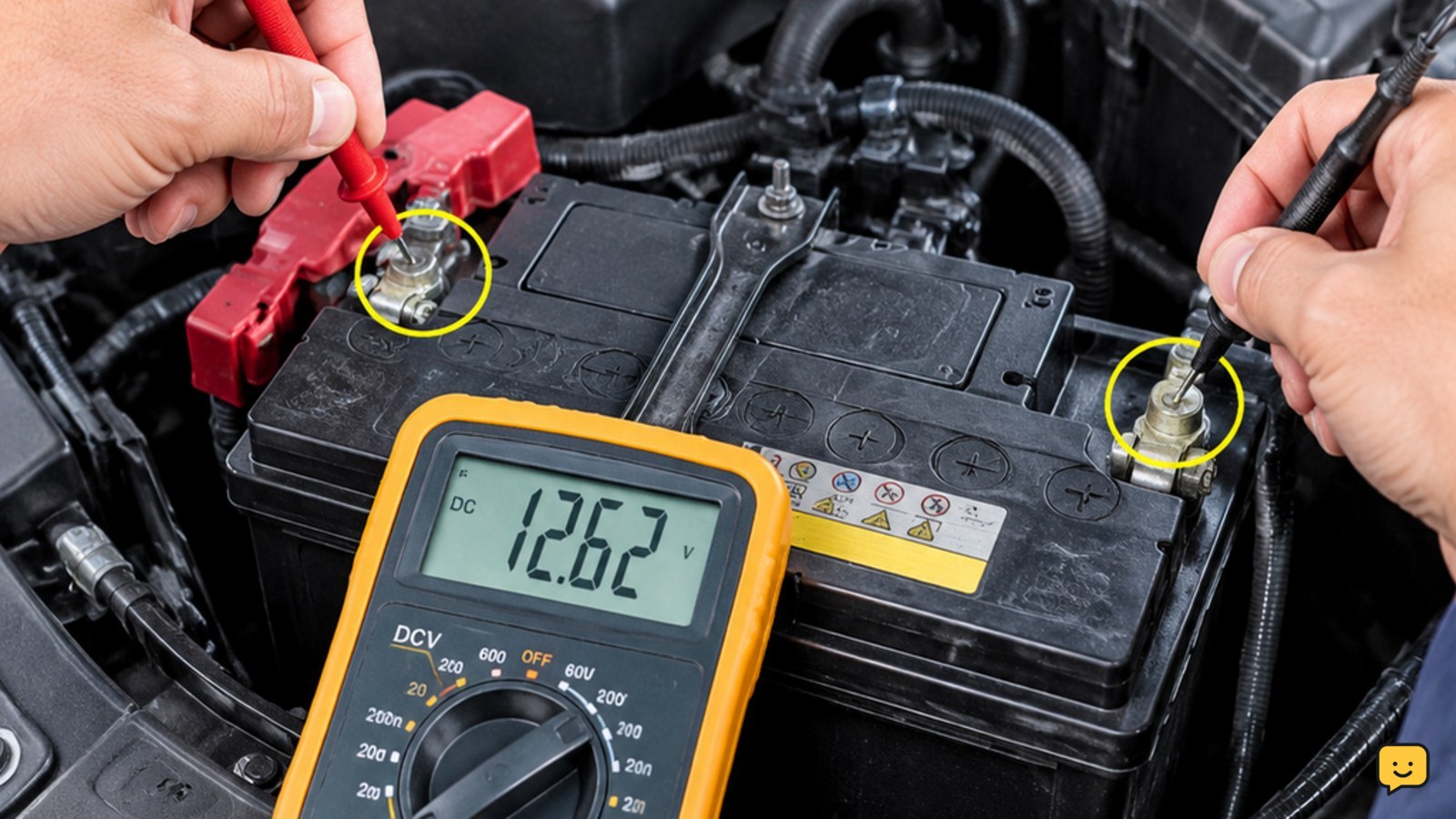
- Inspect the case for swelling, cracks, leakage, or corrosion around the terminals.
- Clean loose corrosion and make sure both terminal connections are tight. Do not force a damaged terminal.
- Check the battery age. If it is near or beyond the replacement interval listed by the manufacturer, request a battery load or conductance test.
- Have the charging system tested after the engine starts. A healthy alternator must restore charge while driving, but an alternator test alone does not rule out overnight drain.
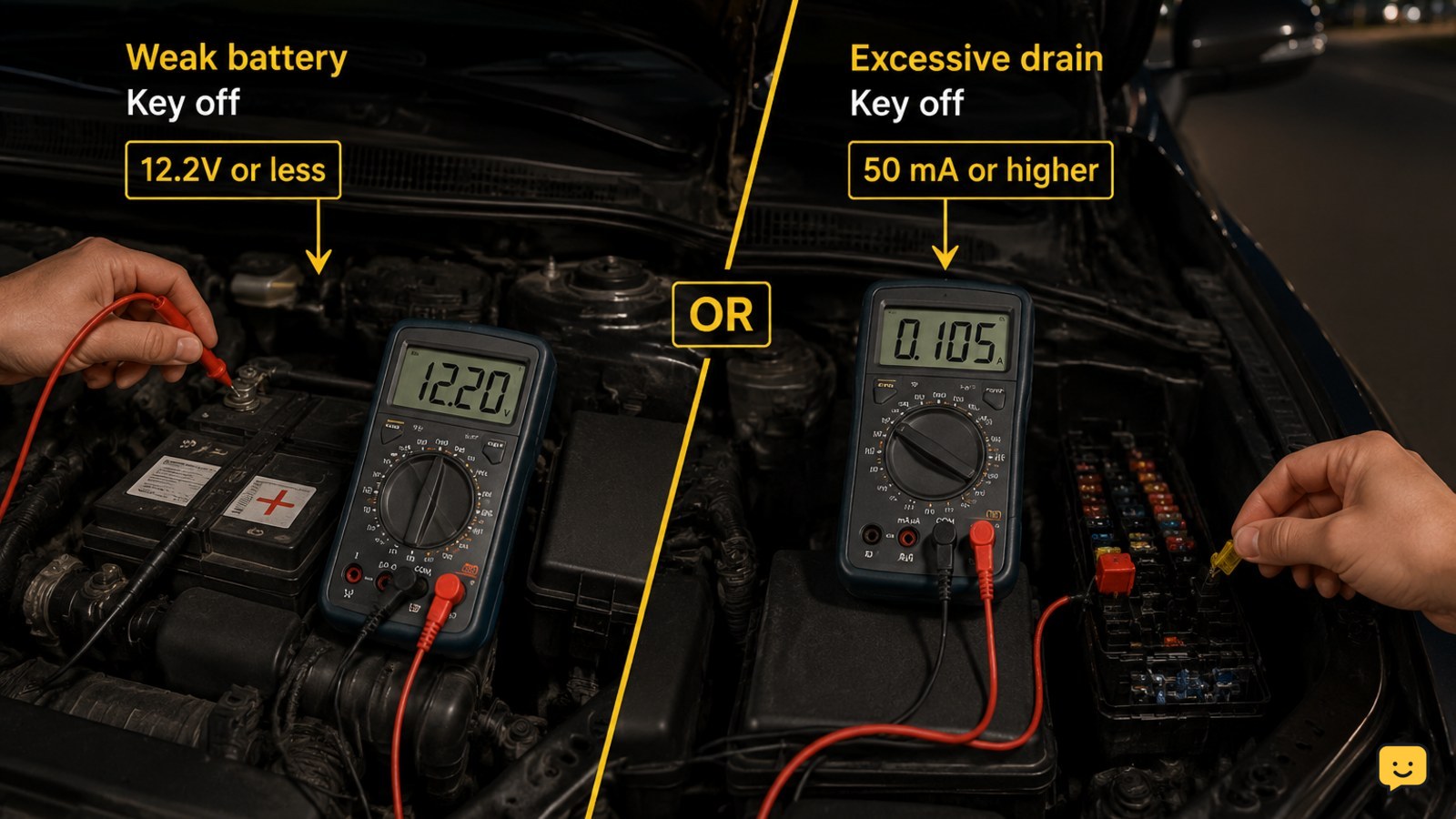
Verification: A battery that fails a proper load test should be replaced before chasing a parasitic drain. A battery that passes but repeatedly goes flat while parked needs a key-off current-draw test.
3. Check the easy overnight drain causes first
Start with items that can remain powered because of a switch, latch, relay, or installation fault. A forgotten interior, trunk, vanity, or glove-box light is a common cause. Some lights are difficult to see in daylight, so use the vehicle’s interior-light-off setting where available and check the trunk and glove box after closing them.
- Remove all USB chargers, phone adapters, portable refrigerators, inverters, and other plugged-in accessories.
- Turn off dash cams, GPS trackers, Bluetooth adapters, and aftermarket stereos. A dash cam may continue recording through a parking-mode kit.
- Check that the trunk, hood, and doors latch fully and that their warning indicators go out.
- Look for water intrusion, damaged wiring, or accessories installed near the fuse box or battery.
- Confirm that the vehicle is fully off and that no cooling fan, pump, screen, or warning light remains active after the normal shutdown period.
Leave suspect accessories disconnected for one night, then compare the morning result. If the battery survives, reconnect one item at a time until the failure returns.
4. Measure key-off current draw safely
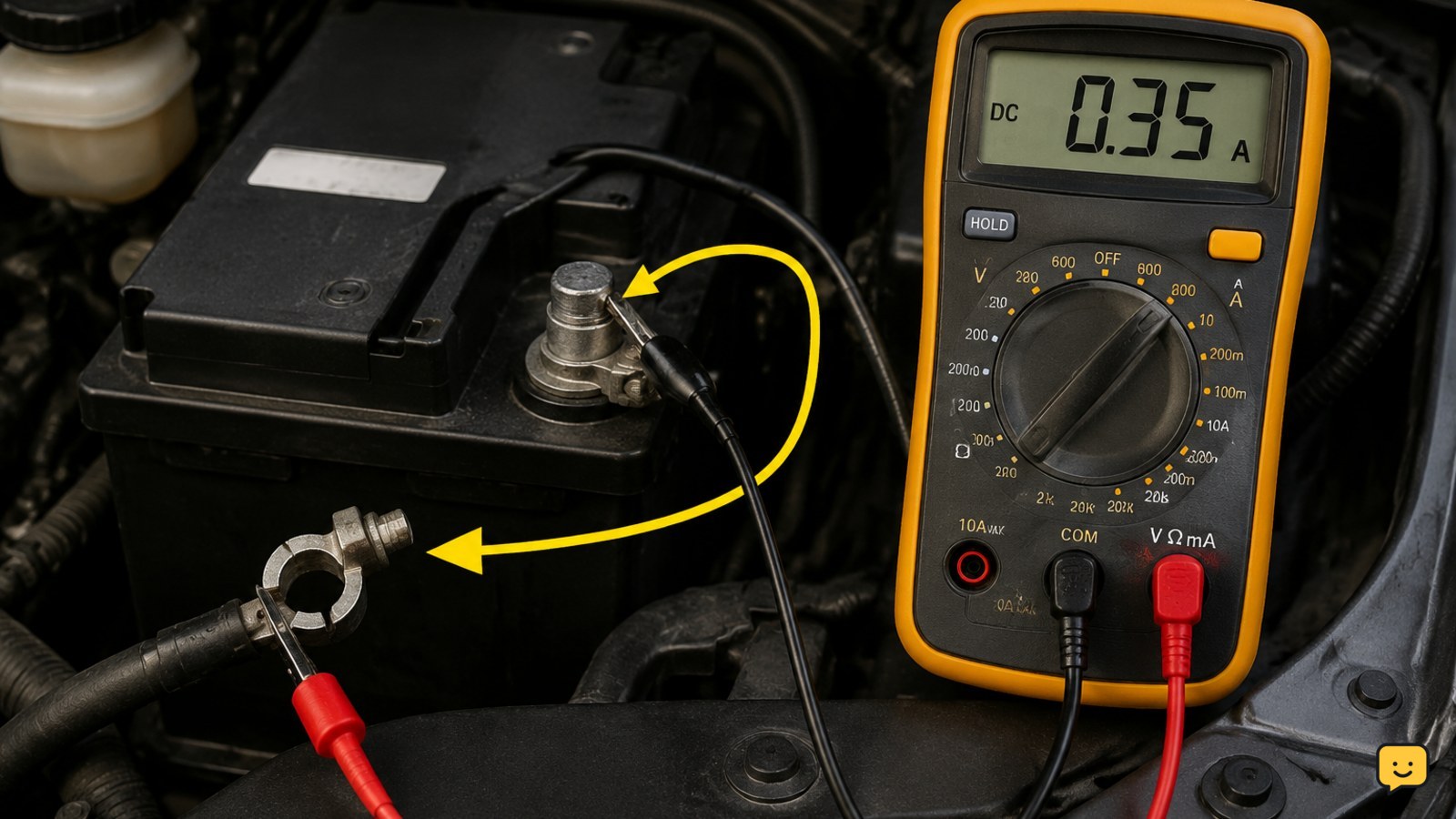
This test checks for parasitic electrical drain: current used after the vehicle is switched off and its control modules have gone to sleep. Modern vehicles may stay awake for several minutes, so follow the wait time in the owner manual before recording a result.
- Charge the battery and switch off every load. Close the doors and latch the hood or use the manual’s procedure to simulate closed latches.
- Set the multimeter to its highest fused DC-current range. Move the red lead to the meter’s correct current socket.
- Disconnect the negative battery cable and connect the meter in series between the negative post and the removed cable. Never place the meter directly across the positive and negative posts while measuring current.
- Lock the vehicle if safe to do so, keep the key away from it, and wait for the specified sleep period. Do not open doors or press the remote during the test.
- Record the settled reading and compare it with the vehicle manufacturer’s specification. A reading above specification indicates a drain, but the correct limit varies by vehicle and equipment.
Verification: If the reading is within specification and the battery still dies, return to battery, alternator, terminal, and charging checks. If it is above specification, continue by isolating circuits.
5. Isolate the fuse or circuit causing the drain
With the meter still connected and the vehicle asleep, remove one fuse at a time, then reinstall it before moving to the next. Record any substantial drop in current. Use the fuse diagram in the manual because several fuse boxes may exist, and some circuits must not be interrupted during testing.
When one fuse changes the reading, identify every component on that circuit before replacing anything. Possible causes include an aftermarket accessory, stuck relay, faulty switch, control module that fails to sleep, or wiring damage. A fuse that has already blown is also a clue, but replacing it with a larger fuse is unsafe.
If removing fuses does not locate the drain, the fault may be on a fusible link, alternator circuit, unfused accessory, or a module that wakes intermittently. This is the point to stop and arrange professional diagnosis.
6. Fix the cause and verify the repair
Repair or disconnect the identified accessory, replace a failed switch or relay, correct damaged wiring, or replace the battery if it failed testing. Use the correct replacement fuse and battery type from the vehicle manual. Some vehicles require battery registration after replacement.
- Fully charge the battery again.
- Repeat the key-off current-draw test after the vehicle reaches sleep mode.
- Confirm that the reading is within the manufacturer’s specification.
- Leave the vehicle parked for at least one normal overnight period.
- Start it the next morning and check for warning lights or new electrical symptoms.
If the battery goes flat again, do not keep jump-starting it without finding the cause. Repeated discharge can leave a new battery unreliable and may conceal an unresolved charging or wiring fault.
Frequently asked questions
Can a bad alternator drain a car battery overnight?
Yes. An alternator can fail to charge the battery, and a damaged alternator diode can allow current to flow backward while the engine is off. Test the charging system and key-off draw separately. If disconnecting the alternator circuit changes an above-specification current reading, professional alternator diagnosis is appropriate.
How can I tell whether the battery or the car is at fault?
Test the battery after fully charging it. If it fails a proper load test, the battery is defective or worn out. If it passes but loses charge while parked, measure key-off current draw. A draw above the vehicle manufacturer’s specification points to the car or an installed accessory.
Will driving the car recharge a battery that died overnight?
A drive may restore some charge, but it may not fully recharge a deeply discharged battery. Use a suitable battery charger, then test the battery and charging system. Continuing to drive without finding the drain can discharge the battery again and shorten its service life.
Can a dash cam cause a battery to die overnight?
Yes. A dash cam can continue using power in parking mode, especially when connected to a constant-power fuse or an incorrectly configured hardwire kit. Disconnect the camera and its adapter for one overnight test. If the battery survives, verify the kit’s low-voltage cutoff and installation.
Browse more Maintenance & Repair guides for help with this topic.