CV axle change cost commonly falls between $250 and $800 per side in 2026. Parts may cost about $55–$700, while labor is often $90–$350 or roughly 1.5–3 hours. A shop quote can rise for luxury, four-wheel-drive, or difficult-to-remove axles. Confirm the diagnosis, exact side, parts quality, labor rate, and added fees before approving work.
For more help with this topic, use the Maintenance Repair guides.
Check the typical CV axle replacement range
CV axle replacement commonly costs about $250–$800 per side. Detroit Axle lists that as a realistic 2026 range, with parts from about $55–$700 and labor from $90–$350. AutoZone gives a narrower parts estimate of roughly $60–$150 and labor of about $150–$350 for many vehicles.
These figures are estimates, not a guaranteed price. The vehicle’s drivetrain, axle design, local labor rate, original-equipment or aftermarket part, seized fasteners, and taxes can move the final bill. A quote near the low end may describe an aftermarket axle and uncomplicated labor; a higher quote may involve a costly vehicle-specific part or difficult access.
Separate the part cost from labor and fees
The axle itself is only one line in the estimate. Ask the shop to show the part number, part price, labor hours, hourly rate, shop supplies, disposal charges, tax, and warranty. AutoZone’s published estimate of 1.5–3 labor hours explains why two shops can quote different totals even when they use similar parts.
Confirm whether the price is for one side. Replacing one failed axle does not automatically mean the other side needs replacement. If both axles show separate damage, request a written explanation and a combined labor quote rather than assuming the second side costs exactly the same.
Also ask whether the quote includes a new axle nut, seal, or transmission-fluid top-off where the vehicle manufacturer’s procedure requires one. Those items may be small compared with labor, but they should be clear before approval.
Verify that the axle is actually the failed component
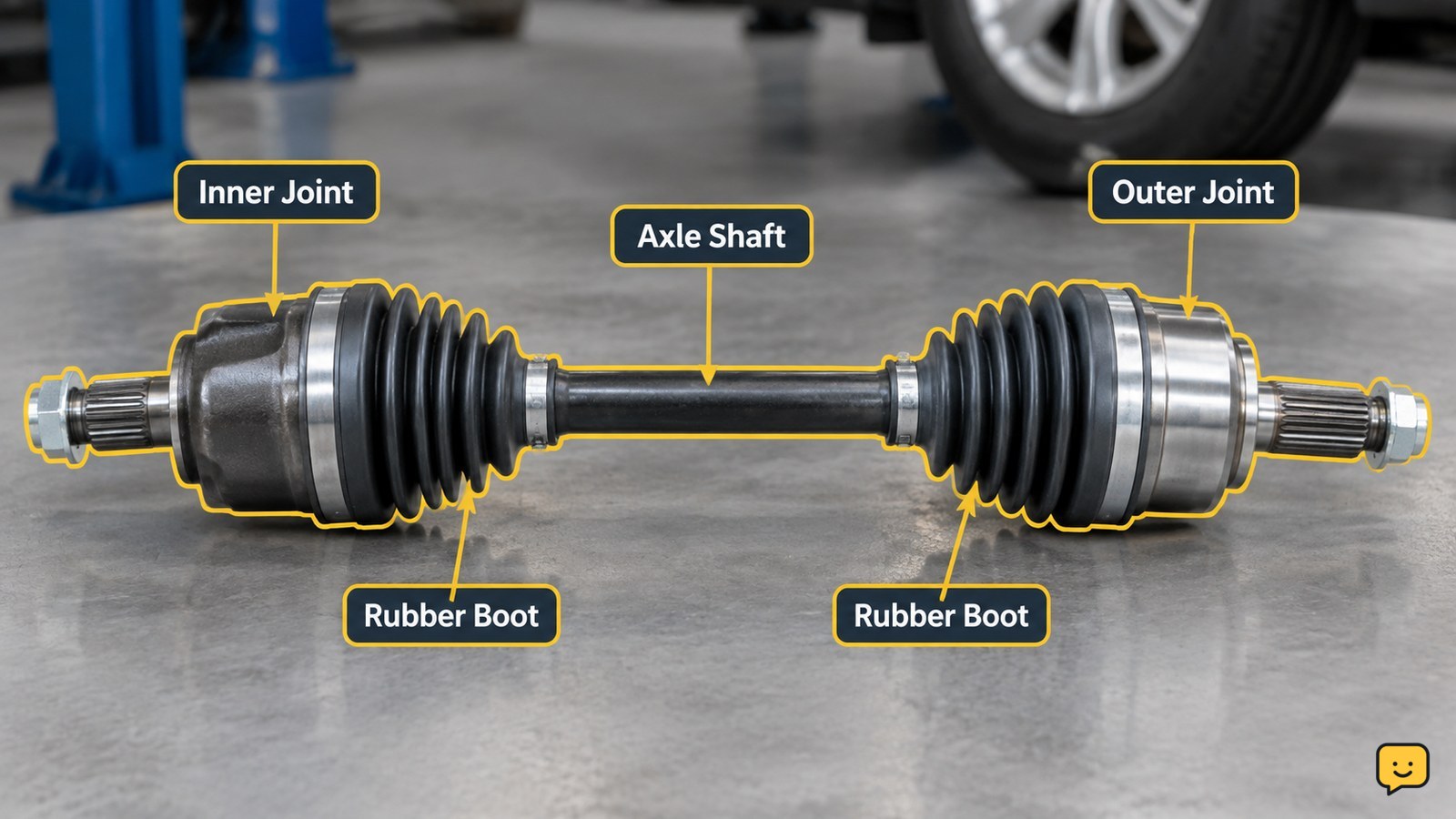
A clicking or popping sound during a tight turn often supports a worn outer CV joint, while vibration under acceleration can be consistent with an inner joint or axle problem. Those symptoms are useful clues, not proof. A torn boot, grease sprayed around the wheel well, play in the joint, or a visibly bent shaft gives the inspection stronger support.
Take a slow, cautious turn in an empty area only if the vehicle is otherwise controllable. Note whether the noise occurs on left turns, right turns, acceleration, deceleration, or straight roads. If the sound is present over bumps, during braking, or with wheel looseness, the cause may instead involve the suspension, wheel bearing, brake, tire, or steering system. For a focused explanation of turning clicks, see how to check clicking when turning.
Failure branch: If the shop cannot identify which joint or axle is faulty, ask for the inspection findings and a second opinion before authorizing replacement. Do not pay for an axle solely because a noise exists.
For a focused explanation of turning clicks, see how to check clicking when turning.
Compare a boot repair with complete axle replacement
A CV boot repair can cost less when the boot is torn but the joint has not lost lubricant or developed noise. Once dirt has entered the joint, grease has been lost for an extended period, or clicking and play are present, a complete replacement axle is often the more practical estimate to compare. The supplied AutoZone evidence identifies replacement axle shafts as a common parts option rather than establishing one universal repair choice.
Ask the technician whether the joint is quiet and tight, whether contamination is visible, and whether the boot damage is recent. A boot-only quote should identify the boot kit, replacement grease, clamps, and labor. A complete-axle quote should identify the replacement assembly and warranty.
Stop condition: Do not choose the cheapest option if the axle is badly damaged, the vehicle vibrates severely, or the joint is separating. Have the vehicle transported for inspection instead of testing it on public roads.
Use these checks to judge a shop quote
A reasonable CV axle quote should state the exact vehicle application, affected side, axle brand or quality level, labor hours, warranty, and final total. Compare at least two written estimates when the vehicle remains safe to drive, but compare like for like: an economy aftermarket axle and an OEM axle are not equivalent parts.
Ask whether the shop found damaged wheel seals, a leaking transmission seal, a worn hub, or stripped axle hardware. A related repair can be legitimate, but it should be documented separately. An alignment is not automatically required for every axle replacement; ask why one is being recommended and whether steering or suspension parts were disturbed.
If the estimate changes after disassembly, request photos or a clear description of the newly discovered fault. Approve additional work only when the safety or mechanical reason is understandable.
Know when driving to the repair shop is unsafe
Driving a short distance may be reasonable only when the vehicle has normal steering and braking, no severe vibration, no major fluid leak, and no loose or separated axle component. Keep the trip short and avoid hard acceleration, tight turns, and high speeds.
Do not drive when the clicking has become a heavy clunk, the axle visibly moves abnormally, grease or fluid is rapidly leaking, the wheel is loose, or the vehicle pulls or shudders strongly. Use a tow service instead. If a wheel or brake concern is also suspected, review these safe wheel and jack checks, but never lift the vehicle without proper support.
If a wheel or brake concern is also suspected, review these safe wheel and jack checks, but never lift the vehicle without proper support.
Frequently asked questions
Is $500 a fair price for a CV axle replacement?
Yes, $500 can be a reasonable one-side price when it includes the axle, labor, taxes, and warranty. Compare the labor hours, hourly rate, axle brand, and any added seal or hardware charges. A lower or higher total can also be fair when the vehicle uses an unusually expensive axle or requires difficult removal.
Can I replace a CV axle instead of the CV joint?
Often, yes. A complete replacement axle is commonly compared with rebuilding or replacing only a joint because it can simplify parts and labor. A boot-only repair may make sense when damage is caught early and the joint is quiet and tight. Ask for the inspection reason before choosing between the options.
Should both CV axles be replaced at the same time?
Not automatically. Replace both only when both assemblies show confirmed wear, boot damage, or other faults, or when a technician gives a vehicle-specific reason. One failed axle does not prove the other has failed. Request separate findings and prices for each side.
Can a bad CV axle damage the transmission?
It can create additional problems if the axle or its seal is damaged, removed incorrectly, or allowed to separate, but the repair risk depends on the vehicle. Ask whether the transmission seal, fluid level, and axle seating were checked. A heavy leak or separated axle is a reason to tow the vehicle.