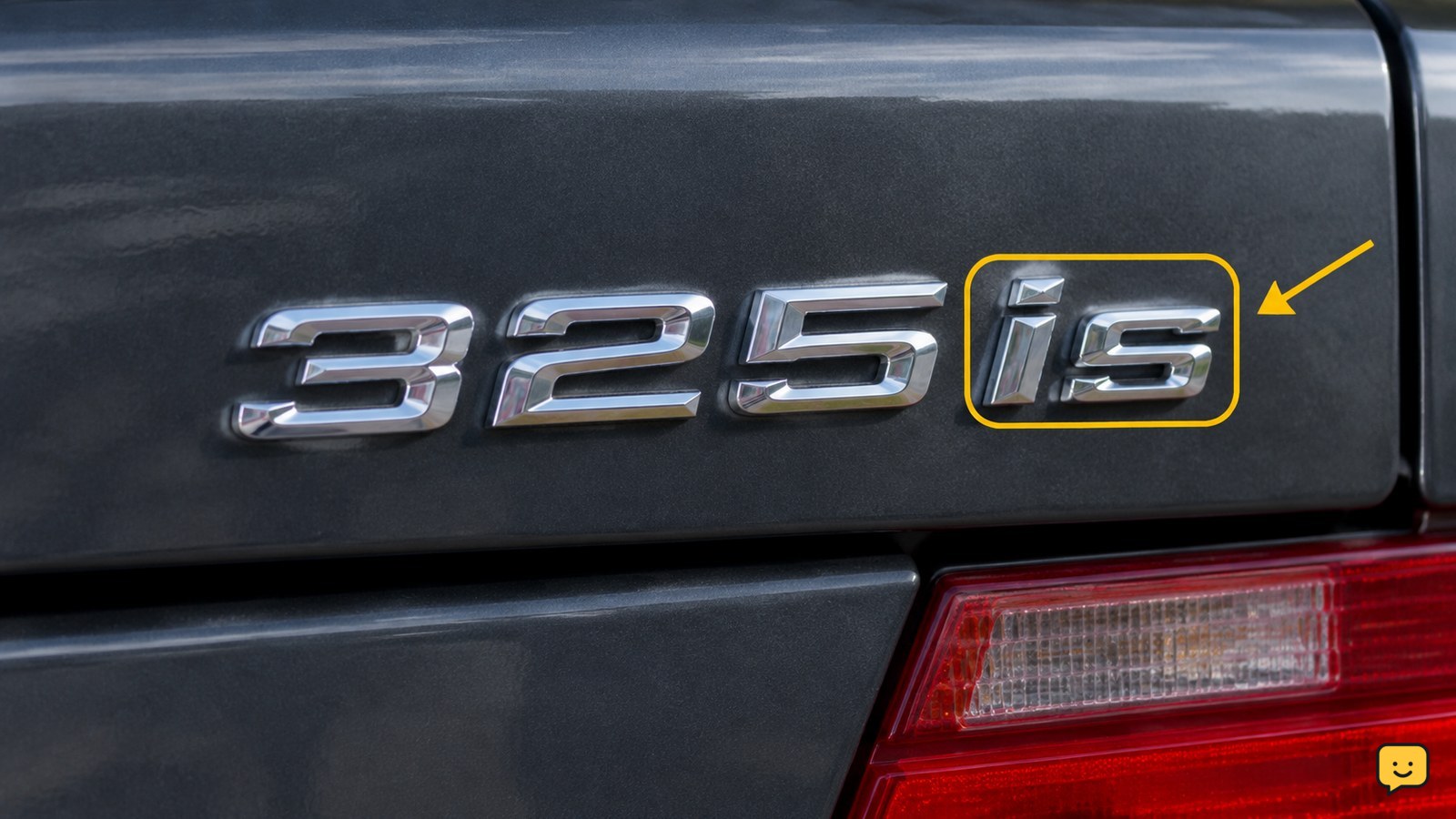
In BMW model badges, “is” generally identifies a sport-oriented version. On older cars, it is often explained as “injection sport” or used to distinguish a sportier coupe from a related sedan, depending on the model and market. BMW has not used “is” as one universal, consistently defined designation, so verify the exact year and model before relying on it.
For more help with this topic, use the Features Controls guides.
Use “is” as a sport-variant clue, not a universal translation
BMW’s “is” suffix usually signals a sport-oriented version of a model, but the letters do not translate identically across all BMW generations. Older references commonly explain “is” as “injection sport,” while North American discussions also describe it as a way to separate a sportier coupe from a related sedan. Those explanations can overlap, but neither should be treated as a universal BMW rule.
The safest plain-English reading is sport-focused model variant. The exact equipment depends on the model, production year, body style, and market. A badge can suggest the car’s position in the range, but it does not by itself confirm a specific engine or package.
Check the complete badge before interpreting the letters
The number and the body style matter as much as the “is” suffix. For example, “318is” and “325is” identify different BMW model families even though both use the same two letters. Do not remove the number from the interpretation.
- Read every character. Note the full badge, including numbers, lowercase or uppercase lettering, and any additional M, xDrive, or competition marking.
- Identify the body style. A coupe, sedan, convertible, touring, or hatchback may use related naming in different markets.
- Check the market. A designation used in North America may not carry the same product meaning in Europe or another region.
- Confirm the year. BMW naming conventions changed across generations, so an older “is” badge should not be mapped directly onto a newer model.
These checks prevent a common mistake: assuming that two cars with “is” in the badge share the same suspension, brakes, engine, or trim.
Separate “is” from BMW’s other performance designations
BMW’s “is” badge is not interchangeable with every other performance label. A car may also carry an M designation, an M Sport package, xDrive, or a market-specific trim name. These labels describe different aspects of the vehicle and can appear together or separately.
Use the badge as a starting point, then verify the actual specification. For maintenance, compare the VIN with BMW parts information or the vehicle’s documentation. For a purchase, ask for the build sheet or factory specification rather than accepting a seller’s claim that “is” automatically means a particular engine, differential, or brake package.
Verify a disputed badge with the VIN and records
The VIN is the reliable next check when the badge, listing, or paperwork disagrees. Match the VIN against the registration, title, service records, and model-specific parts catalog. The owner’s manual may confirm the model family, but it may not list every factory option.
Use this decision rule:
- Badge and VIN agree: continue with model-specific research.
- Badge and listing disagree: trust neither description until the VIN is checked.
- Badge is missing or replaced: identify the car from the VIN and body details, not from the trunk lettering.
- Parts fitment is uncertain: provide the VIN to a BMW parts specialist before ordering.
BMW-related reference pages consistently translate the manufacturer’s name, Bayerische Motoren Werke, as Bavarian Motor Works, but that does not establish one official expansion for every model suffix. The supplied Cars.com and BMW dealer references support the manufacturer-name translation; the “is” interpretation remains model- and market-dependent.
Know when the “is” explanation does not apply
Do not apply the older “injection sport” explanation to every modern BMW that contains the letters “i” and “s.” BMW badges can combine letters for different naming systems, and a lowercase “i” may relate to the model designation rather than a standalone “is” suffix.
If you are decoding a current BMW, identify the full model name and generation first. If you are checking an older 3 Series coupe or sedan, historical naming explanations may be useful, but they still do not replace VIN-based equipment verification. When the badge has been changed, removed, or added by an owner, treat it only as decoration until the records confirm the car’s identity.
Frequently asked questions
Does BMW officially define “is” as “injection sport”?
Not as one universal definition that applies to every BMW model and market. “Injection sport” is a common historical explanation for older badges, but the suffix has also been used to identify a sportier variant or body style. Confirm the individual model’s documentation before treating that phrase as official.
Is a BMW with an “is” badge an M car?
No. An “is” badge does not automatically make a BMW an M model. M cars and M Sport packages use separate designations, although an older “is” version may have sport-focused equipment. Check the VIN and factory specification to identify the actual trim and mechanical components.
Does “is” mean the BMW is a coupe?
Sometimes, especially in older North American naming discussions, “is” helped distinguish a sportier coupe from a related sedan. It is not a dependable rule for every BMW generation. The full badge, body style, market, and VIN must be checked together.
Can I order parts from the BMW “is” badge alone?
No. Use the VIN or complete vehicle specification before ordering parts. BMW versions with similar “is” lettering can have different engines, brakes, suspension components, transmissions, and body panels.