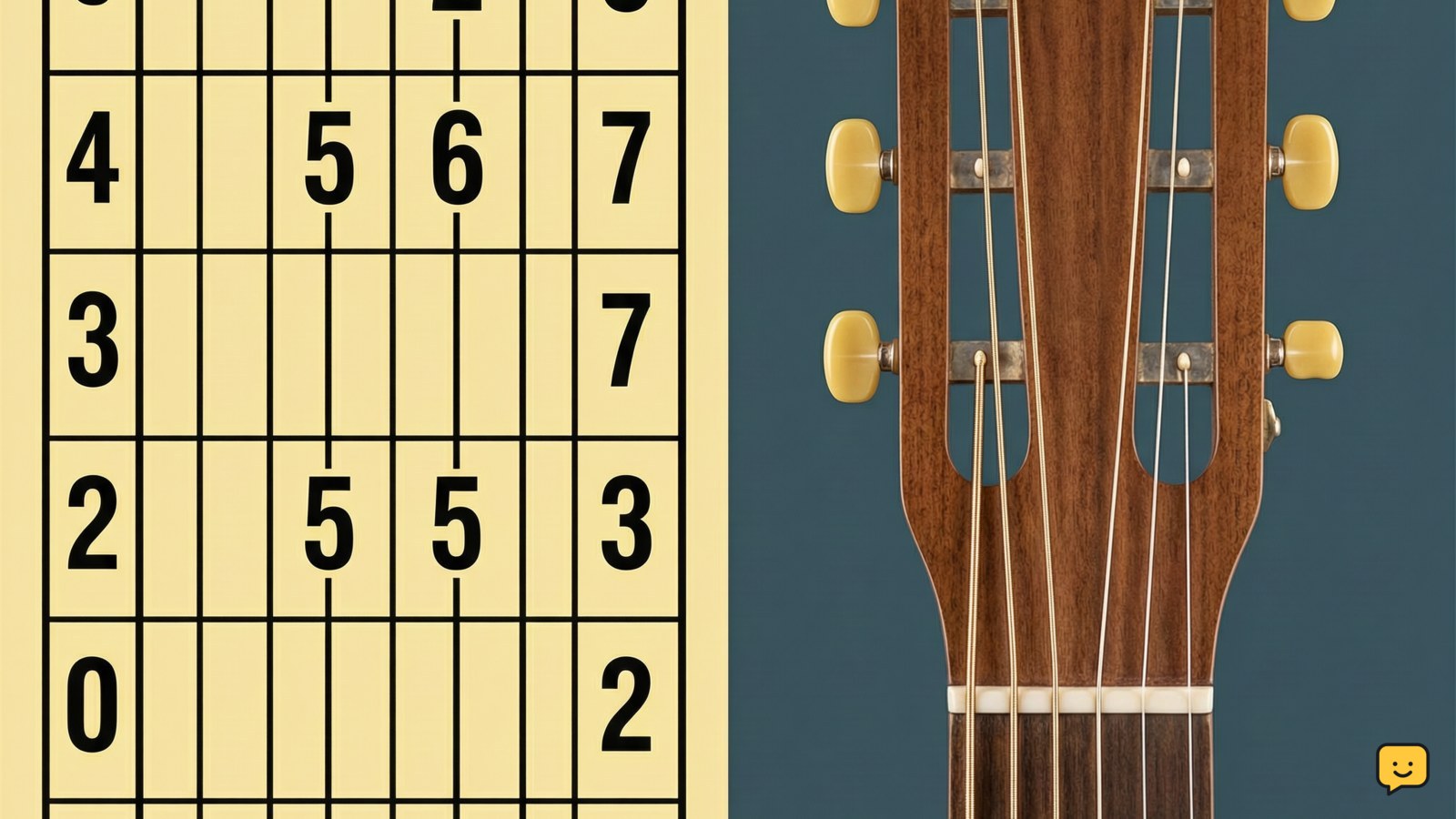
To read guitar tabs, treat the six horizontal lines as the guitar strings: the top line is the thinnest high-e string, and the bottom line is the thickest low-E string. Numbers tell you which fret to press. Read from left to right, play numbers stacked vertically together, and use symbols such as 0, x, h, p, /, and b as technique instructions.
For more help with this topic, use the Learning Study guides.
Identify each tab line and fret number
Guitar tablature uses six horizontal lines to represent the six strings. In the usual layout, the top line is the high-e string, the thinnest string, and the bottom line is the low-E string, the thickest string. The line positions do not describe pitch by themselves; they tell you which physical string to play.
A number on a line tells you which fret to press on that string. 0 means play the string open, without pressing a fret. A two-digit number such as 10 means fret 10, not frets 1 and 0. The numbers are fret locations, so they do not tell you which finger to use.
e|----------------|
B|----------------|
G|----------------|
D|--------2-------|
A|------2---------|
E|--0-------------|
This example starts with the open low-E string, then plays fret 2 on the A string and fret 2 on the D string. Read the tab from left to right, as School of Rock explains for beginner tablature.
Read notes in sequence and chords together
Numbers placed from left to right are played in sequence. Numbers aligned vertically are played at the same time, creating a chord or a multi-string hit. Yamaha notes that tab commonly lines up with bar lines and measures when standard notation appears alongside it.
e|--0-------------|
B|--1-------------|
G|--0-------------|
D|--2-------------|
A|--3-------------|
E|----------------|
Here, the five numbers form one simultaneous shape: an open G string, fret 1 on the B string, an open high-G string, fret 2 on the D string, and fret 3 on the A string. The blank low-E line is not played in this example.
When the same fret appears on several lines at once, place your fingers first, then strum or pick the indicated strings together. When numbers are staggered horizontally, pick each note in the order shown.
Use the tab’s rhythm and spacing carefully
Tab tells you where to play notes, but spacing alone does not always provide exact rhythm. Look for a time signature, rhythmic stems, note values, bar lines, or an audio reference. Songsterr’s tab guide identifies the time signature as the fraction at the beginning of a piece; its top number indicates how many beats are counted in each measure.
Count a simple four-beat measure as 1, 2, 3, 4 before increasing speed. If several notes are close together but no rhythm markings are supplied, do not treat their visual distance as a precise timing instruction. Follow the recording or a version with rhythm notation instead.
Start slowly enough to keep every note clean. A correct sequence played unevenly is not yet a reliable performance, so use a steady count or metronome when the tab includes a clear tempo.
Decode common guitar tab symbols
Common guitar tab symbols describe what to do between or around the numbered frets, but the exact legend can differ by publisher. Check the tab’s own legend before relying on an unfamiliar mark.
| Symbol | Meaning | Action |
|---|---|---|
| 0 | Open string | Play without fretting. |
| x | Muted or dead note | Touch the string without pressing it fully, then strike it for a muted sound. |
| h | Hammer-on | Pick the first note, then fret the higher note with another finger without picking it again. |
| p | Pull-off | Sound a fretted note, then release to a lower fretted note or open string. |
| / or \ | Slide | Play the first note and move along the string to the destination fret. |
| b | Bend | Raise the pitch by pushing or pulling the string as marked. |
For example, 5h7 means pick fret 5 and hammer on to fret 7. A marking such as 7/9 indicates a slide from fret 7 to fret 9. Pickup Music describes bend notation as raising pitch by moving the string upward or downward by the indicated amount.
Play one short tab phrase and verify it
Use this sequence to turn a written tab into an accurate first attempt:
- Check the tuning. Confirm whether the tab uses standard tuning or names another tuning.
- Find the first number. Match its line to the correct string and place the required finger behind the fret.
- Read left to right. Play one note at a time unless numbers share the same vertical position.
- Separate technique from pitch. Apply a slide, bend, hammer-on, pull-off, or mute only where the notation marks it.
- Repeat slowly. Increase speed only when the notes ring cleanly and unwanted strings remain quiet.
Your first verification is physical: the correct string should vibrate, the fret should not buzz, and a simultaneous group should sound together. If the result does not match the reference recording, check the tuning, string order, fret number, and whether a symbol was overlooked.
Fix common reading mistakes before speeding up
Most beginner tab errors come from confusing string order, sequence, and timing. Use the symptom to choose the next check:
| What you hear or see | Likely cause | Next action |
|---|---|---|
| The whole phrase sounds too low or too high. | The guitar is tuned differently from the tab. | Check the stated tuning and retune before changing finger positions. |
| A chord sounds incomplete. | A vertically aligned number was skipped. | Read down the stack and identify every string that should sound. |
| The notes are correct but the rhythm feels wrong. | The tab has limited rhythm information. | Use the time signature, count the beats, or consult a version with rhythm notation. |
| Extra strings ring out. | Unplayed strings are not being muted. | Relax the fretting hand, lightly touch unwanted strings, and pick only the marked strings. |
| A technique sounds unlike the recording. | The symbol or its legend was misunderstood. | Read the source’s legend and practice the marked motion slowly. |
Stop treating the tab as sufficient when it omits tuning, rhythm, or a symbol key for a technically important passage. In that case, use a clearer edition or compare the passage with a legitimate audio reference.
Frequently asked questions
Which line is the thickest guitar string in tab?
The bottom line normally represents the thickest low-E string. The top line represents the thinnest high-e string. This layout can feel reversed because the lowest physical string is shown at the bottom, so identify the string labels before playing.
What does 0 mean in guitar tabs?
The number 0 means play that string open. Do not press a fret. Pick the indicated string and let its open pitch sound. If several zeros are vertically aligned, play those open strings together.
How do you know when to play two tab numbers together?
Numbers stacked vertically are played at the same time. Numbers arranged horizontally are played one after another from left to right. A vertical stack may represent a full chord, a partial chord, or a simultaneous two-note shape.
Can you read guitar tabs without knowing standard music notation?
Yes. Tab directly shows the string and fret, so you can begin without reading staff notation. You still need another timing source when the tab does not include rhythm markings, such as a count, recording, or notation with note values.