
Rotate most tires every 5,000 to 8,000 miles, following the vehicle owner’s manual when its interval differs. Rotate sooner if the tires show uneven wear or the vehicle has unusual pulling, vibration, or noise. Use only the rotation pattern approved for your tire and wheel setup, then verify pressure and lug-nut security before driving.
For more help with this topic, use the Maintenance Repair guides.
Check the manual before choosing an interval
The owner’s manual is the controlling source for your vehicle’s tire-rotation schedule and pattern. If it gives a mileage or service interval, use that instruction even when it differs from a general recommendation.
When no more specific schedule is available, many tire manufacturers recommend rotating tires between 5,000 and 8,000 miles, according to Jiffy Lube’s tire-maintenance guidance. Use the lower end when you want a simple conservative reminder, but do not treat the range as permission to ignore the manual.
Record the odometer reading and date after each rotation. A maintenance record prevents the interval from becoming a guess, especially when different drivers use the vehicle.
Choose the correct rotation pattern
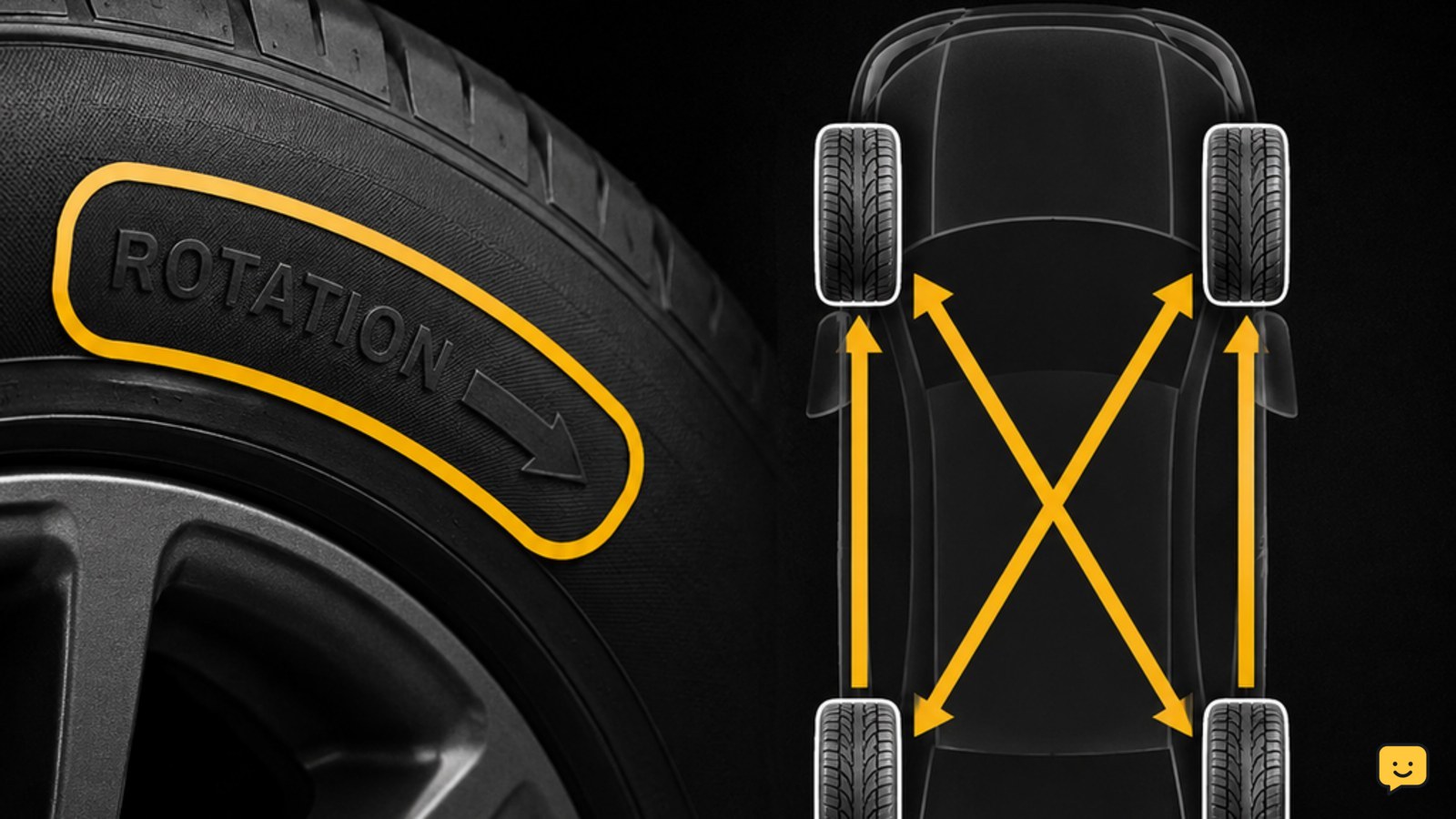
The correct tire-rotation pattern depends on the tire and wheel arrangement, so identify the setup before removing any wheel. The manual may specify a front-to-back movement, a cross pattern, or no front-to-rear swap for a particular configuration.
Directional tires have sidewall arrows showing the required direction of travel. They generally remain on the same side and move only where the approved pattern allows. Different-size front and rear tires may also be restricted to their original axle.
Do not use a generic diagram when the manual shows a different arrangement. If the tire sizes, tread direction, or approved pattern are unclear, stop and have a tire shop identify the correct placement.
Inspect tread and pressure before moving wheels
Inspect each tire before rotation because moving a damaged tire can hide the problem or place it where it is harder to notice. Look across the tread and sidewall for cuts, bulges, exposed cords, embedded objects, or a visibly low tire.
Compare tread wear across the inner edge, center, and outer edge. Wear concentrated on one edge, cupping, scalloping, or a single tire that is much more worn than the others can indicate alignment, balance, suspension, inflation, or tire damage rather than a routine rotation need.
Measure pressure when the tires are cold and set it to the vehicle placard or owner’s-manual value. Do not use the maximum pressure molded into the sidewall as the normal vehicle setting.
Rotate the tires with supported wheel positions
Secure the parked vehicle with wheel chocks, loosen lug nuts slightly while each wheel is on the ground, and lift only at the manufacturer’s marked jack points. Support the vehicle with jack stands before removing wheels; never work under a vehicle supported only by a jack.
- Mark each wheel’s original position if the approved pattern is not already written down.
- Move each tire to its assigned position without reversing a directional tire or violating a front/rear size restriction.
- Start every lug nut by hand to avoid cross-threading.
- Lower the vehicle until the tires contact the ground, then tighten the lug nuts in the manufacturer’s specified sequence and torque.
The exact torque value is vehicle-specific. Find it in the owner’s manual or service information rather than guessing. If you lack suitable stands or a torque wrench, have the rotation completed by a qualified tire shop.
Verify the work before driving
A completed rotation should leave every tire in the manual-approved position, with the correct tread direction and no visible damage. Check all four pressures again and replace valve caps that are missing or damaged.
Confirm that every lug nut is installed and tightened to the vehicle specification. After a short, low-speed check in a safe area, listen for new rubbing or thumping and confirm that the steering feels normal.
Recheck lug-nut torque using the manufacturer’s procedure after the initial drive if the manual or tire shop instructs you to do so. Do not continue driving if a warning light remains, a tire loses pressure, or the vehicle pulls or vibrates.
What to do if wear or vibration remains
Rotation does not correct an alignment, balance, suspension, or tire defect. If the same edge continues wearing quickly, schedule an alignment and suspension inspection instead of shortening the rotation interval indefinitely.
If the steering wheel shakes, especially at road speed, check tire pressure and stop for a professional inspection when the vibration is strong, sudden, or accompanied by handling changes. A related guide explains how to separate likely tire, wheel-balance, alignment, and suspension causes: {link}
If a tire must be replaced because of damage, use the vehicle and tire manufacturer’s fitment guidance. For a roadside puncture or flat, follow the safe wheel-changing procedure here: {link}
A related guide explains how to find the cause of steering vibration when uneven wear or a road-speed shake remains.
Frequently asked questions
Is rotating tires every 5,000 miles too often?
No, a 5,000-mile rotation is generally within the 5,000-to-8,000-mile range cited by Jiffy Lube, but your owner’s manual takes priority. Rotating at the lower end can make the schedule easier to remember. Inspect the tires at each service and address uneven wear rather than relying on rotation alone.
Should tires be rotated by time or mileage?
Use mileage when the vehicle is driven regularly, but use the manual’s time-based service guidance when mileage is low or the vehicle sits for long periods. Tires can develop age- or storage-related problems even when they have few miles. Inspect them before every planned rotation.
Can directional tires be rotated from side to side?
Usually not by simply crossing them to the opposite side, because the tread must continue pointing in its marked direction of travel. Follow the manual or tire manufacturer’s pattern. If the setup prevents an approved rotation, ask a tire professional to confirm whether a front-to-back move is allowed.
Do new tires need to be rotated sooner?
Use the vehicle’s normal schedule unless the tire or vehicle manufacturer specifies another interval. Check pressure frequently after installation and inspect for uneven wear. If one new tire loses pressure, pulls, vibrates, or wears differently, stop treating it as a routine rotation issue and arrange an inspection.