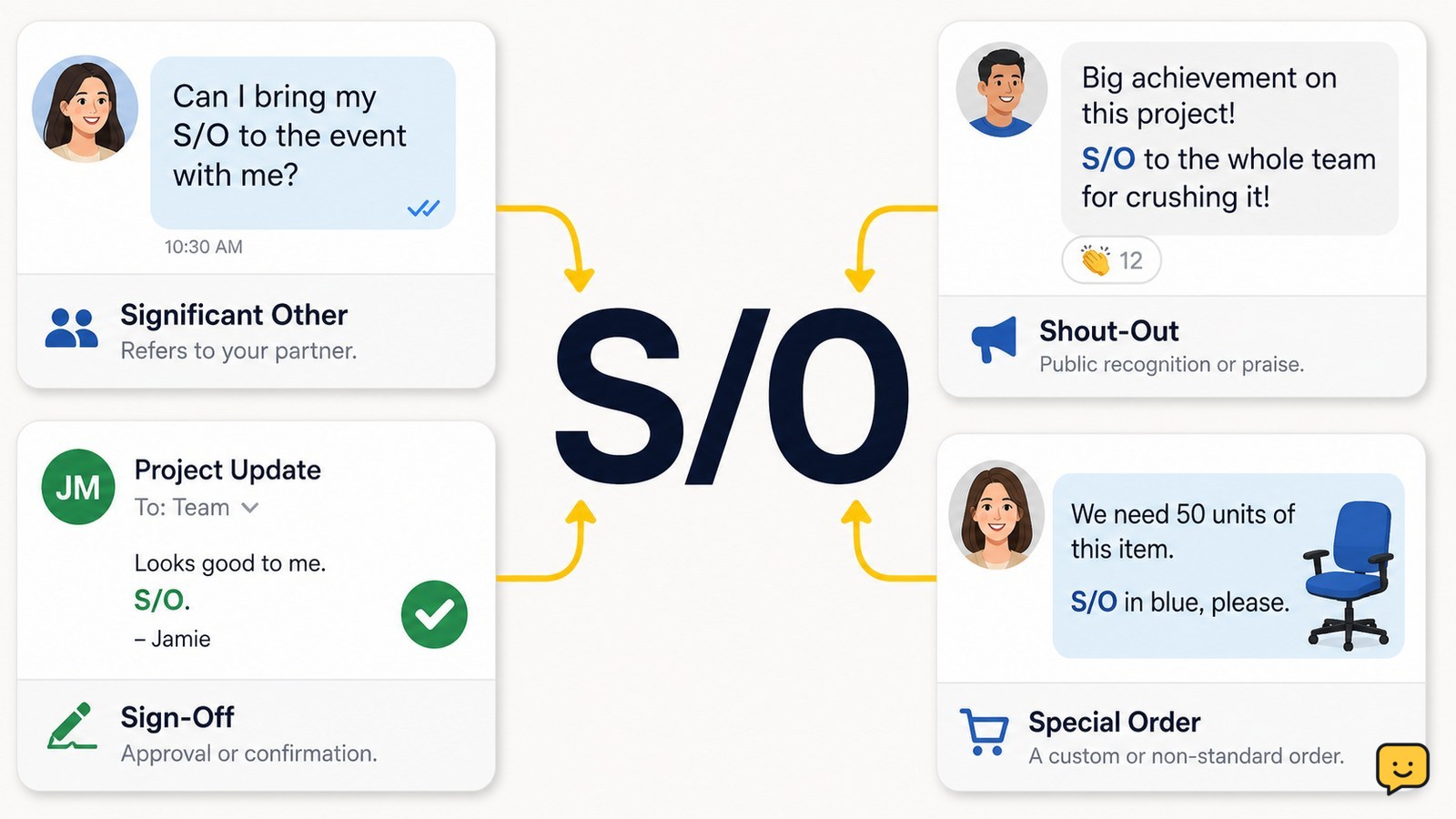
S/O most commonly means “significant other,” referring to a spouse, partner, or other romantic life partner. In workplace or online messages, S/O may also mean “shout-out,” “sign-off,” or “special order.” Check the surrounding words, the sender, and the message purpose before choosing a meaning.
Check whether S/O means significant other
S/O means “significant other” when the message discusses a person’s partner or relationship. The phrase is gender-neutral and can refer to a spouse, life partner, or romantic partner. For example, “My S/O is joining us for dinner” means the writer’s partner is joining them.
This meaning is especially likely when S/O appears beside personal topics such as dating, marriage, family events, holidays, travel, or invitations. Brides describes S.O. as a non-gendered abbreviation for “significant other.”
Success check: Replace S/O with “partner” or “spouse.” If the sentence still makes sense and keeps the same tone, “significant other” is probably correct.
Match S/O to the message’s purpose
S/O can have several meanings in work and online communication, so the message purpose is the fastest deciding clue. Use this comparison before replying:
| Likely meaning | Context clues | Example |
|---|---|---|
| Significant other | Personal relationships, invitations, family, dating | “Please let me know if your S/O is attending.” |
| Shout-out | Praise, recognition, social posts, team updates | “S/O to Maya for fixing the report.” |
| Sign-off | Approval, completion, review, email closing, project status | “We need your S/O before launch.” |
| Special order | Purchasing, inventory, products, suppliers, customer requests | “This item is available by S/O.” |
AcronymFinder lists “shout out,” “sign off,” and “special order” among meanings for SO. It also lists other organization-specific uses, so the surrounding words matter more than capitalization alone.
Use the surrounding words to verify the meaning
The words immediately before and after S/O usually reveal which definition applies. Look for these signals:
- People and events: “bring your S/O,” “my S/O said,” or “S/O is coming” usually means significant other.
- Praise or credit: “S/O to…” usually means shout-out and introduces recognition for a person or team.
- Approval or completion: “waiting for S/O,” “manager S/O,” or “send for S/O” usually points to sign-off.
- Products or purchasing: “available by S/O” or “customer S/O” can mean special order.
Success check: Substitute one possible meaning into the full sentence. The correct version should fit both the grammar and the action being discussed. If “partner,” “praise,” “approval,” and “special order” all seem possible, the context is not sufficient yet.
Reply safely when S/O appears at work
In a workplace message, confirm S/O before taking action if the abbreviation could affect a decision. “We need S/O” may refer to approval, while “S/O to Jordan” is likely praise. Treating one as the other could create confusion about whether a task is complete.
Use a short clarification that preserves the sender’s wording:
- “Just to confirm, does S/O mean sign-off here?”
- “When you say S/O, do you mean special order?”
- “Is this referring to a significant other or a shout-out?”
In a professional setting, avoid guessing that S/O means someone’s romantic partner when the message concerns staffing, scheduling, approvals, or customer work. A neutral question is clearer and less intrusive.
Choose a clearer alternative for your own message
Writing out the phrase is safer when your audience may not know the abbreviation. Use “significant other” for personal or inclusive relationship references, “shout-out” for public praise, “sign-off” for approval, and “special order” for purchasing or inventory.
For example, write “Please confirm your significant other’s name” rather than “Please confirm your S/O’s name” on a formal form. Write “The project needs final sign-off” rather than “The project needs final S/O” when approval status matters.
Failure path: If the abbreviation appears in a template, spreadsheet, or form and no definition is provided, search the same document for a glossary or earlier usage. If none exists, ask the document owner before editing, submitting, ordering, or approving anything.
Frequently asked questions
Does S/O always mean significant other?
No. Significant other is a common meaning, especially in personal messages, but S/O can also mean shout-out, sign-off, or special order. In a work message, read the full sentence and identify whether it concerns praise, approval, or purchasing before deciding.
What does S/O mean in a text message?
In a personal text, S/O usually means significant other. In a social or team message, “S/O to [name]” usually means shout-out. Replace the abbreviation with the full phrase and check whether the sentence still makes sense.
What does S/O mean in business?
In business, S/O may mean sign-off when a person must approve work, or special order when a product must be requested from a supplier. The words around the abbreviation should identify whether the message concerns approval or purchasing.
How should I ask what S/O means?
Ask a specific, neutral question: “Does S/O mean sign-off in this message?” or “When you say S/O, do you mean special order?” Naming the likely interpretation makes it easier for the sender to confirm or correct you.
For more help with this topic, use the Writing Communication guides.