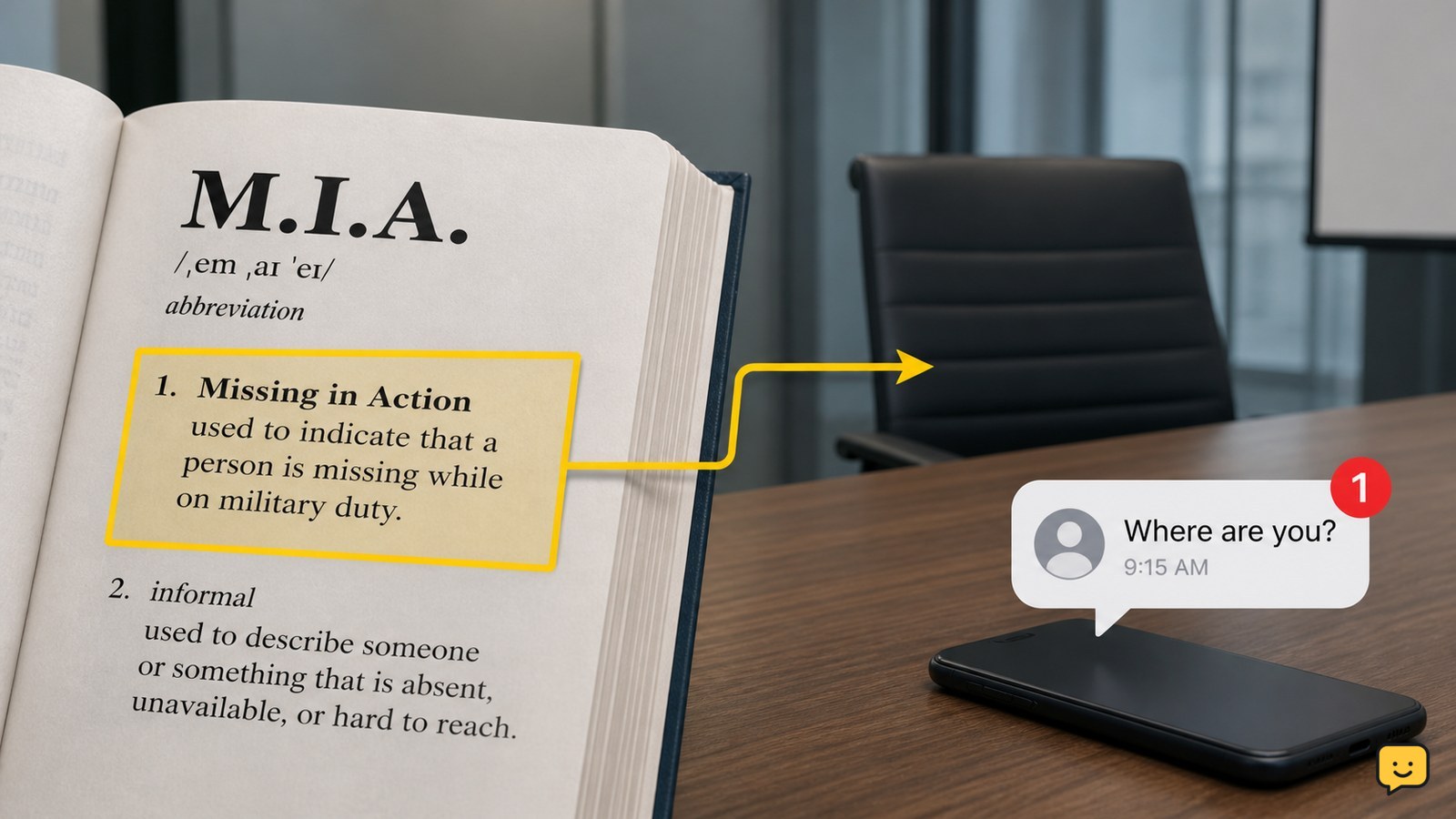
M.I.A. means “missing in action.” It originally described a service member whose location was unknown during military operations. In everyday messages, M.I.A. usually means someone is absent, unavailable, or not responding. For example, “Sam has been M.I.A. all morning” means Sam has not appeared or replied.
Check the sentence for the intended meaning
M.I.A. means “missing in action,” but the practical meaning depends on context. Cambridge Dictionary defines MIA as an abbreviation for “missing in action,” used for a member of the armed forces who has not been located and, more generally, for someone or something that has disappeared or cannot be contacted.
Use this quick distinction:
| Context | Meaning | Example |
|---|---|---|
| Military or historical | A service member reported missing during an operation | “Several soldiers were listed as M.I.A.” |
| Everyday conversation | Absent, unavailable, or not replying | “You’ve been M.I.A. lately.” |
| Work or school | A person, file, update, or task has not appeared | “The budget report is M.I.A.” |
The figurative meaning is the one most people intend in texts, group chats, and informal workplace messages.
Use M.I.A. to describe an absence or silence
Use M.I.A. when you want to say that someone or something is noticeably absent or inactive. The expression can describe a person who has not attended, replied, checked in, or been seen, as well as an item that cannot be found.
- Identify what is missing: a person, reply, document, update, or activity.
- Check that the absence is noticeable or unexpected; M.I.A. is less natural for a planned vacation or scheduled break.
- Place M.I.A. after the subject or use it as a short description, such as “Jordan is M.I.A.” or “The status update is still M.I.A.”
Success check: A reader should be able to replace M.I.A. with “absent,” “unavailable,” “missing,” or “not responding” without changing the basic meaning.
For example, “The printer has gone M.I.A.” means the printer is missing or unavailable. It does not necessarily mean the printer has been physically lost.
Choose a clearer alternative for formal messages
In formal work or school writing, replace M.I.A. with a precise description of the situation. The abbreviation is casual and can sound playful, vague, or mildly critical depending on the relationship and timing.
- Instead of “Alex is M.I.A.,” write “Alex has not joined the meeting” or “I have not received Alex’s update.”
- Instead of “The invoice is M.I.A.,” write “I cannot find the invoice in the shared folder.”
- Instead of “You’ve been M.I.A.,” write “I have not been able to reach you about the assignment.”
- Instead of “The results are M.I.A.,” write “The results have not been posted yet.”
This wording separates an observable fact from an assumption about why the absence happened. Merriam-Webster describes the figurative use as someone or something notably or unexpectedly missing, absent, or inactive, so the phrase is not limited to people.
Verify the tone before sending M.I.A.
M.I.A. is usually informal, so verify that the recipient will read it as neutral rather than accusatory. A message such as “Where have you been? You’re M.I.A.” may sound teasing between friends but impatient in a message to a manager, colleague, student, or client.
- Ask whether the recipient already knows the abbreviation.
- Replace it with a direct status statement when the message concerns a deadline, responsibility, attendance, or customer-facing work.
- Add a neutral next step, such as “Could you confirm when the file will be available?”
Observable result: The message states what is missing and what response you need. If the recipient could reasonably misunderstand whether you mean absence, nonresponse, or a missing item, use the clearer alternative.
What to do if M.I.A. is ambiguous
If M.I.A. does not make the missing person or item clear, ask a short clarification question instead of guessing. The abbreviation can describe a person who is not answering, a document that cannot be found, or an update that has not been published.
Try one of these questions:
- “Do you mean the person is unavailable, or that the file is missing?”
- “Are you saying the update has not been posted yet?”
- “Should I contact them through another approved channel?”
If the issue affects a deadline, record the specific observable fact—such as “no reply received by 2 p.m.”—and follow the normal escalation or attendance process. Do not infer misconduct from silence alone.
Frequently asked questions
Is M.I.A. the same as missing in action?
Yes. M.I.A. is an abbreviation for “missing in action.” In its original military meaning, it refers to a service member whose location is unknown during or after an operation. In casual modern use, it usually means absent, unavailable, or not responding.
Is M.I.A. slang?
M.I.A. is an abbreviation with a military origin that is also used informally as slang. In a text or casual conversation, “You’ve been M.I.A.” commonly means “You have been absent or out of touch.” Use more direct wording in formal or sensitive communication.
How do you use M.I.A. in a sentence?
Use M.I.A. for a person or thing that is unexpectedly absent, unavailable, or missing. Examples include “Taylor has been M.I.A. from the group chat” and “The signed form is still M.I.A.” The intended meaning should be clear from the surrounding sentence.
Should I use M.I.A. in a work email?
Usually, choose clearer wording in a work email. Say that someone has not responded, a document is missing, or an update has not been posted. M.I.A. may be acceptable in an informal team chat when the tone and meaning are obvious, but it can sound vague or critical in formal writing.
For more help with this topic, use the Learning Study guides.