HMU means “hit me up.” In a text, chat, or social post, it is a casual invitation to contact the sender—usually by messaging, calling, or replying later. Read the surrounding sentence to confirm the timing and purpose. In formal work or school communication, use “contact me” or “message me” instead.
Check what HMU means in the sentence
HMU usually means “hit me up,” which is an informal way to say “contact me.” Dictionary.com and Merriam-Webster identify HMU as a casual abbreviation used in electronic communication.
The contact method is not fixed. Depending on the conversation, the sender may want you to text, call, direct-message, or speak to them later. HMU alone normally does not indicate which method to use.
Use a quick substitution check: replace HMU with “contact me.” If the sentence still makes sense, you have probably interpreted it correctly.
- “HMU when you’re free” means “Contact me when you’re free.”
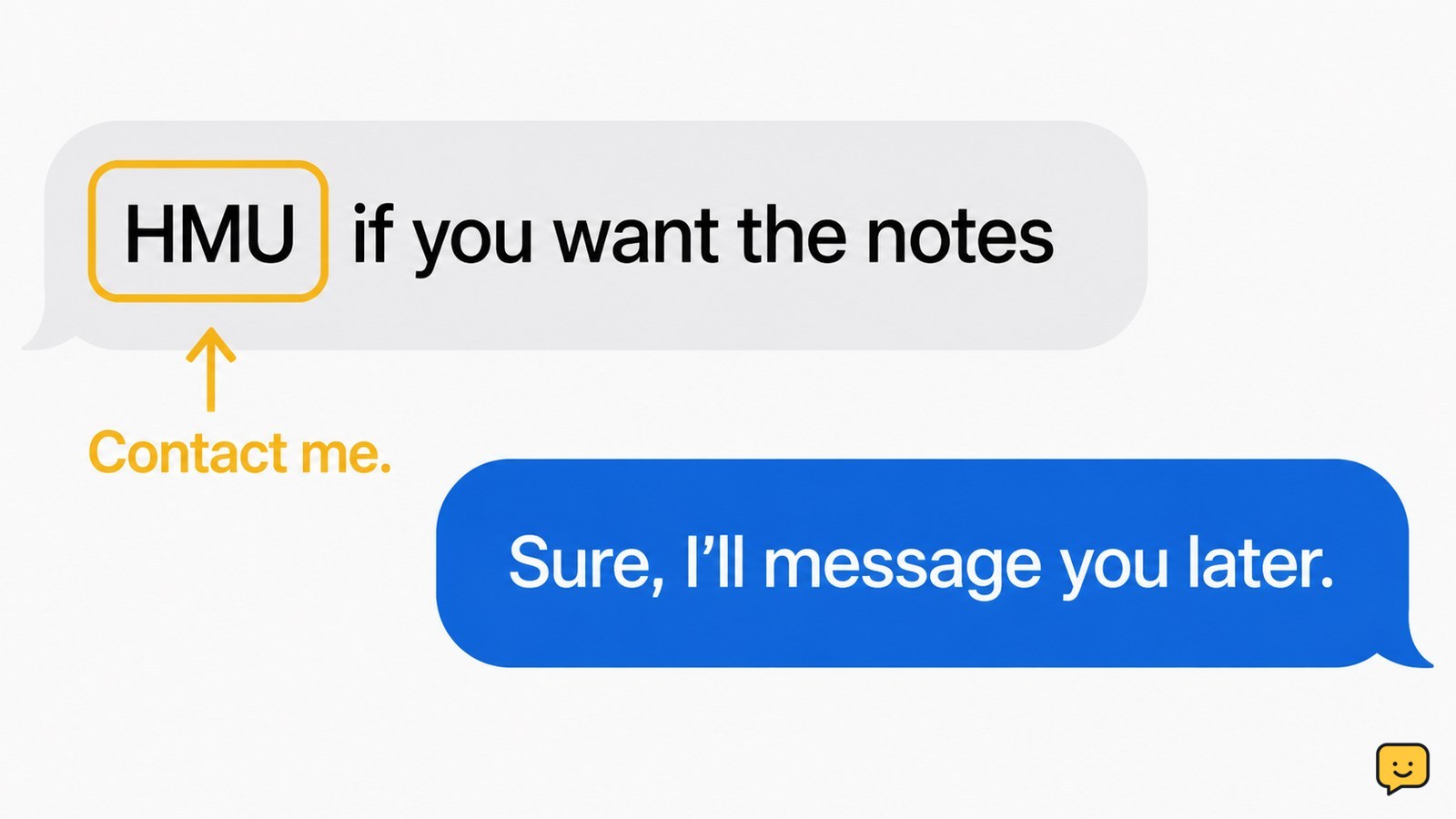
- “HMU if you want the notes” means “Contact me if you want the notes.”
- “You can HMU tomorrow” means “You can contact me tomorrow.”
This meaning applies to casual messages and social posts. It does not automatically mean “call me now,” and it usually is not an urgent instruction.
Use the surrounding words to find the sender’s intent
The words around HMU reveal when the sender expects contact and what they want to discuss.
- Find the timing. Phrases such as “later,” “after class,” or “this weekend” tell you when to make contact. If no time appears, a normal reply in the same conversation is usually sufficient.
- Identify the reason. Look for a topic after words such as “about,” “for,” or “if.” In “HMU about the study group,” the sender wants to discuss the group.
- Check the relationship. Friends and classmates may use HMU casually. A coworker may use it in an informal team chat, but the same wording can sound too relaxed in a client email or official request.
You have a clear interpretation when you can state both the action and the context—for example, “They want me to message them later about the assignment.” If you can identify only “contact them” but not why or when, ask a short follow-up question.
Reply to HMU based on what you want to do
Your reply to HMU can accept the invitation, set a different time, decline, or request clarification.
To accept:
- “Sure, I’ll message you after class.”
- “Sounds good. I’ll call this evening.”
- “Okay, I’ll reach out tomorrow.”
To change the timing:
- “I’m busy tonight, but I can message you tomorrow.”
- “Can I get back to you after the meeting?”
To decline:
- “Thanks, but I won’t be available.”
- “I can’t join this time, but I appreciate the invitation.”
To clarify:
- “Sure—what would you like to discuss?”
- “Do you want me to text or call?”
A successful reply makes your availability clear. You do not need to copy the sender’s slang; a plain response such as “I’ll message you later” works in any casual conversation.
Use HMU naturally in a casual message
HMU works best as a brief invitation at the end of a casual message.
- Name the reason for contacting you. Write “HMU if you need the file” rather than sending only “HMU.”
- Add useful timing. “HMU after 6” gives the recipient a clear contact window.
- Check the tone. Use the abbreviation only if slang already fits your relationship and communication channel.
Useful examples include “HMU if you want to study together,” “HMU when you get there,” and “HMU later about the schedule.” Each example tells the reader either why or when to make contact.
Avoid combining HMU with a demand for an immediate answer. If the matter is time-sensitive, state the deadline directly: “Please reply by 3 p.m.” is clearer than “HMU ASAP.”
Choose clearer wording for work or school
HMU is usually too informal for professional, official, or graded communication, even though it may be acceptable in a relaxed team chat.
Choose an alternative that matches the situation:
- Casual team chat: “Message me if you have questions.”
- Email to a coworker: “Contact me if you need the updated document.”
- Client communication: “Please let me know if you would like to discuss the proposal.”
- Message to an instructor: “Please let me know when you are available.”
- Application or formal letter: “I would be happy to provide additional information.”
The message is ready when the recipient can tell what action to take, why they should contact you, and whether a deadline applies. If the tone might affect a grade, application, customer relationship, or official record, spell out the request instead of using HMU.
Distinguish HMU from similar uses of “hit up”
HMU usually requests contact, but the longer phrase “hit someone up for something” can have a different meaning.
Cambridge Dictionary documents “hit someone up” as informal language that can involve asking someone for something. For example, “He hit me up for money” means he asked for money; it does not simply mean he contacted the speaker.
Use the sentence structure to separate the meanings:
- “HMU later”: Contact me later.
- “She hit me up for advice”: She asked me for advice.
- “HMU for the address”: Contact me to get the address.
If the wording concerns money, private details, login codes, or an unexpected favor, clarify the request before acting. The abbreviation itself does not establish that the sender or request is trustworthy.
Ask for clarification when HMU does not fit
Ask the sender directly when “contact me” does not produce a sensible or safe interpretation.
Reply with a neutral question such as “What do you mean by HMU here?” or “What would you like me to contact you about?” This is especially useful when the message comes from an unfamiliar person, lacks context, or appears inside a specialized group where abbreviations may have local meanings.
Do not guess based only on capitalization: HMU, hmu, and Hmu are normally read the same way in casual messages. Continue only after the sender provides enough context for you to understand the purpose and choose an appropriate response.
Frequently asked questions
Does HMU mean call or text?
HMU can mean either call or text because it broadly asks someone to make contact. The communication channel, earlier messages, or surrounding words may identify the preferred method. If they do not, reply in the same channel or ask, “Would you like me to call or message you?”
What does “HMU later” mean?
“HMU later” means “contact me later.” It suggests that an immediate conversation is unnecessary, but it does not provide an exact time. If timing matters, ask when the sender will be available rather than guessing.
Does HMU mean someone is flirting?
HMU does not automatically indicate flirting. It is a general invitation to contact someone and can be friendly, practical, professional, or romantic depending on the conversation. Look at the topic, tone, relationship, and surrounding messages instead of treating the abbreviation alone as evidence of interest.
Is HMU rude?
HMU is not normally rude in a casual conversation, but it can sound overly familiar or vague in formal settings. Use “contact me,” “message me,” or “please let me know” when writing to a client, instructor, recruiter, manager, or someone you do not know well.
What is the difference between HMU and DM me?
HMU means contact me by an appropriate method, while “DM me” specifically requests a direct message on a social or messaging platform. Use “DM me” when the channel matters and HMU when any reasonable form of contact will work.
For more help with this topic, use the Writing Communication guides.