Fields of Mistria currently has no documented soil-fertility meter or depletion cycle that requires crop rotation. You can reuse prepared plots instead of abandoning them. Rotate crops for seasonal timing, regrowing harvests, quests, cooking, gifts, or stamina management—not to restore soil. If a crop stops progressing, check watering, season availability, planting date, and whether it is ready to harvest.
Browse more Fields of Mistria guides
Check whether your field has a fertility mechanic
Current farming references describe crops as growing in tilled soil and emphasize seasonal availability, watering, growth time, regrowth, and planting day. They do not document a fertility meter, nutrient value, crop penalty, or soil-rest requirement.
That means crop rotation is not currently required to prevent fertility depletion. A plot can be reused for another crop after harvest without first leaving it empty or planting a special restorative crop. This is the key distinction between soil management and crop planning in Fields of Mistria.
Because the game can change through updates, verify the result in your own save: inspect a prepared tile before planting, plant a suitable seed, water it, and check its status on the following day. If the tile shows no fertility value and the crop progresses normally, there is no visible depletion mechanic affecting that test.
Reuse prepared plots instead of abandoning them
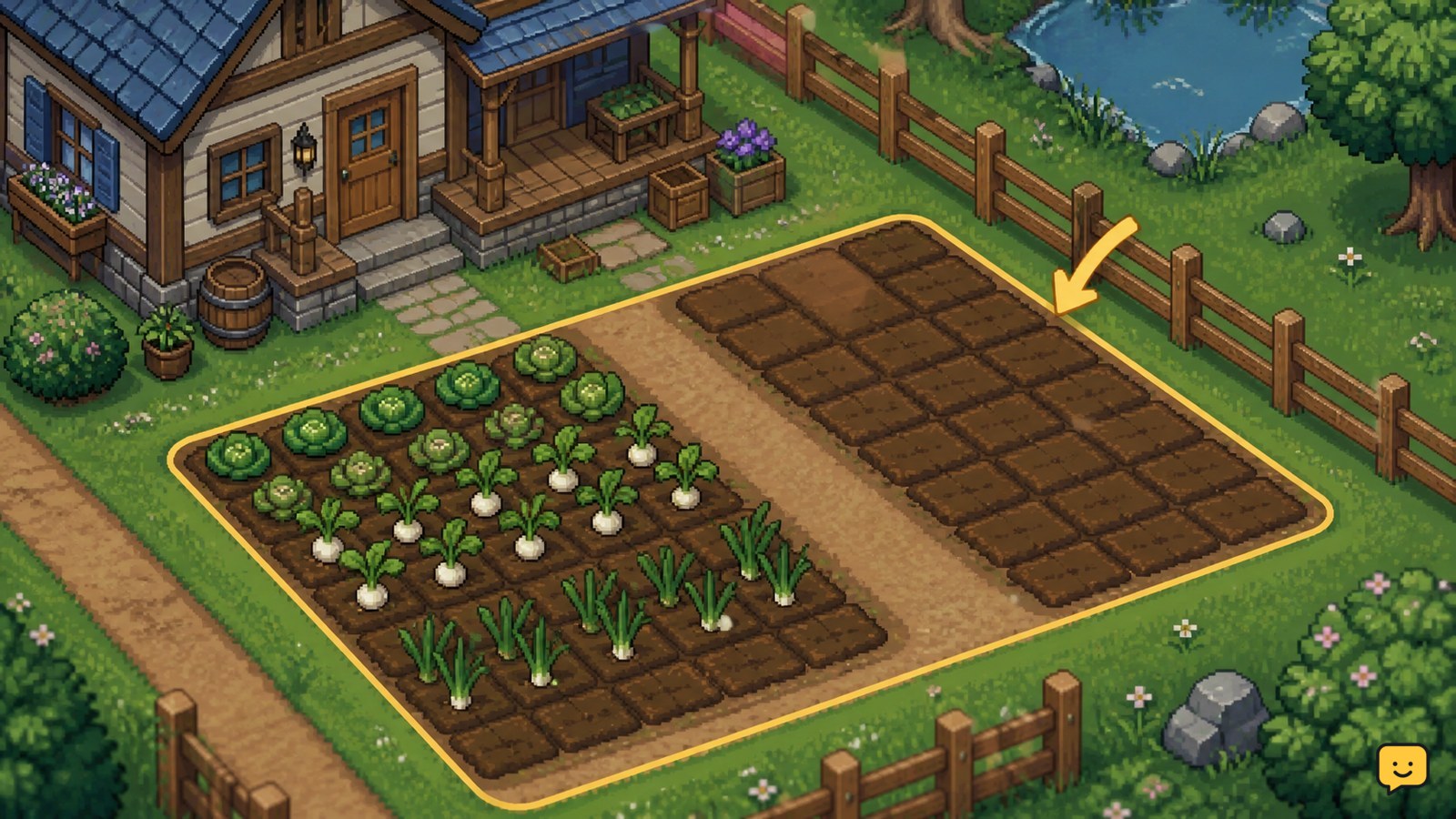
Use a compact field near your usual storage and watering route. Clear and till only the number of tiles you can maintain. The available farming guidance specifically recommends starting with a manageable, waterable plot rather than preparing the whole farm immediately.
- Clear a small area with a direct route to storage.
- Till only the tiles needed for your current crop plan.
- Plant seeds that fit the current season.
- Water every planted tile according to the crop’s needs.
- Harvest when the crop is ready, then reuse the same prepared area.
Leaving a tile unused may help you manage time, energy, or future expansion, but it is not needed to replenish soil fertility based on the currently documented mechanics.
Rotate crops for timing and useful output
Rotation still has practical value, just not as a soil-recovery rule. Change crops when you need to match the season, fit a growth window, collect a regrowing harvest, supply a recipe, complete a request, prepare a gift, or reduce daily watering pressure.
Plan by planting day rather than by sale price alone. A crop with a longer growth period can lose value if planted too late in the season, while a regrowing crop may be worthwhile when planted early enough to produce multiple harvests. The crop-planning references model a 28-day season and compare growth time, regrowth, seed cost, and seasonal totals.
A durable rotation can therefore look like this: use fast or early-season crops at the start of a season, reserve space for longer crops only when their growth window fits, and replace harvested tiles with crops that still have enough days remaining. This protects time and expected output without pretending the soil itself is being repaired.
Keep watering and season checks separate from soil health
A crop that appears stalled does not automatically indicate depleted soil. Check the actual farming variables in this order:
- Watering: Confirm that the crop received the required daily water.
- Season: Confirm that the seed is valid for the current season and that the season has not turned.
- Growth time: Compare the crop’s expected growth period with the number of days since planting.
- Harvest state: Check whether the crop is ready to collect or has a regrowth cycle.
- Version behavior: If the result contradicts the in-game description, check recent patch information before changing your entire field layout.
Do not destroy a working plot or wait through several days solely because you suspect fertility loss. First verify the tile and crop status in-game.
Verify a suspected fertility problem with a controlled test
Use a small comparison instead of risking your main harvest.
- Select two adjacent prepared tiles with the same watering access.
- Plant the same crop on both tiles at the same time.
- Water both tiles consistently.
- Record the planting day and inspect both crops on successive days.
- After harvest, replant one tile and leave the other unused, then compare the next crop under the same conditions.
If both crops behave the same and no fertility indicator appears, the suspected depletion is not supported by the test. If they differ, repeat the test with identical seeds and watering before concluding that soil is responsible. Reported behavior that cannot be reproduced may instead come from a missed watering day, a season transition, a crop-specific rule, or a version change.
Choose a sustainable field layout for long saves
The safest long-term layout is the one you can water and harvest reliably. Keep the main field compact, leave walking space to storage, and expand only when your tools, stamina, seeds, and daily schedule support the extra tiles.
Use separate areas for different purposes if that makes checking them easier: a dependable seasonal block, a smaller test block for unfamiliar crops, and open space for later buildings or layout changes. These divisions are organizational choices, not fertility requirements.
Revisit the plan at the start of each season. Remove crops that no longer fit the calendar, prioritize plants with enough time to mature, and keep any crop you need for cooking, gifts, requests, or collection goals. For related collection planning, see the Fields of Mistria museum donations guide.
Frequently asked questions
Does Fields of Mistria have soil fertility depletion?
No documented fertility-depletion system currently requires crop rotation. The available farming references focus on tilled soil, watering, seasonal crops, growth time, and regrowth, without describing a fertility meter or nutrient penalty. Recheck the current in-game behavior after major updates.
Do I need to leave fields empty between crops?
No. You can reuse prepared plots after harvesting. Leave tiles empty only when you need to conserve stamina, reduce watering work, reserve space, or wait for a better seasonal planting window.
Why should I rotate crops if soil does not lose fertility?
Rotate crops to manage timing and output. Seasonal availability, growth duration, regrowth, cooking uses, gifts, requests, and watering workload can all make one crop more useful than another at a particular point in the season.
What should I check if a crop stops growing?
Check watering first, then confirm the crop fits the current season. Next, compare its growth time with the planting day and inspect whether it is ready to harvest or regrow. Only investigate a new soil mechanic if those checks do not explain the result.
How large should my field be?
Make the field only as large as you can water consistently during your normal day. A smaller field with reliable watering and harvesting is safer than a large field that consumes all your time and stamina.