To tow a trailer safely, first confirm your vehicle, hitch and trailer are rated for the loaded weight. Distribute cargo evenly with heavier items toward the front, then secure the coupler, pin, safety chains, wiring and breakaway cable. Check tires, lights and brakes before moving, practice slowly in an open area, and stop immediately if the trailer sways, a connection loosens or braking feels abnormal.
For more help with this topic, use the Accessories Ownership guides.
Confirm the vehicle, hitch and trailer can work together
Your tow vehicle and trailer are suitable only when the loaded combination stays within every rating in the vehicle, hitch and trailer documentation. Check the vehicle’s permitted trailer weight, the hitch rating, the ball-mount and ball capacity, the trailer’s gross rating, tire limits and axle limits. Use the lowest applicable limit.
Include cargo, fluids and equipment in the trailer’s loaded weight. A trailer that is within its own rating can still be too heavy for the vehicle or hitch. If the manuals give different limits for the same setup, stop and confirm the correct specification with the vehicle or trailer manufacturer.
Load the trailer so it remains stable
A safely loaded trailer has its cargo distributed across the trailer without overloading one side or axle. Place heavier items low and toward the front of the trailer, then spread the remaining weight evenly. Black Rhino Trailer’s beginner guidance also recommends keeping heavier items closest to the hitch.
Secure every item so it cannot slide, roll or fall during braking or turns. Close and latch the trailer, and check that cargo does not block lights, the plate or the driver’s view through the mirrors. Recheck the load after a short drive; a shifted load can change how the trailer handles.
Inspect the hitch, tires, lights and brakes
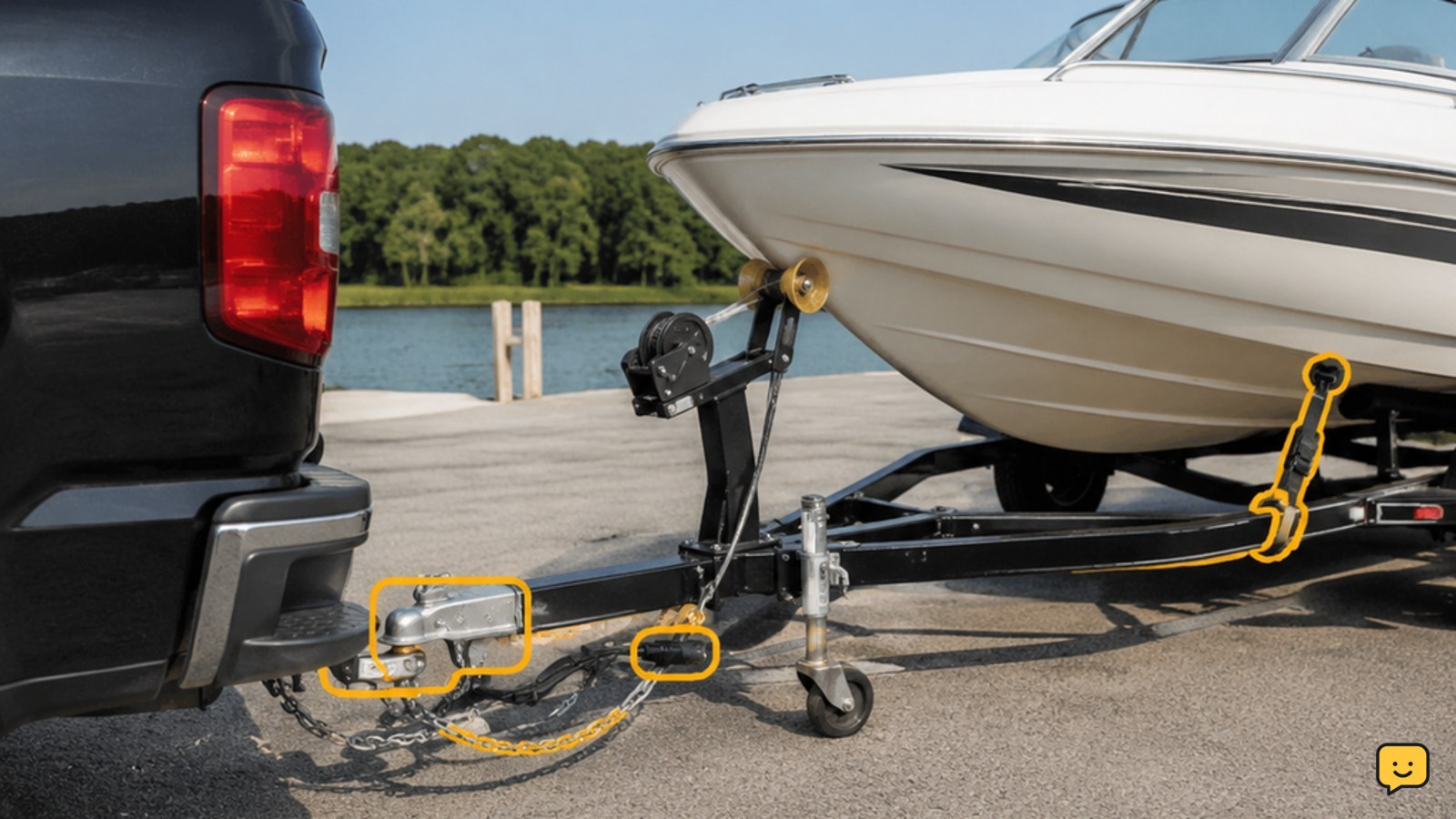
A pre-tow inspection should find loose connections, damaged tires or failed lighting before the trailer enters traffic. Check the coupler, hitch receiver, ball, locking mechanism, safety chains, wiring plug, breakaway cable, jack and any stabilizers. Inspect trailer tires for visible damage and confirm their pressure against the trailer documentation.
Connect the trailer wiring and verify the running lights, turn signals, brake lights and hazard lights with a helper. Test the trailer brakes and brake controller if the setup has them, following the vehicle and trailer instructions. Ken Feagin Truck & Trailer’s checklist also calls out tire, light, brake and mirror checks.
Expected result: Every connection is tight, the safety hardware is retained, tires look sound, mirrors show the trailer sides and all required lights respond to the vehicle controls. If any item fails, repair or adjust it before towing.
Hitch the trailer and verify every connection
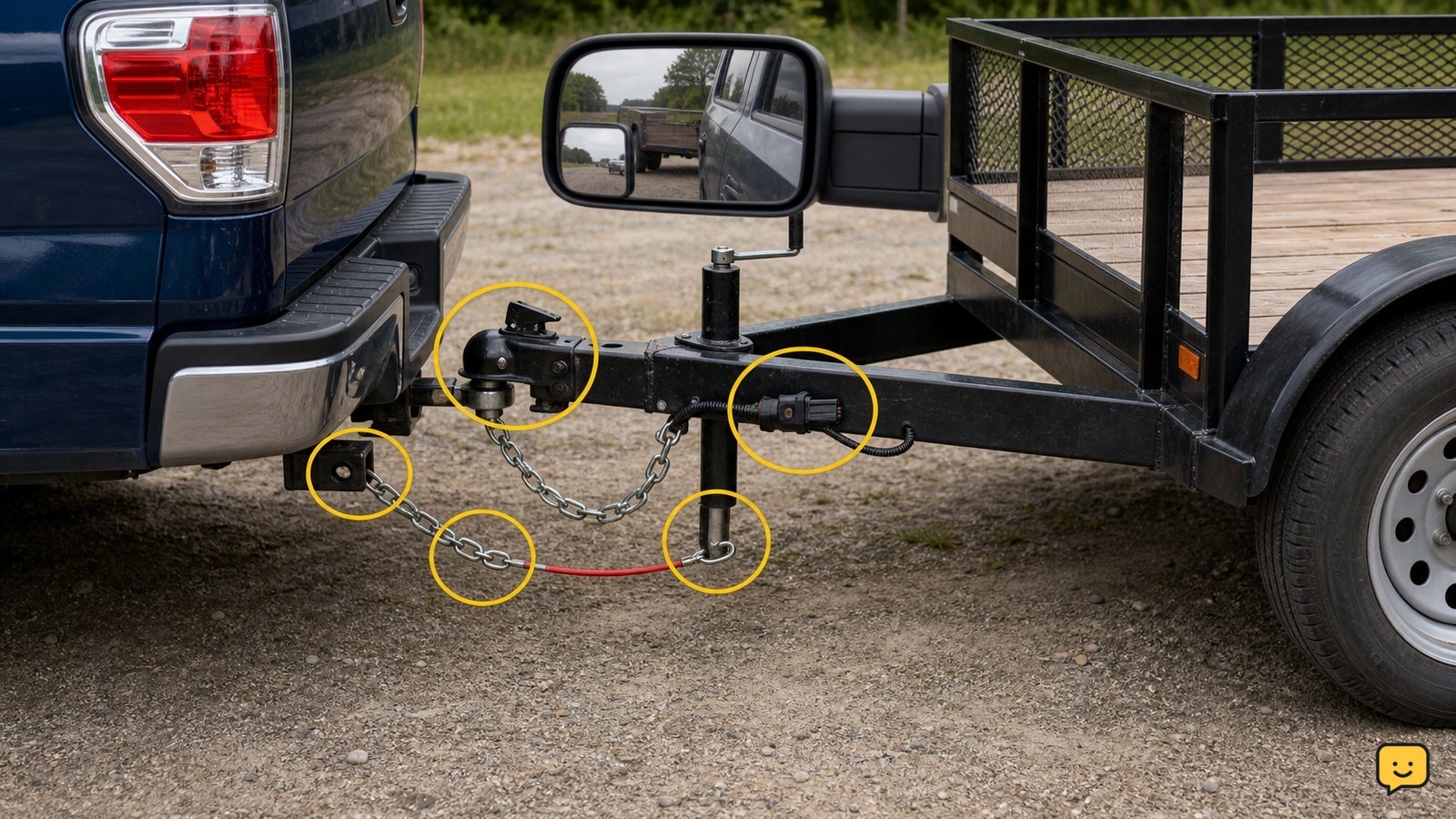
To hitch safely, keep the tow vehicle aligned with the coupler and use a helper while reversing slowly. Lower the coupler fully onto the correctly sized ball, close and lock the coupler, and install its retaining pin or clip. Raise the jack clear of the ground only after the connection is locked.
Cross the safety chains under the coupler so they can help support it if the connection separates, while leaving enough slack for turns without dragging. Plug in the wiring. Attach the breakaway cable to an appropriate dedicated point on the tow vehicle rather than looping it around the chains. Confirm the cable can activate the trailer braking system if separation occurs, according to the trailer manual.
Perform a visual second check: the coupler is seated, the latch is closed, the pin is installed, chains are attached to the vehicle, the plug is fully inserted and the jack is secured. If you cannot identify a positive locked state, do not move the vehicle.
Test the combination before entering traffic
Before a first trip, test the connected vehicle and trailer in a clear, level area. Start with gentle movement, then check steering, acceleration, braking, turn signals and reversing. Have the helper watch for chain drag, wiring strain, tire contact, loose cargo or unusual movement.
Curt Manufacturing recommends allowing extra stopping distance and anticipating problems when towing. Brake earlier than you would without the trailer, make smooth inputs and leave more space around other vehicles. Practice wide turns and remember that the trailer tracks inside the tow vehicle’s path.
Expected result: The combination moves straight at low speed, brakes without pulling or shuddering, and the trailer follows predictably through turns. Recheck the hitch and load before joining faster traffic.
Control speed, turns and trailer sway
Safe towing depends on smooth steering, gradual braking and a speed appropriate for the road, weather, load and posted limit. Keep both hands available, scan farther ahead than usual and avoid abrupt lane changes. Use mirrors before turning or changing lanes, and allow room for the trailer to clear the inside of a corner.
If the trailer begins to sway, stay calm, keep the steering as straight as conditions allow and ease off the accelerator without making a sharp correction. Do not accelerate to chase the sway or repeatedly steer against it. If it continues, slow in a controlled way and pull over when safe to inspect the load, tires, hitch and trailer brakes.
Do not continue after a sway event if cargo has shifted, a tire is damaged, a connection is loose or the cause is unclear. Get the setup inspected or use a qualified towing service before resuming.
Frequently asked questions
How fast should a beginner tow a trailer?
Use the lower of the posted limit, the trailer or vehicle instruction, and a speed that keeps the combination stable for the road and weather. Beginners should practice at low speed in an open area first. Reduce speed further for wind, rain, uneven pavement, heavy loads or any hint of sway.
Should safety chains cross under a trailer hitch?
Yes. Cross the chains under the coupler and attach them to suitable points on the tow vehicle, leaving enough slack for normal turns without letting them drag. The crossed chains are intended to help support the coupler if it separates. If the chains cannot attach securely, do not tow.
How do I know a trailer is connected correctly?
A correct connection has the coupler fully seated on the properly sized ball, the latch locked with its retaining pin or clip installed, both safety chains attached, the wiring plug secured, the breakaway cable connected and the jack raised and secured. Test the lights and brakes before entering traffic.
What should I do if a trailer starts swaying?
Keep the steering steady, avoid sharp corrections and ease off the accelerator. Slow in a controlled manner, then pull over safely to inspect the load, tires, hitch and brakes. Do not continue if the sway returns or you find shifted cargo, damage, a loose connection or an unknown fault.