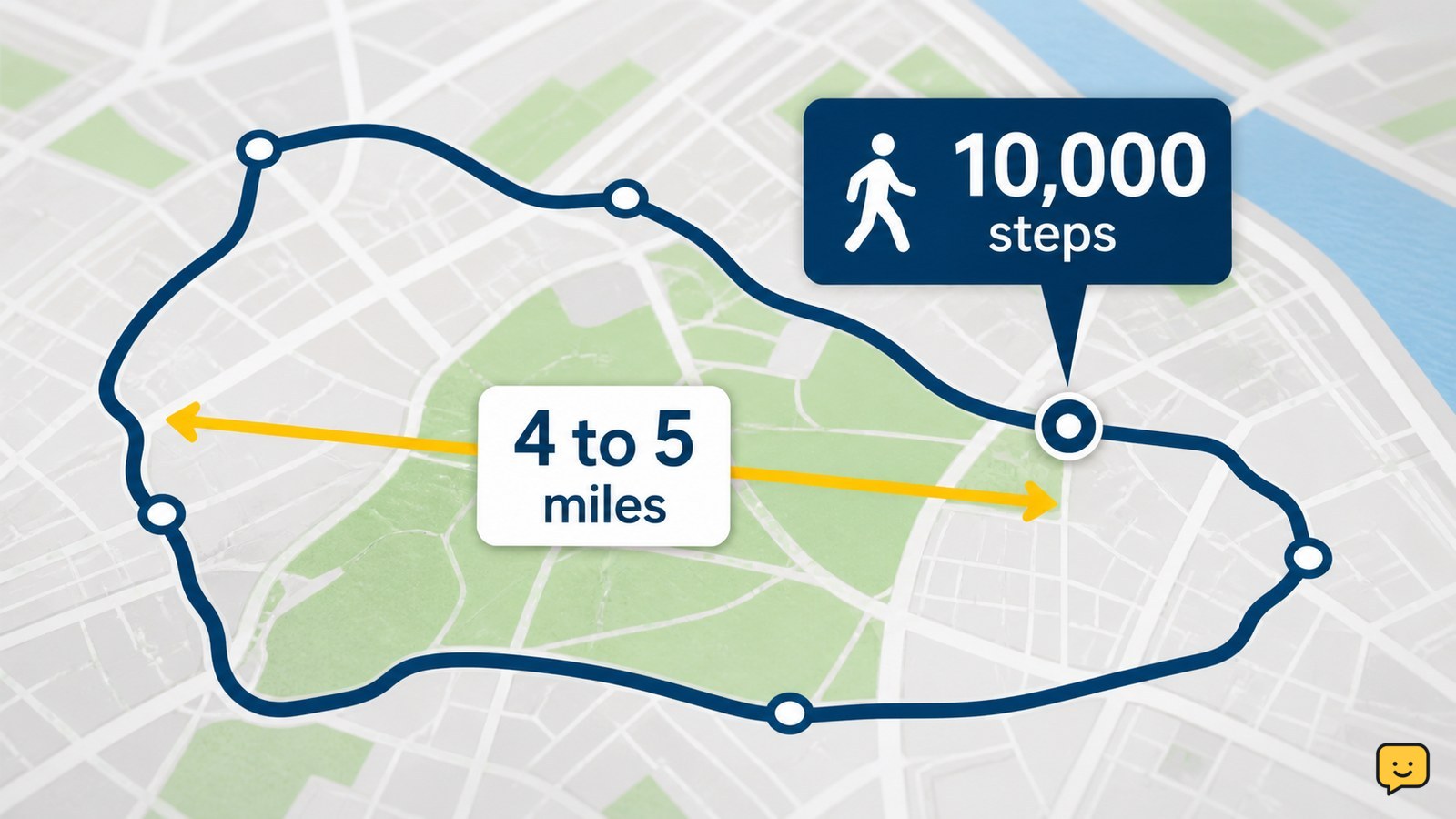
10,000 steps is approximately 4 to 5 miles for most people. The exact distance varies with stride length, height, and walking pace. A person with shorter steps may cover less than 4 miles, while someone with a longer stride may exceed 5 miles. Use a measured route or calibrated tracker for your personal result.
For more help with this topic, use the Sports Recreation guides.
Use 4 to 5 miles as the quick estimate
10,000 steps usually represents about 4 to 5 miles. That range is the most useful answer when you do not know your stride length. The supplied distance guidance also identifies stride length, height, and walking pace as reasons the result changes.
For planning a walk, use 4 miles as a conservative estimate and 5 miles as the upper end of a typical range. Do not treat either figure as a fixed conversion for every person: two walkers can finish 10,000 steps at different distances.
Calculate your personal distance from stride length
Your stride length gives a more personal estimate than a generic miles-per-step figure. First measure a route in miles, walk it normally, and record the number of steps taken. Divide the route distance by the steps recorded, then multiply that miles-per-step figure by 10,000.
- Walk a measured route, such as 1 mile, at your usual pace.
- Record your step count for that route.
- Divide 1 mile by the number of steps.
- Multiply the result by 10,000.
For example, if a measured mile takes 2,500 steps, the estimate is 4 miles for 10,000 steps. If it takes 2,000 steps, the estimate is 5 miles. These examples show why stride length matters without pretending that either step count applies to everyone.
Check whether your tracker is measuring distance correctly
A phone, watch, or pedometer can provide a useful personal check when its step and distance readings are consistent. Walk a route whose distance you already know, then compare the device’s displayed distance with that route. Repeat the check using your normal walking pace rather than an unusually slow or fast walk.
If the tracker reports roughly the expected distance and the step count rises steadily, use its 10,000-step distance as your working estimate. If the distance is far outside the usual 4-to-5-mile range, check whether the device was worn or carried consistently and whether it counted nonwalking movement.
A missing or implausible reading is a measurement problem, not proof that 10,000 steps equals a different universal distance. Recheck the same route before changing your personal conversion.
Choose the right estimate for route planning
Use the range for rough planning and your measured result for timing or route length. A 4-mile estimate may be enough to decide whether a walk fits into your day. A measured route is better when you need to know where 10,000 steps will finish.
- Quick estimate: plan for approximately 4 to 5 miles.
- Personal estimate: measure your steps over a known distance and scale the result to 10,000.
- Outdoor route: rely on mapped or marked distance, then use steps as a progress check.
- Fitness tracking: compare several ordinary walks instead of relying on one unusual outing.
Walking pace can change how your tracker behaves and how consistently you take steps, while the distance covered still depends chiefly on the length of each step. Keep your pace natural during a comparison.
What to do if your 10,000-step result looks wrong
An unusually high or low result usually points to stride variation, tracking conditions, or an inaccurate route measurement. Use the symptom that best matches what you see:
| What you see | Likely reason | Next check |
|---|---|---|
| Under 4 miles | Shorter stride or extra steps on turns | Repeat a measured-mile test at your normal pace. |
| Over 5 miles | Longer stride or an overstated route distance | Compare the tracker with a known-distance route. |
| Steps rise but distance barely changes | Indoor movement, standing, or repeated short turns | Test the device during continuous outdoor walking. |
| Distance changes sharply between similar walks | Inconsistent device placement or tracking | Wear or carry it in the same position for each test. |
If repeated checks still disagree, use the measured route distance for that walk and keep the 4-to-5-mile figure only as a broad comparison. The conversion does not apply precisely to running, uneven terrain, or activities where the device counts movements that are not forward walking.
Frequently asked questions
Is 10,000 steps exactly 5 miles?
No. 10,000 steps is often estimated at 4 to 5 miles, but it is not exactly 5 miles for everyone. A shorter stride produces fewer miles, while a longer stride produces more. Measure your steps over a known-distance route if the exact estimate matters.
How long does it take to walk 10,000 steps?
The time varies with walking pace, stride length, stops, and terrain. Because 10,000 steps commonly covers about 4 to 5 miles, use your normal walking speed and the distance shown by your tracker for a better time estimate than step count alone.
Does height change how many miles 10,000 steps is?
Yes, height can affect stride length, so it can change the distance covered in 10,000 steps. Height is only a general indicator, however. A measured route is more reliable because walking style, pace, and natural stride also affect the result.
What is the easiest way to measure my 10,000-step distance?
Walk a route with a known distance, record your steps, and scale that result to 10,000 steps. For instance, if one measured mile takes 2,500 steps, 10,000 steps estimates to 4 miles. Repeat the test at your ordinary pace for a more useful average.