Dragon Sword Awakening’s current evidence confirms gear, crafting, equipment sets, and resource use, but it does not verify every inventory label or a universal storage system. Keep equipped and upgrade-candidate gear separate from duplicate drops, review item details before selling or dismantling, and reserve materials for a planned set. Stop if an item’s use, binding status, or recovery value is unclear.
Browse more DragonSword: Awakening guides
Separate equipped gear from items awaiting review
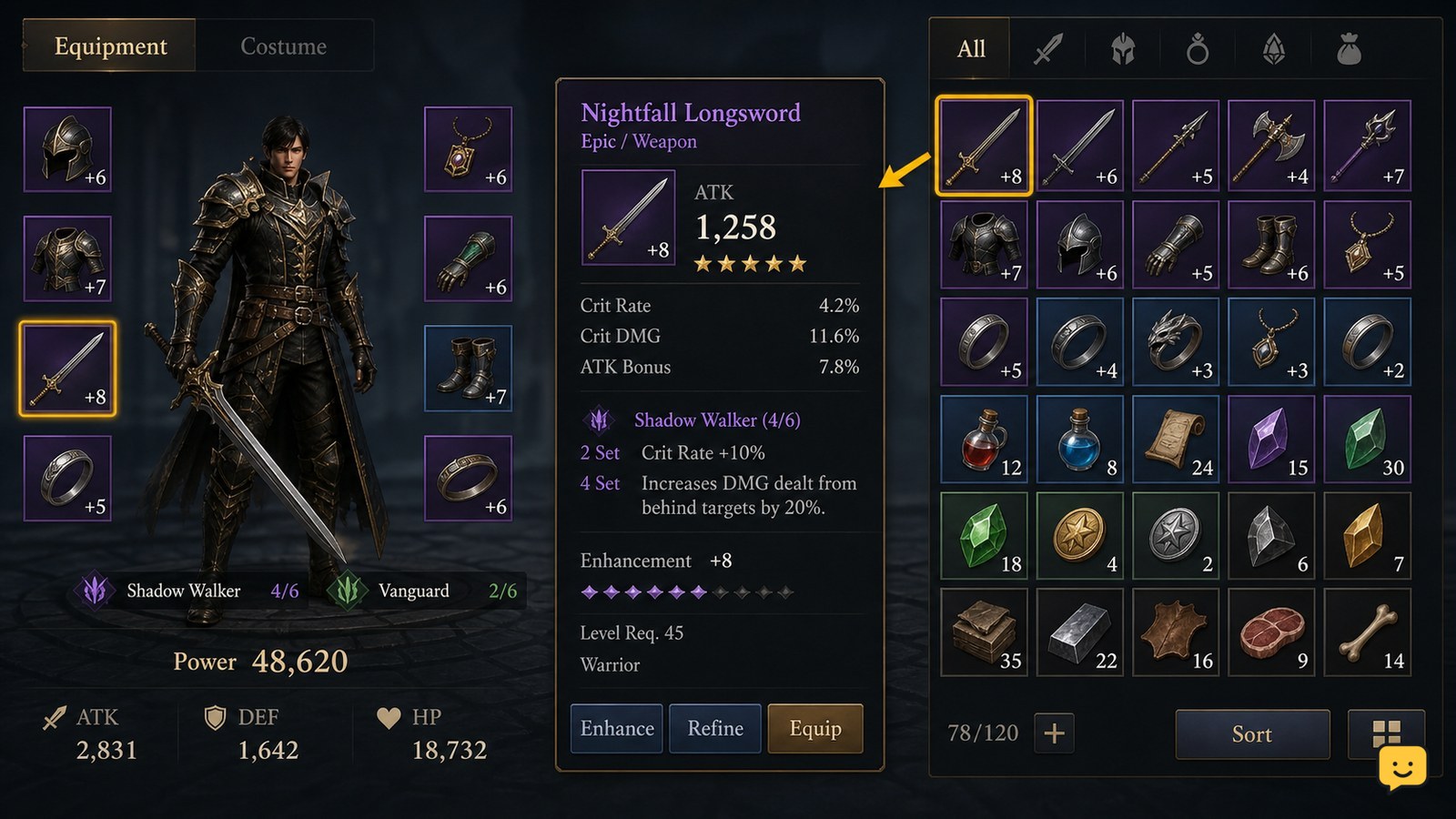
Dragon Sword Awakening inventory management starts by separating gear that is already equipped from items that still need a decision. Open the character equipment view first, note the pieces contributing to your current build, and avoid treating every higher-level drop as an automatic replacement.
The available equipment evidence describes a 3+2 set approach, main-stat choices, crafting, and reforging. That makes set contribution and useful main stats more important than a simple item-level comparison. Keep any piece that could complete or improve your planned combination in a review group until you compare its details.
- Mark or place equipped pieces in your mental “keep” group.
- Compare duplicate pieces by set contribution, main stat, and upgrade state.
- Move only clearly weaker duplicates into the disposal review group.
Verify: after reviewing a replacement, the character panel should still show the intended equipment and build direction. If a bonus disappears, restore the previous piece and stop the cleanup.
Keep upgrade candidates before selling or dismantling
Dragon Sword Awakening players should keep upgrade candidates until enhancement and reforge value have been checked. The supplied equipment guide evidence specifically warns that strengthening, crafting, gold, and reforging resources require careful prioritization, so disposal decisions should happen after comparison rather than before it.
Review an item’s visible level, rarity, set identity, main stat, and any existing investment. A lower-level item can remain useful when it has the set piece or stat your build needs. Conversely, a duplicate with no useful set role and no investment is a safer disposal candidate, provided the game clearly shows its sell, dismantle, or exchange result.
- Open the item details instead of disposing of it from the grid.
- Check whether it is equipped, locked, quest-related, or already enhanced.
- Compare it with the weakest item in the same equipment slot.
- Dispose of it only after the confirmation screen shows the expected currency or material return.
Failure path: if no confirmation appears, cancel the action and leave the item in inventory. Do not assume a missing confirmation means the item was preserved or removed.
Reserve materials for one planned equipment path
Dragon Sword Awakening materials are safest when reserved for one active equipment plan instead of being spread across every new drop. Current gameplay references discuss crafting, gear sets, Karma, and resource requirements, while the available evidence does not establish a complete item-by-item material table.
Use a simple priority order: first the gear pieces that improve your current set direction, then the upgrades that improve a usable main stat, and finally side-grade items that are not needed for immediate progression. Keep a buffer of gold and crafting materials for the next confirmed upgrade rather than spending down to zero.
- Choose the set and stat direction you are currently building.
- List the next one or two upgrades visible in the equipment or crafting screens.
- Spend materials only when the requirement and resulting item are shown in-game.
- Recheck your inventory count and equipped stats after each completed action.
Stop condition: do not spend a material when its destination is unclear, when the recipe is unavailable, or when the result is not displayed before confirmation.
Check sorting, filters, and disposal controls without assuming them
Inventory controls such as sorting, filters, locking, batch selling, or dismantling should be treated as version-dependent until they are visible in your current client. The available references support gear and crafting management, but they do not verify a universal menu path for these controls.
Check the inventory screen for clearly labeled options such as sort, filter, lock, sell, dismantle, or exchange. Use one harmless duplicate to verify the result before applying a batch action. If the screen has no visible control, manage items manually by opening their details rather than following an unverified shortcut.
Expected result: a successful action should produce a visible inventory-count change, currency or material change, or an item-state change such as a lock indicator. If none of these appears, cancel, leave the screen, and reopen the inventory before trying again.
Recover safely when an item or material seems missing
When Dragon Sword Awakening inventory contents appear incorrect, first determine whether the item moved, was consumed, was exchanged, or is filtered out. A missing icon alone does not prove data loss.
- Clear any visible category or rarity filter.
- Check equipped slots, crafting requirements, quest objectives, and exchange screens.
- Compare the current gold and material totals with the notes made before cleanup.
- Return to a safe area, close and reopen the relevant menu, and check again.
If the item still cannot be found and the count changed without a clear confirmation, stop making further inventory changes. Capture the item name, previous count, current count, character state, and the screen where the change occurred before contacting the game’s supported help channel. Do not repeat the disposal or upgrade action while the state is uncertain.
Frequently asked questions
Does Dragon Sword Awakening have a confirmed shared storage system?
No confirmed shared-storage workflow is established by the available current evidence. Check your present inventory and storage screens for a clearly labeled deposit, warehouse, or account-storage control. If none appears, keep progression items on the character that uses them and do not rely on an assumed shared inventory.
Should I keep duplicate equipment in Dragon Sword Awakening?
Keep duplicates when they can complete a useful set combination, carry a needed main stat, or already contain enhancement or reforge investment. A duplicate is safer to sell or dismantle only after its detail panel shows no quest, crafting, exchange, or set value and the disposal result is clearly displayed.
Can I safely dismantle all low-level gear?
No. Low-level gear can still matter for a set combination, a replacement slot, or a progression requirement. Compare each candidate with your current equipment and confirm the returned materials before dismantling. If the item’s purpose or recovery value is not shown, leave it untouched.
What should I do if my inventory is full?
Start with clearly identified duplicate drops that are not equipped, quest-related, enhanced, or part of your planned set. Review them individually if bulk controls are not visible. Do not destroy crafting materials or uncertain equipment merely to create space; return to a safe area and use a confirmed sell, dismantle, or exchange action.