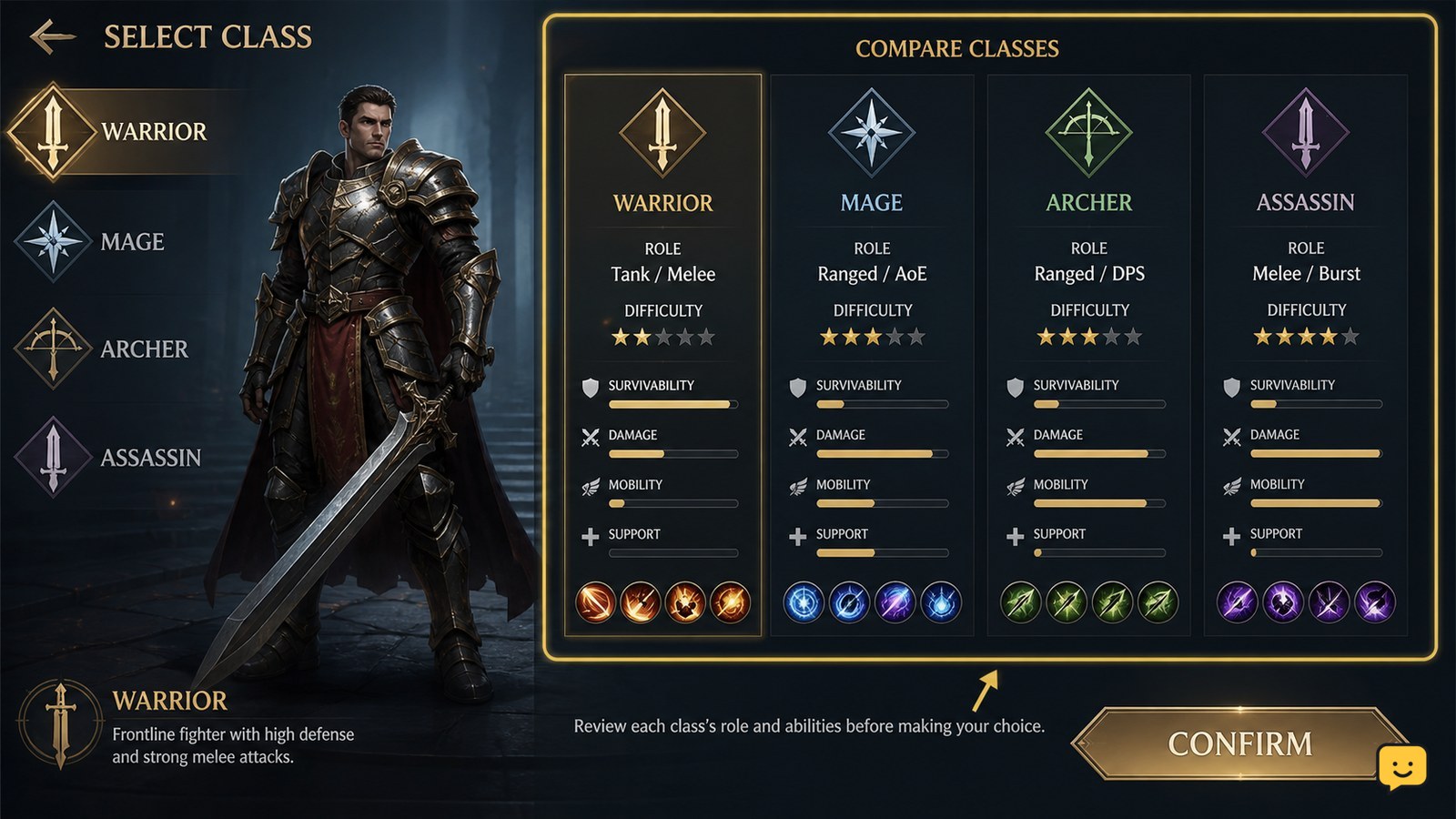
Choose the class whose displayed role matches how you want to fight, not a temporary tier list or damage number. Confirm the class name, weapon, skills, and role on your current DragonSword: Awakening selection screen before accepting it. The available evidence supports role-based choices such as main DPS, sub-DPS, support, and healer, but it does not verify a complete current list of named starting classes or separate Evrima and Legacy rules.
Browse more DragonSword: Awakening guides
Check which DragonSword: Awakening version you are playing
DragonSword: Awakening class advice only applies when the guide and your game show the same version and selection system. The supplied evidence does not verify separate Evrima and Legacy class rules, so treat those labels as boundaries rather than interchangeable terms.
- Look at the game’s title screen, launcher, server selector, or class-selection screen for a visible version or mode label.
- Compare the displayed class names, role tags, weapons, and skills with the source you are using.
- If the source mentions Evrima or Legacy but your game does not display that label, use only the information visible in your own client.
Do not assume a class list from a video or community post is complete. The supplied YouTube evidence shows a class breakdown, but it does not provide enough confirmed text to establish every current class name or its exact starting abilities.
Match the displayed role to your preferred combat style
Choose a DragonSword: Awakening class by deciding what you want to contribute during combat: sustained damage, burst damage, team utility, or recovery. OSLink’s character-build guide uses the practical role categories main DPS, sub-DPS, support, and healer; these categories are useful for comparison without depending on temporary balance values.
- Main DPS: Pick this role if you want to stay active against priority targets and build your play around consistent damage.
- Sub-DPS: Pick this role if you prefer entering combat for bursts, follow-up attacks, or damage during another character’s setup.
- Support: Pick this role if you enjoy improving allies, controlling encounters, applying utility, or creating openings rather than dealing the most direct damage.
- Healer: Pick this role if monitoring health, preventing failed attempts, and keeping a team active sounds more appealing than chasing damage.
These labels describe combat functions, not a confirmed list of starting class names. Use the role that appears on your current screen as the deciding label.
Compare each class by weapon, range, and recovery demands
The current class screen should be your comparison point for weapon handling, attack distance, skill timing, and how much recovery the role requires. Do not choose from a ranking when the game gives you more reliable information through previews and descriptions.
- Check whether the weapon preview favors close-range attacks, ranged attacks, area coverage, or rapid repositioning.
- Read the first abilities and identify whether they deal direct damage, improve allies, apply a status effect, control enemies, or restore health.
- Look for resource, cooldown, positioning, or timing requirements in the skill descriptions.
- Choose the class whose ordinary actions sound enjoyable to repeat during routine fights, not only during a boss encounter.
InsertCoins.press describes DragonSword: Awakening as using tag-team combat, status ailments, poise breaking, and Signal Skills. That means a class should be judged partly by how its actions fit your switching and setup habits, if those systems are visible in your build. Exact cooldowns, damage values, and rankings are not evergreen selection criteria.
Use a simple decision rule before confirming the class
The safest class decision is the one that satisfies your preferred range, responsibility, and learning burden at the same time. Use this order when two choices appear similar.
- Choose by range: Select close range if you want frequent positioning and direct contact; select ranged play if you prefer distance and target management.
- Choose by responsibility: Select damage if you want your own output to be the main focus; select support or healing if you prefer making the whole team more reliable.
- Choose by complexity: Prefer the class with the clearer starting skill loop if you are learning the combat system.
- Choose by team fit: If you already know which characters or roles your team uses, select a class that adds a missing function instead of duplicating it.
When no role label is shown, do not infer one from the class name alone. Use the weapon and ability descriptions, then leave the screen without confirming if those details are too vague to compare safely.
Verify the selection and recover when the class screen differs
A successful class choice is visible in the confirmation result: the selected character or class is highlighted, equipped, or shown as active in the next screen. Verify that state before spending resources or entering content that assumes the choice is final.
- Confirm the displayed name and role after selecting the class.
- Open the character, equipment, or skills screen and check that the expected weapon and starting abilities are attached.
- Use the first safe combat or tutorial encounter to confirm the basic attack pattern and role behavior.
- Check for a visible change-class, switch-character, or reset option before assuming the choice is permanent.
If the expected class does not appear, return to the selection screen and check the active server or version label. If the menu, role, or class names differ from the guide, stop using that guide. The available evidence does not confirm a universal reset or reincarnation path, so do not spend materials while testing an uncertain choice.
Frequently asked questions
What is the easiest DragonSword: Awakening class for a new player?
There is no confirmed evergreen easiest class or universal ranking in the supplied evidence. Start with the role whose weapon and first abilities are easiest for you to understand. A straightforward damage role may be easier to evaluate alone, while support or healing can suit players who prefer team-focused decisions.
Can you change your class after choosing one?
Do not assume you can. Check the current character or account menus for an explicitly labeled class-change, switch, or reset option. The supplied evidence does not verify a universal class-reset system. If no such control appears, stop before spending upgrade materials or premium resources.
Should I choose a main DPS, sub-DPS, support, or healer?
Choose main DPS for sustained personal damage, sub-DPS for burst or follow-up attacks, support for team utility, or healer for health recovery and survival. If you already have a team, select the role that fills its missing function. If you play alone, choose the role whose combat loop you most enjoy repeating.
Do Evrima and Legacy use the same classes?
That is not confirmed by the supplied evidence. Treat Evrima and Legacy as separate version boundaries and compare the actual class screen in your build. Do not transfer class names, skills, role descriptions, or reset instructions between them unless the same details are confirmed for both versions.