A double mini trampoline, often called double mini or DMT, is a small two-section trampoline used in a gymnastics discipline. The athlete runs onto the apparatus, performs a mount or first flight element, takes a second flight from the bed, and lands on a separate landing area. It is built for coached acrobatic routines, not ordinary backyard bouncing.
For more help with this topic, use the Sports Recreation guides.
Identify the two sections that make a DMT
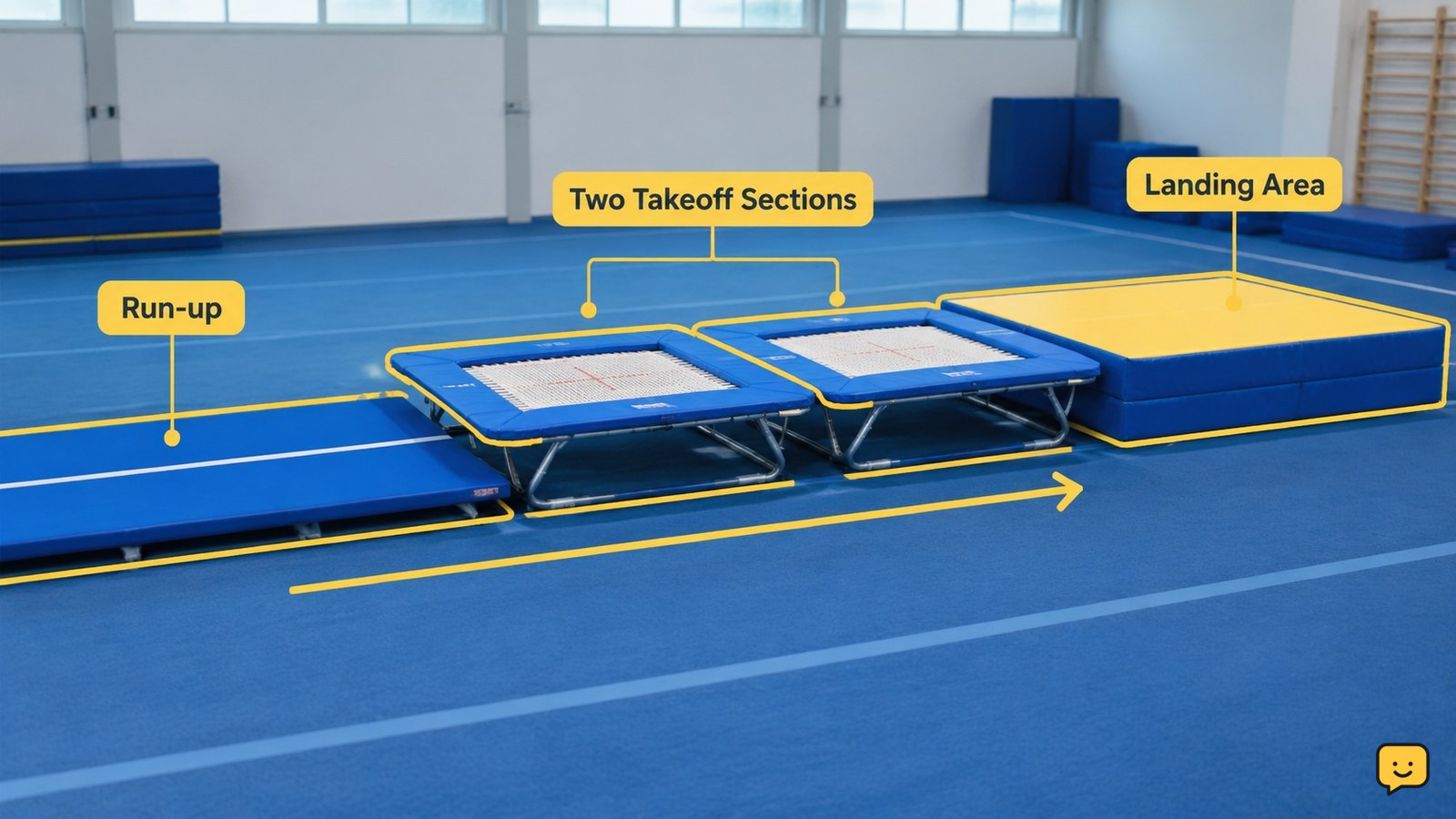
A double mini trampoline is identified by two connected trampoline sections rather than one large recreational bed. The athlete approaches from a run-up, mounts the first section, and uses the apparatus to create a second flight before landing.
Gymnastics Canada describes double-mini trampoline as a small trampoline with two sections. The Federation Internationale de Gymnastique, or FIG, treats the routine as two flight elements followed by the landing. That layout is the key difference from a regular trampoline, where the athlete repeatedly bounces on one bed.
- Look for the run-up direction and the first, higher section used for the mount.
- Find the second takeoff section immediately beyond it.
- Locate the separate landing zone or landing mat at the far end.
If you see only one large, central bed, you are probably looking at a standard trampoline rather than a double mini trampoline.
Understand how a double mini routine works
A DMT routine uses a defined sequence: run, mount, second flight and landing. FIG names the first phase the mount and describes the routine as two flight elements plus the all-important landing.
- Run-up: the gymnast builds controlled forward movement toward the apparatus.
- Mount: the gymnast contacts the first section and performs the opening flight element.
- Second takeoff: the gymnast uses the next section for the main aerial element.
- Landing: the gymnast finishes on the designated landing area and aims to control the body without stepping out.
The exact skills depend on the gymnast’s level and the rules used by the governing organisation. Do not copy a competition sequence from a video without coaching: a skill that looks simple can require precise takeoff timing, body position and landing control.
Check whether DMT is the right equipment
A double mini trampoline suits structured gymnastics training and competition, while a standard trampoline suits general bouncing and basic recreational jumping. The two apparatuses have different layouts, movement patterns and skill demands.
| Choose a DMT when you need | Choose another option when you need |
|---|---|
| Run-up-based takeoffs, linked flight elements and coached landing practice | Open-ended recreational bouncing or simple family use |
| A gymnastics discipline with defined routines | A beginner-friendly activity without a run-up or aerial progression |
| Access to a club, coach and proper landing equipment | A backyard activity with no qualified supervision |
A mini trampoline used for fitness or rehabilitation is also not automatically a DMT. Check whether it has the two-section competition-style layout before calling it a double mini trampoline.
Verify the apparatus before any coached session
A DMT is ready for use only when its structure, jumping surface and landing area are secure. Make this check before every session because a visual problem can change the takeoff or landing.
- Inspect the frame for bends, cracks, sharp edges or movement.
- Check the bed, stitching and springs for visible damage, looseness or missing parts.
- Confirm that protective padding is fitted correctly and does not shift when touched.
- Walk the run-up and landing area to remove bags, loose equipment and other obstacles.
- Ask the coach or facility staff to confirm that the setup matches the equipment instructions.
If the landing area is incomplete or the apparatus shifts, stop and report it. Do not compensate by shortening the run, changing the skill or adding improvised mats.
Use safer alternatives when DMT access is limited
If you cannot access a supervised DMT, practise the underlying preparation without attempting the apparatus. Suitable alternatives may include coach-led floor drills, landing mechanics on a stable surface, strength and mobility work, or basic trampoline instruction on equipment designed for that purpose.
These alternatives do not reproduce the height, timing or two-stage takeoff of DMT. Treat them as preparation rather than a direct replacement. A regular trampoline is not an equivalent substitute for learning DMT skills, and a home setup should not be used for advanced aerial attempts.
For general movement preparation, controlled flexibility work can support body-position practice; ShowU’s guide to safe flexibility for dancing explains how to progress mobility without forcing range.
Controlled mobility practice can support preparation; see safe flexibility for dancing for safe progression without forcing range.
Frequently asked questions
Is a double mini trampoline the same as a mini trampoline?
No. A double mini trampoline has two connected sections used for a run-up, mount, second flight and landing. A mini trampoline usually refers to a smaller single-bed rebounder used for fitness, training or basic jumping. Check the apparatus layout and its intended discipline rather than relying on the word mini alone.
What does DMT stand for in gymnastics?
DMT stands for double mini trampoline. It is both the name of the apparatus and the gymnastics discipline performed on it. A routine contains two flight elements and a landing, with the first phase commonly called the mount.
Can beginners use a double mini trampoline?
Beginners can learn DMT fundamentals, but they should start with a qualified coach in a properly equipped facility. Initial work may focus on approach control, basic mounts, body position and landing mechanics. Beginners should not attempt flips or other aerial skills independently.
Can you put a double mini trampoline in a backyard?
A backyard is generally not an appropriate place for DMT skill training unless the entire setup, landing area, clearance and supervision meet the manufacturer’s and facility requirements. A DMT depends on a controlled run-up and landing zone, so a standard recreational trampoline or coached club session may be safer for the intended activity.