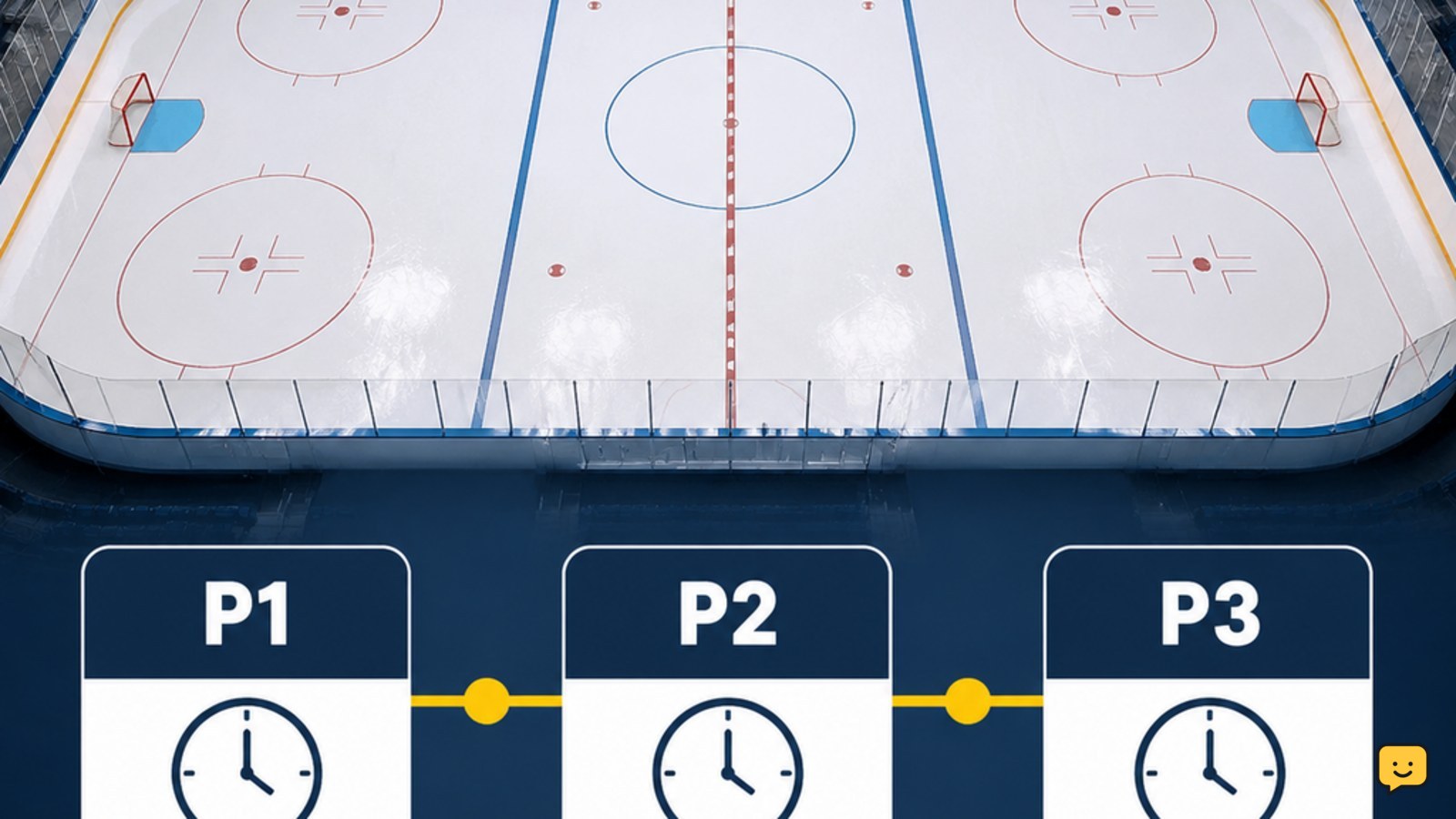
Ice hockey has three regulation periods, and each period is normally 20 minutes long, for 60 minutes of scheduled playing time. If the score is tied after the third period, the game may continue into overtime, but overtime is extra play rather than one of the three regulation periods. Exact overtime and interval rules depend on the competition.
For more help with this topic, use the Sports Recreation guides.
Count the three regulation periods
A standard ice hockey game is divided into three regulation periods: the first period, second period, and third period. The Solent Devils’ introductory ice hockey guide confirms this three-period structure and states that each period lasts 20 minutes.
The end of the third period marks the end of regulation. If one team is ahead, the game normally finishes at that point. If the score is tied, the competition’s overtime rules determine what happens next.
Calculate the scheduled playing time
Three 20-minute periods produce 60 minutes of scheduled regulation playing time.
- The first period contributes 20 minutes.
- The second period brings the total to 40 minutes.
- The third period brings the regulation total to 60 minutes.
This calculation refers to playing time, not the complete time spent at the arena or watching a broadcast. Intermissions between periods make the elapsed event time longer.
Allow for the two intermissions
Three periods create two regulation intermissions: one after the first period and another after the second. There is no regulation intermission after the third period unless the tied-game procedure requires additional play.
Break lengths are not necessarily identical across every competition. As one documented example, the Solent Devils guide lists a 15-minute interval after period one and a 20-minute interval after period two. Treat those figures as an event-specific example rather than a universal schedule.
For an exact arrival, collection, or broadcast-end estimate, consult the event timetable instead of adding only 60 minutes to the starting time.
Check whether overtime extends the game
Overtime can extend a tied hockey game beyond its three regulation periods, but it does not change the regulation count to four periods. It is an additional phase played after regulation.
The duration and format of overtime can depend on the league, tournament stage, or event rules. Do not use one competition’s overtime procedure to predict another. If a schedule or scoreboard uses a label such as overtime rather than fourth period, that confirms the game has moved beyond regulation.
If you cannot find the overtime rule, check the competition’s official rulebook or ask the venue staff. Avoid estimating the finishing time until the required format is confirmed.
Verify the format for the game you are watching
The event’s official information provides the best check when the game format is unclear.
- Identify the hockey code. The three-period answer here applies to standard ice hockey.
- Check the scoreboard or broadcast graphic. It should identify the current period and show when regulation has ended.
- Read the competition rules. Look for sections covering period length, intermissions, tied games, and overtime.
- Confirm modified formats. Youth, recreational, exhibition, and tournament games may use event-specific timing arrangements.
Success means the displayed period, scheduled duration, and event rules agree. If they conflict, follow the competition’s published rules rather than a general hockey explanation.
Know when the three-period answer does not apply
The three-period answer is specific to the standard ice hockey format and should not be applied automatically to every sport called hockey. Another hockey code or a modified event may divide play differently.
A shortened charity game, training match, youth event, or recreational competition may also alter period lengths while still using three sections of play. In that situation, the number of periods may be familiar but the 20-minute calculation may be wrong.
If the organizer describes quarters, halves, running time, or shortened periods, stop using the standard 60-minute calculation. Use the event sheet, venue notice, or official competition rules instead.
Frequently asked questions
Is overtime considered a fourth period in hockey?
No. Overtime is additional play after the three regulation periods, not a fourth regulation period. Its length and format vary by competition, so check the applicable league or tournament rules.
How many minutes are in three hockey periods?
Three standard 20-minute ice hockey periods provide 60 minutes of scheduled regulation playing time. Intermissions extend the total elapsed time of the event beyond those 60 minutes.
How many breaks are there in an ice hockey game?
There are two regulation intermissions in a three-period game: one between the first and second periods and another between the second and third. Exact intermission lengths can vary by event.
Do all hockey games have three periods?
No. Three periods is the standard ice hockey structure covered here, but other hockey codes and modified youth, recreational, exhibition, or tournament formats may divide the game differently.
How can I confirm a hockey game’s period length?
Check the competition’s official rules, event schedule, scoreboard, or broadcast information. If those sources specify shortened periods or another timing format, use that information instead of assuming each period lasts 20 minutes.