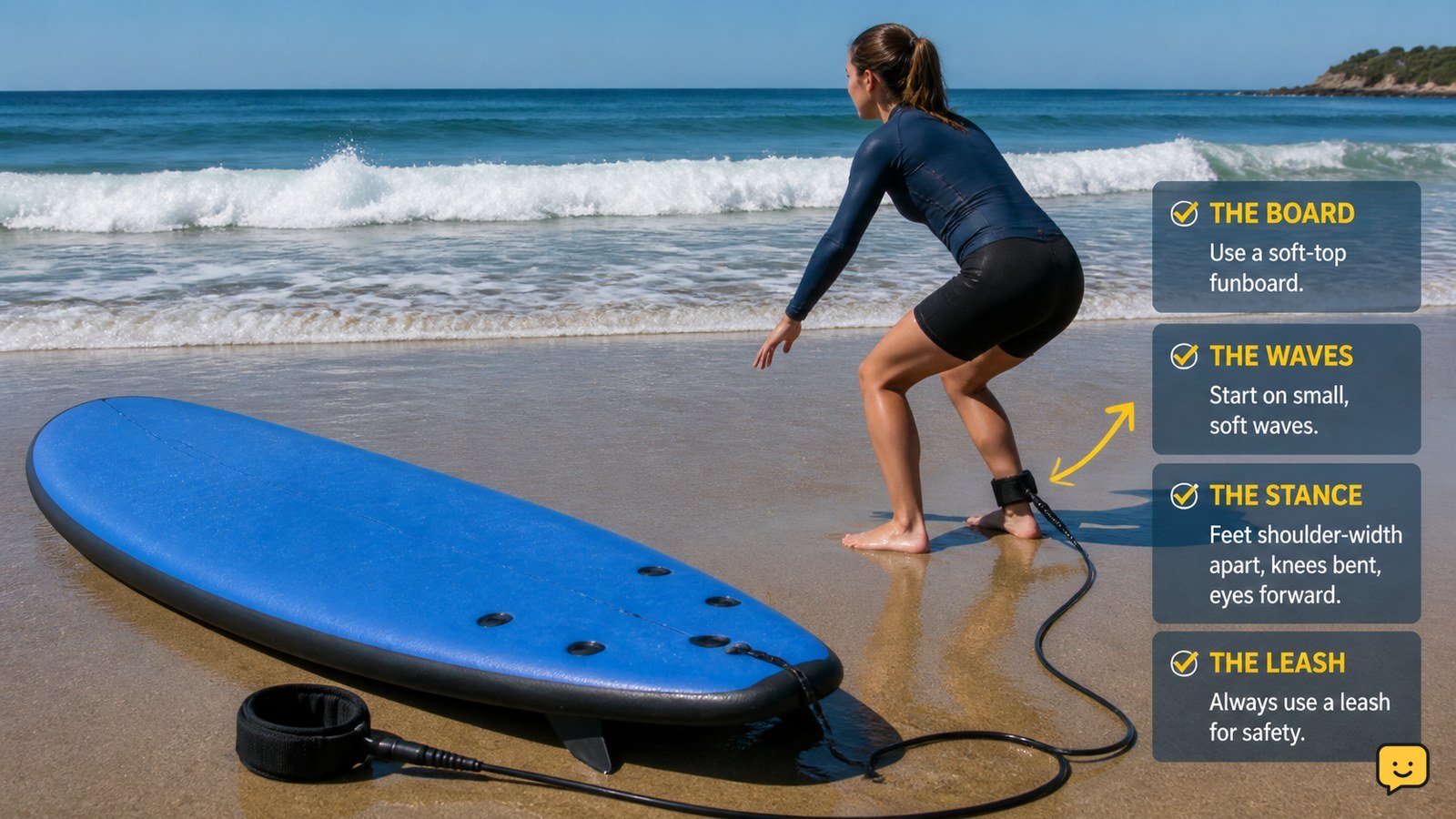
Start on a small, forgiving beach break with a soft-top board, a leash, and someone who can keep an eye on you. Paddle hard, catch whitewater first, then pop up with your hands under your shoulders and your feet centered on the board. If the current, crowd, or your fatigue gets ahead of you, stop for the day.
Check that the wave and beach are beginner-safe
Begin at a sandy beach with small, gentle waves that break in a predictable line. Beginner surf tips from Much Better Adventures and Bodhi Surf + Yoga both stress timing, ocean comfort, and choosing an easier setup first. If the surf is fast, hollow, rocky, or current-filled, it does not fit a first session.
- Look for knee-to-waist-high waves or whitewater close to shore.
- Choose a spot with room to walk, paddle, and fall without hitting rocks or swimmers.
- Watch for 10 to 15 minutes before entering so you can see where waves break.
Success looks like a wave that repeats in the same area and a channel or calm patch you can use to recover. If you cannot identify a safe entry or exit, do not paddle out.
Choose the right beginner board and leash
A large soft-top board gives you more stability, more float, and a slower, more forgiving ride. Bodhi Surf + Yoga notes that gear choice matters for self-teaching, and that is especially true for beginners who need easy paddling and stable pop-ups. Use a leash so the board does not drift into others after a fall.
- Pick the biggest soft-top you can comfortably carry and turn.
- Make sure the leash is attached before you enter the water.
- Wear a wetsuit or rash guard suited to the water temperature.
Success looks like the board sitting high in the water and moving straight when you paddle. If the board feels twitchy or sinks under your chest, it is probably too small for learning.
Paddle into whitewater first
Start with whitewater, not the steepest green wave. Whitewater is slower, easier to read, and less punishing when your timing is off. Paddle hard, keep your body centered, and aim to match the wave speed before you try to stand.
- Lie with your chest near the center of the board.
- Look ahead, not down at your hands.
- Paddle until the wave clearly lifts the tail of the board.
Success looks like the board sliding forward on its own while your strokes get lighter. If the wave passes under you, paddle earlier. If the nose buries, shift slightly back and try a smaller wave.
Pop up in one clean motion
O’Neill’s beginner guide describes the pop-up clearly: place your hands next to your shoulders, push your upper body up, and slide your preferred foot forward. Do not knee up first unless that is the only way you can keep balance. The goal is one smooth movement, not several half-steps.
- Press up from your chest with your hands under your shoulders.
- Bring your feet under you fast enough to land centered on the board.
- Keep your knees bent and your eyes forward.
Success looks like standing with both feet on the stringer line area and your weight low. If you keep landing on your knees or chest, practice the hand placement on dry land before the next wave.
Ride the wave and come off the board safely
Once you are up, stay low and keep your weight centered. Look where you want to go; your body usually follows your eyes and shoulders. For a first ride, staying upright for a few seconds on whitewater counts as a real win.
- Keep your arms relaxed instead of flailing.
- Shift slightly forward to keep speed, or slightly back if the nose dips.
- Fall flat away from the board when you lose balance.
Success looks like a controlled glide, not a long ride. If the board shoots ahead, stalls, or spins out, return to paddling and try a smaller wave or a cleaner pop-up.
Fix the most common beginner problems
Timing is the most common issue for new surfers. Much Better Adventures highlights timing as the key lesson, and that matches the usual beginner pattern: late paddling, slow pop-ups, and standing up after the wave has already passed. The fix is usually to simplify, not to force harder.
- Wave passes under you: start paddling earlier.
- Nose dives: shift slightly back on the board.
- Pop-up feels stuck: practice the push-up and foot slide on land.
- You feel overwhelmed: take a break and re-check the conditions.
If you cannot repeat at least one controlled takeoff in manageable surf, the session is still too hard for your current level.
Frequently asked questions
Can you learn to surf without lessons?
Yes, but a lesson is safer and usually faster for most beginners. If you teach yourself, do it only in small surf at a lifeguarded beach, with a soft-top board and a strong swimming comfort level. If the break is crowded or current-heavy, stop and choose guided instruction instead.
What size wave should a beginner surf?
Small waves are best, especially soft whitewater that breaks predictably on a sandy bottom. Waist-high or smaller is a common beginner target. If the wave is steep, fast, or closing out across the whole beach, it is not the right first wave.
What should a beginner surfer wear?
Wear a leash and clothing or a wetsuit that matches the water temperature. A rash guard helps against rub marks in warm water, while a wetsuit may be needed in cooler conditions. The right outfit keeps you comfortable enough to stay focused on balance and timing.
How do I know when to stop surfing?
Stop when fatigue, fear, cold, currents, or crowding starts reducing control. If you cannot paddle safely, keep your board under control after a fall, or read the waves clearly, that session is over. Ending early is safer than pushing into a bad decision.
For more help with this topic, use the Sports Recreation guides.