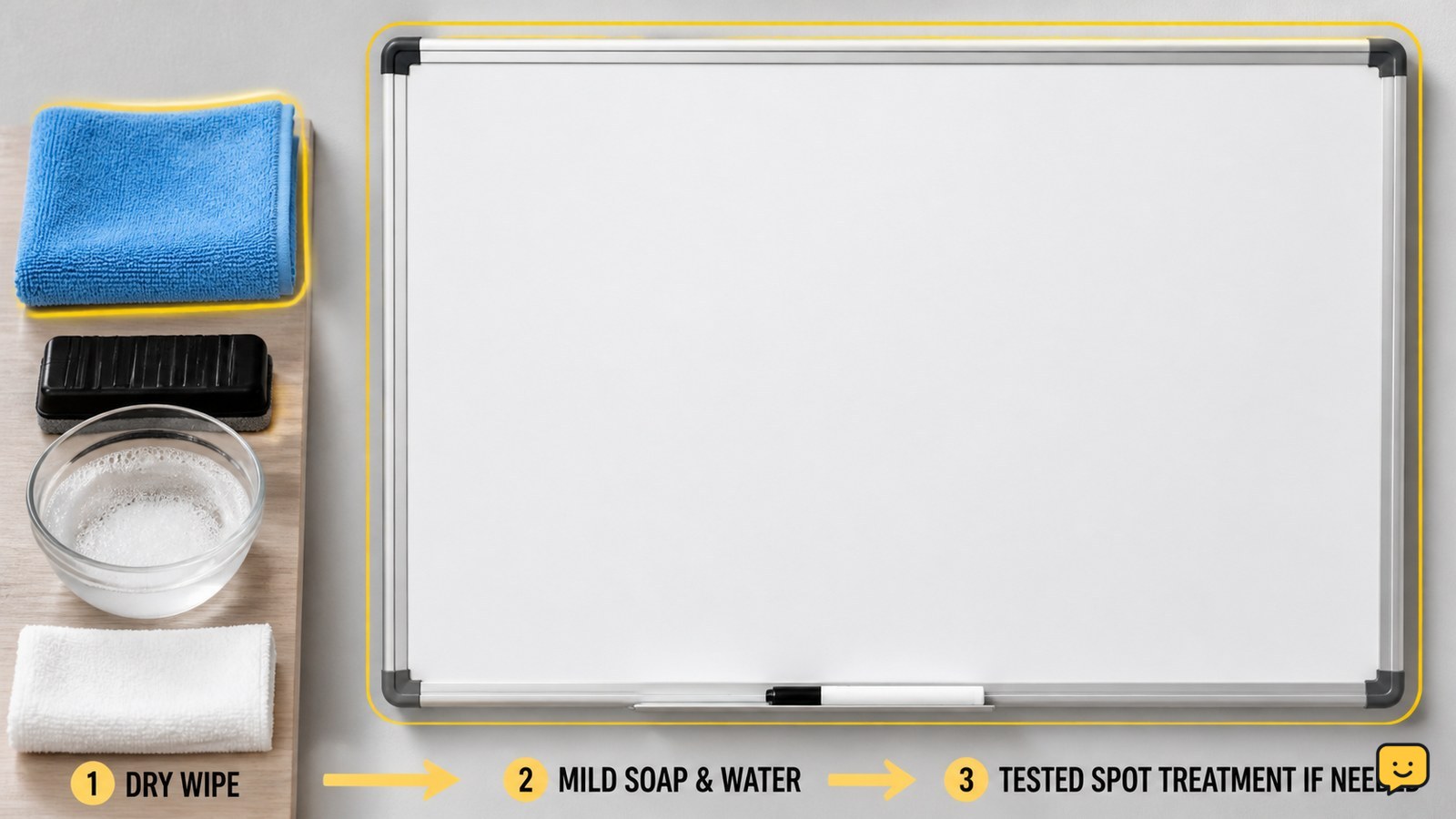
To clean a whiteboard, erase all writing with a clean, dry microfiber cloth or whiteboard eraser. For residue, wipe with a barely damp cloth and a small amount of mild dish soap, then remove soap with clean water and dry completely. For stubborn ghosting, spot-test isopropyl alcohol first, use it sparingly, and stop if the finish becomes dull or sticky.
Check the whiteboard surface before choosing a cleaner
A whiteboard should be treated according to its surface coating, because a cleaner that works on one board can damage another. Look for care instructions on the frame, rear label or product manual. Glass boards and boards with printed, coated or electronic surfaces need their own approved cleaning method.
For a conventional dry-erase board with no special warning, begin with the least aggressive method: dry wiping, followed by diluted mild soap only when a dry cloth leaves a film. Avoid assuming that a marker stain requires a strong solvent.
Remove loose marker and dust with a dry wipe
A clean, dry microfiber cloth or whiteboard eraser removes most fresh dry-erase ink and loose dust without adding moisture to the coating.
- Work from the top of the board downward.
- Use overlapping strokes rather than pressing hard in one spot.
- Turn the cloth to a clean side as ink transfers onto it.
- Wipe the frame and tray separately so dirty water or ink does not run back onto the writing area.
The board has passed this stage when no loose powder or fresh marker transfers to a clean section of the cloth. If a hazy film or older marks remain, continue with a damp clean rather than scrubbing harder.
Wash the board with mild soap and water
Mild dish soap diluted in lukewarm water is the safest general-purpose next step for oily residue, fingerprints and marker buildup on a standard non-porous whiteboard.
- Add a small amount of mild dish soap to a bowl of lukewarm water; the solution should be lightly soapy, not thick or foamy.
- Dampen a microfiber cloth and wring it out thoroughly. The cloth should be moist, not dripping.
- Wipe a manageable section using light, straight passes.
- Use a second cloth dampened with clean water to remove soap residue.
- Dry the surface immediately with a fresh towel.
Success is visible as an even, streak-free surface with no slippery feel. If the board still feels tacky, repeat the clean-water wipe and dry again. Do not leave water sitting along the frame, seams or tray.
Treat stubborn ghosting with a spot-tested alcohol wipe
Isopropyl alcohol can help loosen persistent dry-erase ghosting, but it should be treated as a limited spot treatment rather than a routine cleaner. MIT Admissions describes applying alcohol to a paper towel and replacing the towel as it becomes dirty or dry; Trainers Warehouse also lists isopropyl alcohol among products evaluated for dry-erase cleaning.
- Apply a small amount of isopropyl alcohol to a cloth or paper towel, never directly across the whole board.
- Test an inconspicuous corner or edge first.
- Gently wipe a small ghosted area, changing to a clean part of the cloth as ink transfers.
- Immediately wipe the area with a clean, water-dampened cloth.
- Dry the board and inspect the finish under normal light.
The treatment is acceptable only if the mark fades and the coating remains uniform, smooth and non-sticky. If the test area turns cloudy or dull, stop and use only the manufacturer’s approved cleaner.
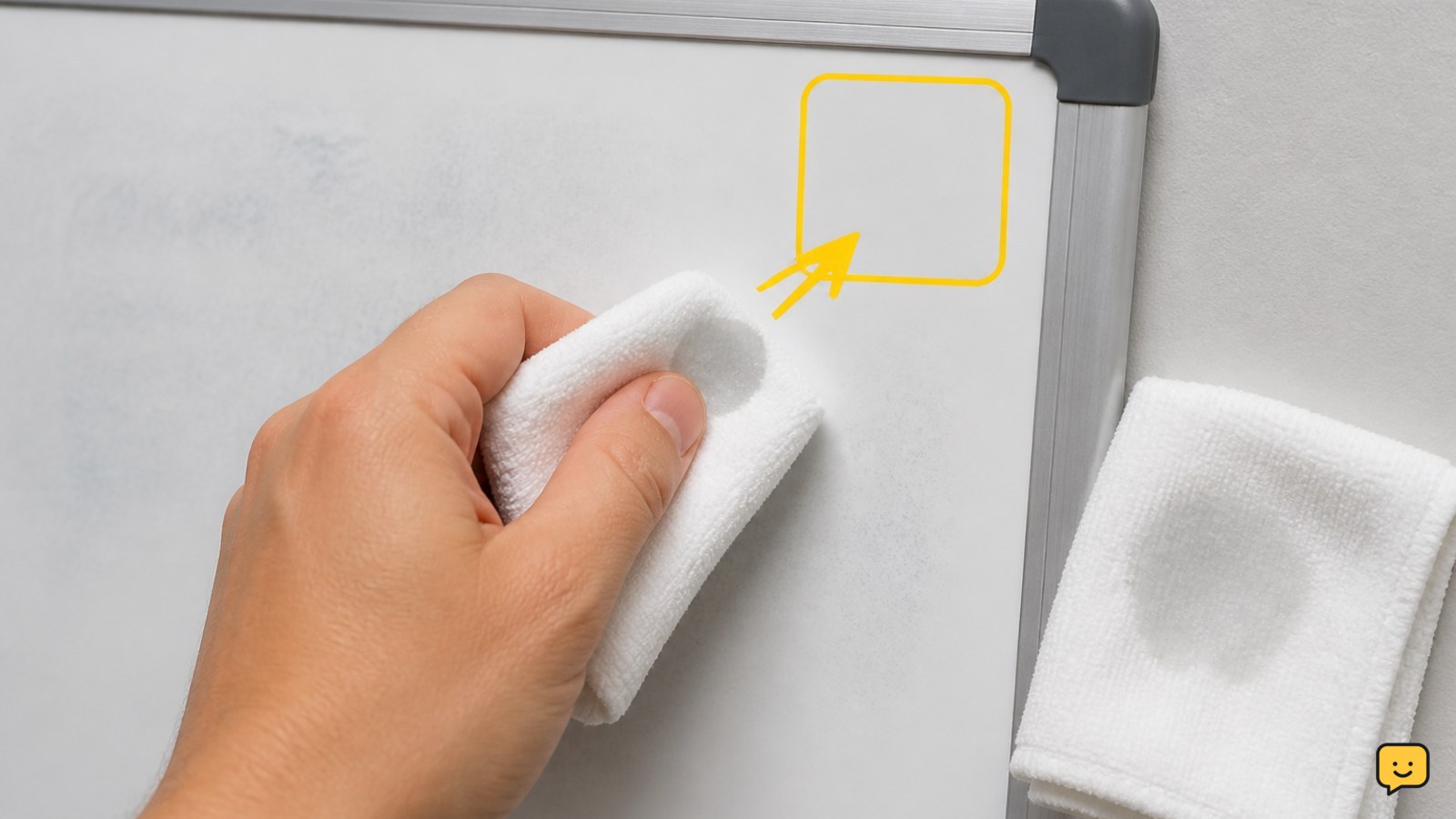
Verify the finish and handle marks that remain
A clean whiteboard should look evenly colored, feel smooth and dry, and accept a small test line that erases normally after you finish cleaning.
Write a short line with an approved dry-erase marker on a dry corner, leave it briefly, and erase it with a clean eraser. If the line smears, the surface may still have soap, alcohol or oily residue; wipe once with clean water, dry fully and test again.
If a stain remains after the mild-soap clean and a successful alcohol spot test, do not escalate to abrasive tools or household solvents. The mark may be permanent coating damage, ink that has penetrated the finish or discoloration in the board material. Check the care guide or contact the manufacturer instead.
Frequently asked questions
Can you clean a whiteboard with vinegar?
It is better to avoid vinegar unless the board manufacturer specifically approves it. Use a dry microfiber cloth first, then mild dish soap diluted in water. Unapproved acidic cleaners can leave residue or affect some coatings, so stop if the surface becomes dull, streaked or tacky.
How do you remove permanent marker from a whiteboard?
First check the board care instructions and test any treatment in a hidden corner. A small amount of isopropyl alcohol on a cloth may loosen some stubborn ink, but it is not suitable for every coating. If the finish changes or the mark remains after one gentle pass, stop rather than scrubbing.
Why does my whiteboard still look dirty after erasing?
A whiteboard can look dirty after erasing because marker pigment, oil or cleaner residue remains on the coating. Wash it with a barely damp cloth containing mild soap, wipe again with clean water, and dry it. Replace dirty erasers and cloths, which can redistribute ink across the surface.
Can you use a Magic Eraser on a whiteboard?
Avoid melamine foam and other abrasive pads unless the manufacturer explicitly approves them. They can change the surface texture, making future marker harder to erase. Start with a microfiber cloth, mild soap and water, and stop if the board coating shows dullness or uneven sheen.
For more help with this topic, use the Cleaning Stain Removal guides.